
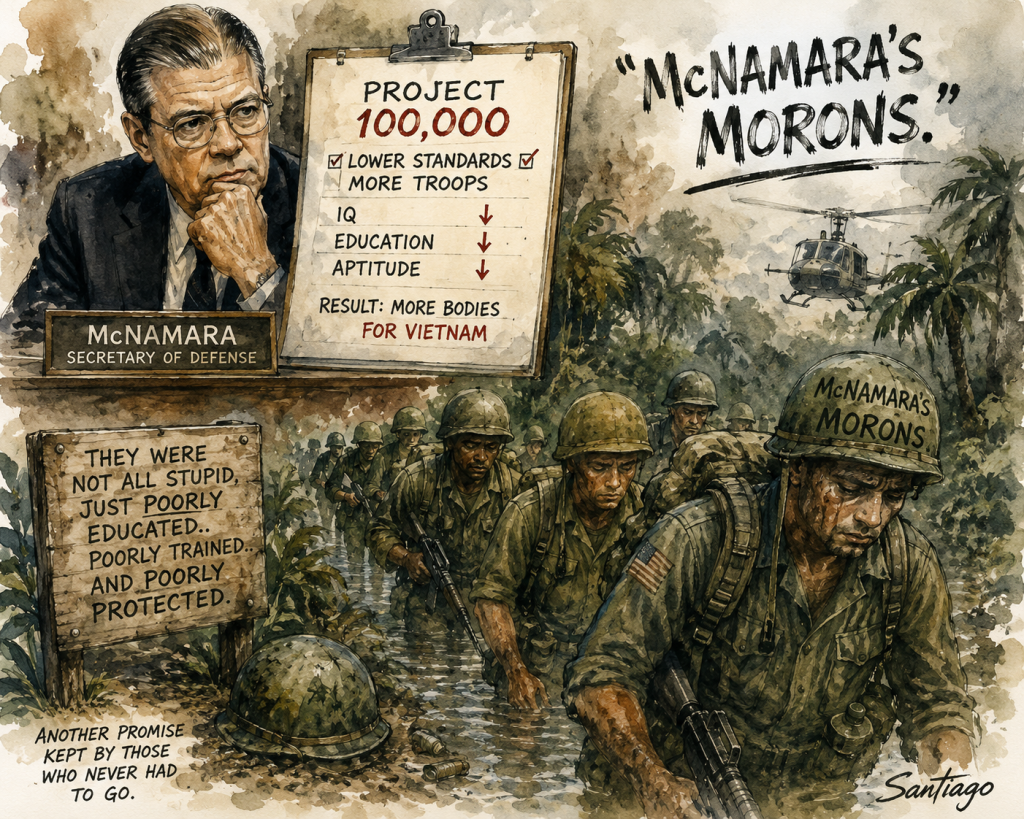
Sometimes one runs into an article that just grabs one’s attention. When I saw “Project 100,000,” I was curious. What I found is disgusting about how our country treats its young men.
Project 100,000 is one of those episodes in American history that sounds unbelievable until you dig into the records.
Here’s what happened.
In 1966, Secretary of Defense Robert McNamara faced a manpower problem. The Vietnam War was expanding, casualties were mounting, and the Johnson administration wanted more troops. But drafting more college students or mobilizing large numbers of National Guard and Reserve units carried a high political cost at home.
McNamara proposed what sounded, publicly, like a humanitarian program.
He argued that thousands of poor young men had been rejected by the military because they scored too low on entrance exams or failed certain physical standards. The military, he said, could train them, teach them skills, and help lift them out of poverty. It was presented as part of the broader War on Poverty.
That was the public argument.
The reality was more complicated.
Between 1966 and 1971, roughly 340,000–354,000 men entered the armed forces under these lowered standards. About 90% were admitted because they failed the normal mental aptitude requirements rather than physical standards.
The nickname that emerged inside the military was cruel:
“McNamara’s Morons.”
That was not an official name, but it reflected how many soldiers and officers viewed the program.
It’s important to avoid one common misconception.
These men were not all intellectually disabled.
Many came from terrible schools, rural poverty, inner-city neighborhoods, or backgrounds where they had little formal education. Military entrance exams measured reading, vocabulary, arithmetic, and other academic skills as well as aptitude. Some recruits undoubtedly had low intellectual ability, but others were products of educational deprivation rather than innate inability.
Critics argue that once they entered the military, many were assigned to dangerous jobs without receiving the additional training McNamara had envisioned.
Studies have found that participants suffered substantially higher casualty rates than other servicemembers—often cited as about three times higher—and many struggled after returning home with employment, income, and other life outcomes.
The debate today centers on intent.
One interpretation is that McNamara sincerely believed military service could become a social program that would educate and employ disadvantaged men.
The other interpretation is much darker:
That the administration needed bodies for Vietnam but wanted to avoid the political consequences of drafting larger numbers of middle-class college students, so it lowered standards instead. Many historians argue the program disproportionately affected poor Americans, including many Black and rural white recruits.
A more recent scholarly review concludes that neither extreme tells the whole story. It argues that Project 100,000 achieved some employment and training goals for certain participants while also producing serious and often tragic consequences for many others.