
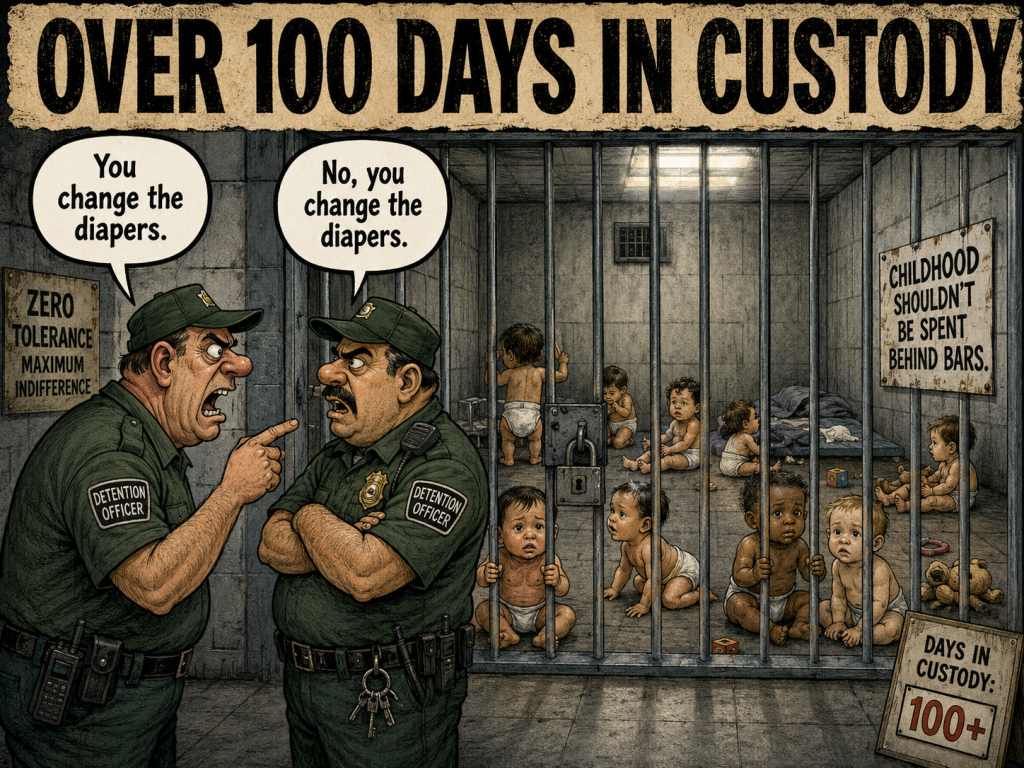
Look at the babies in the illustration.
They are in diapers because some children caught in America’s immigration detention system really are that young. The two guards arguing over who will change them are satire.
The detention is not.
At least 60 children have been held at the Dilley Immigration Processing Center in South Texas for 100 days or longer, according to an analysis of federal data by The Texas Tribune. The long-standing court limit for holding children in immigration detention is generally 20 days. (The Texas Tribune)
One hundred days.
Five times the limit.
And some children have been there even longer.
A 16-year-old California high school student, identified in court documents only by his initials, had been detained with his mother for 123 days when the Tribune published its investigation on August 12. Before his arrest, he was looking forward to his junior year and hoped to make his school’s varsity tennis team. His parents are both psychology professors. The family came to the United States from Iran more than a decade ago. (The Texas Tribune)
Now the boy is in Dilley.
His father is detained somewhere else.
The teenager said in a sworn declaration that he has lost 10 pounds since his arrest. His mother wrote that the family’s physical and mental health has deteriorated and that she and her son are allowed only a short, supervised telephone conversation with her husband every two weeks. (The Texas Tribune)
This isn’t supposed to happen.
The rules governing children in immigration custody grew out of the Flores Settlement Agreement, the result of litigation that began in 1985 after lawyers challenged the government’s treatment of detained immigrant children. The agreement requires that children be released as quickly as possible and that they not be held for prolonged periods. A federal judge later interpreted the agreement as generally requiring release within about 20 days. (CHRCL)
Twenty days may already seem like an eternity to a child.
Try 100.
The Dilley facility reopened after Donald Trump returned to office and resumed family detention. During its first year back in operation, roughly 3,000 children were held there. More than half remained in custody longer than 20 days. (The Texas Tribune)
That number is important.
If one child stays too long because of a paperwork mistake, someone can call it a mistake.
If ten children do, perhaps there is a bureaucratic problem.
When more than half of approximately 3,000 children remain beyond the limit, we are no longer talking about an exception. We are talking about a system.
And yes, some of these children are babies.
An earlier investigation by The Marshall Project found that since Trump’s second inauguration, ICE had detained more than 500 babies and toddlers age 3 and younger. Through March 2026, at least 175 babies and toddlers had been held longer than 20 days. (The Marshall Project)
One was a 1-year-old boy named Amir.
His Russian parents had fled their country after opposing Vladimir Putin’s war in Ukraine. They expected they might spend several weeks in immigration custody after arriving in the United States.
Instead, the family spent about four months in detention.
His parents said that while detained, Amir became withdrawn, began hitting himself in the face, and eventually stopped saying almost everything except “mom” and “dad.” (The Marshall Project)
So when you see babies crawling behind bars in our illustration, understand something:
The cartoon is exaggerated. The underlying story isn’t.
The Trump administration argues that the Flores restrictions themselves are the problem. It is fighting in court to terminate the agreement, calling it outdated and an improper interference with immigration enforcement. DHS told the Tribune that Flores wastes taxpayer resources, while ICE has said some unusually long detentions involve people classified as national-security risks and other complications. The government also says it works to release minors from custody as promptly as possible. (The Texas Tribune)
That is the government’s argument.
Here is mine.
A government certainly has the right to enforce immigration laws. It can arrest people. It can bring deportation cases. It can investigate genuine security threats.
But babies are not national-security threats.
Toddlers do not decide where their parents take them.
A child does not become more dangerous on Day 21.
And keeping children locked up for 60, 100, or 123 days does not suddenly become humane because the government calls the building a “family residential center” instead of a jail.
There are bars.
There are locked doors.
The people inside cannot leave.
Most Americans would understand exactly what we meant if we used the ordinary English word.
Custody.
That is why the number 100 matters.
Immigration debates easily disappear into arguments about borders, asylum law, deportation statistics and whether someone entered legally or illegally. People choose a political team, and soon they stop hearing one another.
A baby does not have a political party.
A toddler doesn’t know what MAGA means.
The 1-year-old sitting on the floor does not know whether his parents filed the correct immigration form.
He only knows that he cannot go outside.
He knows his parents are frightened.
He knows something is wrong.
Donald Trump’s administration wants the courts to give it more freedom from the Flores restrictions. Perhaps eventually the Supreme Court or Congress will decide that the old rules should change.
But Americans do not need a law degree to decide the larger question.
How long should the United States government keep a child behind locked doors for something the child did not do?
Twenty days?
One hundred days?
Four months?
A year?
At some point, the argument stops being about immigration.
It becomes a question about us.
And while Washington argues over the law, somewhere in South Texas there is a child waking up to another morning in detention.
Day 101.
Day 102.
Day 103.
And counting.
________
America has done this before — placed children behind fences because of decisions made about their parents, their families, or the group to which the government said they belonged.
This is not the first time America has told itself that children behind fences were necessary. During World War II, Japanese-American children — many of them American citizens — grew up behind barbed wire because the government decided their families represented a threat. Decades later, the country apologized and paid reparations. The children at Dilley will someday be adults too. The question is what America will say to them then.


