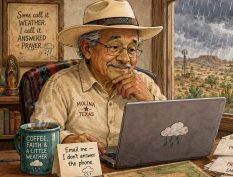
I will be taking a short trip to Corpus, but this is the first of at least four musical tours of what the music was like for us old Tejanos.
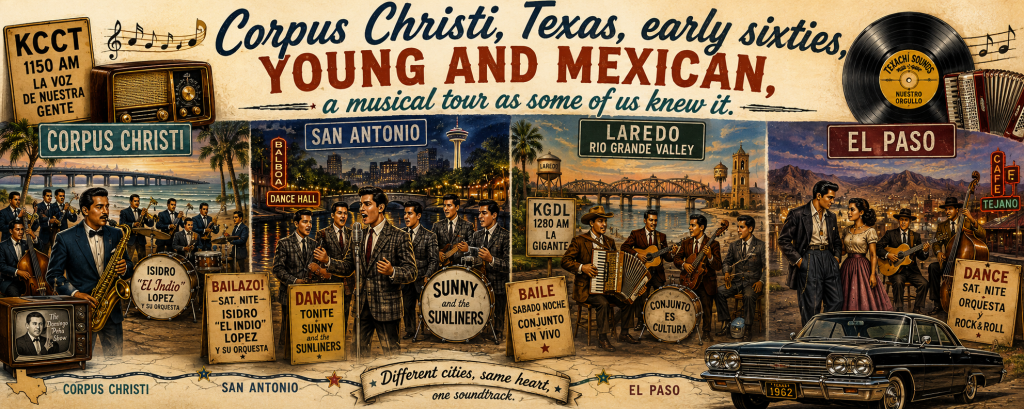
Not “Tejano music” as one blob, but four regional worlds:
- Corpus Christi / Coastal Bend — Isidro López, Óscar Martínez, KCCT, local television, dance halls, Ideal Records, the bridge from orquesta to the younger 1960s sound.
- San Antonio — Sunny Ozuna, the Sunglows/Sunliners, conjunto, West Side soul, Flaco Jiménez, dance halls and the Mexican-American radio scene.
- Rio Grande Valley / Laredo — border radio, conjunto, ranchera, bolero, accordion traditions, cross-border musicians, dances on both sides, and whatever was coming out of McAllen, Brownsville, Harlingen, Weslaco, and Laredo.
- El Paso — a different border culture again: orquesta, pachucos, R&B, rock-and-roll, Mexican music coming directly from Juárez, and the long shadow of 1940s–50s pachuco culture.
And the fun part is that we can make each one feel like a weekend trip in 1962:
Friday afternoon: what station are you hearing in the car?
Saturday: what record store do you walk into?
Saturday night: where is the dance and who is playing?
Sunday: what do you hear on Spanish-language radio or television?
That gives younger readers something far better than a list of famous musicians. It tells them what it felt like to be Mexican-American in that city at that moment.
_____________
Imagine that it is 1962 and you are a Mexican-American teenager in Corpus Christi.
There is no Spotify. No YouTube. No cassette recorder sitting beside the radio yet. If you want music, you listen when the radio plays it, buy a record if you can afford one, feed coins into a jukebox, or wait for Saturday night and go hear the band yourself.
And in Corpus Christi, you had something worth waiting for.
You had Isidro “El Indio” López.
Before Anybody Called It Tejano
Today we would call much of this music Tejano. In 1962, people were more likely to talk about an orquesta, conjunto, rancheras, boleros, or simply Mexican music.
Isidro López stood right in the middle of those worlds.
Born in Bishop and raised around Corpus Christi, López learned saxophone as a young man and played professionally while still young. By the mid-1950s, he had formed his own large orquesta. By 1960, the Texas State Historical Association says López was considered the leading Tejano bandleader of his era. His orchestra could grow to fifteen or sixteen musicians, much closer in appearance to the big bands Americans already knew than to the small conjunto groups built around accordion and bajo sexto.
But López did something important with that big-band structure.
He refused to leave the Mexican side of himself outside the dance hall.
He mixed the horns and arrangements of the orquesta with rancheras, mariachi, polkas, accordion, rock-and-roll, jazz, and Cuban boleros. He even gave his mixture a name: “Texachi,” Texas plus mariachi.
That mixture tells us something about Mexican-American life in South Texas.
These young people weren’t choosing between being Mexican and being American every time they turned on the radio.
They were already both.
Turn On the Radio
In 1954, Corpus Christi got KCCT, 1150 AM, a Spanish-language radio station aimed largely at the Mexican-American community. That meant Mexican-American families no longer depended entirely on English-language stations to decide what music deserved airtime.
But the musical boundaries were never clean.
Another Corpus Christi musician, Óscar Martínez, had played with López before forming his own orchestra in 1958. Martínez recorded an English-language song called “Makes No Difference,” which became a local hit on KEYS, an English-language Corpus Christi station. His band also recorded “La Bamba” around the same period.
So picture the radio dial.
Turn one direction, and you might hear Spanish.
Turn another, and you might hear rhythm and blues, rock-and-roll, doo-wop, or country.
The Mexican-American teenager listening did not necessarily recognize those as separate cultural territories.
They were simply the sounds coming out of Corpus Christi.
The Mexican Kids Singing Doo-Wop
There was another group around Corpus Christi that makes that point even better.
The Dinos.
They were Mexican-American kids singing the American rhythm-and-blues and vocal-harmony music they heard around them. Abraham Quintanilla was one of the members—the same Abraham Quintanilla who would decades later become the father and manager of Selena.
The Dinos’ “So Hard to Tell” received substantial airplay on KEYS around 1959, and the group’s music got them bookings around Corpus Christi, Kingsville, and Woodsboro. Texas State University’s history of Chicano soul identifies the Dinos as one of the best-known Mexican-American harmony groups to emerge from Texas during that period.
That is important.
Mexican-American music history didn’t move neatly from Mexican music to Tejano music.
At the same moment López was combining rancheras and horns, Mexican-American teenagers were standing in front of microphones singing doo-wop.
And being Mexican still followed them through the door.
The Dinos encountered clubs that would book them when owners didn’t realize they were Mexican-American, then reject them after discovering who they were. They also faced discrimination at motels while traveling.
America liked their music better than it always liked them.
That was not unusual.
Saturday Night
Now it is Saturday.
Maybe you spent the week working. Maybe your parents did. Maybe somebody in the family worked at the naval air station, the port, an oil facility, construction, agriculture or one of the countless jobs that kept South Texas moving.
Tonight you dressed up.
And you could go hear a Mexican-American orchestra that did not sound like something imported from Mexico City.
It sounded like South Texas.
The horns could swing.
Then came a ranchera.
Then perhaps a bolero.
An accordion could appear beside instruments associated with American big bands.
López had played with conjunto pioneer Narciso Martínez before becoming an orquesta leader, and he considered both the conjunto and orquesta traditions valuable. That helps explain why his music could move so comfortably between them.
Young musicians were listening too.
Óscar Martínez had learned in Corpus Christi clubs such as Ibarra’s, where veteran musicians helped younger players develop. He later joined López’s orchestra before starting his own.
This wasn’t merely entertainment.
It was a musical school.
One generation taught the next one on bandstands, in clubs, over radio microphones and while driving from one dance to another.
And Then Television Arrived
Beginning in 1964, Corpus Christi entertainer Domingo Peña hosted a television program that put Mexican-American musicians directly into South Texas living rooms.
The Domingo Peña Show featured performers including Isidro López and accordionist Esteban “Steve” Jordan. But Peña did something else remarkable: he also brought representatives of organizations such as LULAC and the American G.I. Forum onto the program to discuss civil rights and issues affecting Mexican Americans.
Think about what that television set was doing.
One minute a Mexican-American family could watch musicians who looked like them performing music created in their own communities.
Then people were talking publicly about Mexican-American rights.
That combination—music, identity, and politics—would become increasingly important as the 1960s continued.
The Sound Was Changing
By the middle of the decade, López was no longer alone at the top.
Younger musicians were arriving.
Sunny Ozuna was becoming a star out of San Antonio. Little Joe Hernández and the Latinaires were developing the sound that would eventually become associated with the Onda Chicana. In Corpus Christi, Óscar Martínez was writing and recording his own music.
The old categories were becoming even harder to maintain.
Rock-and-roll was coming in.
Rhythm and blues was coming in.
Conjunto remained.
The orquestas remained.
Mexican rancheras remained.
And Mexican-American musicians kept taking pieces from all of them and making something that belonged to Texas.
In 1965, Martínez wrote “El Tejano Enamorado.” Isidro López recorded it, and the song became widely popular on Tejano radio around Texas.
The word Tejano itself was beginning to carry more cultural weight.
It Wasn’t “Latino Music”
Looking backward, there is a temptation to put all of this under one convenient heading: Latino music.
But that loses the story.
This was Mexican-American music growing from a particular place.
Corpus Christi had its own neighborhoods, radio stations, musicians, dance halls, working families, racial boundaries, and relationship with Mexico.
A Cuban orchestra in New York belonged to another history.
Puerto Rican musicians in New York belonged to another.
Mexican-American musicians in San Antonio would develop yet another regional sound.
Even El Paso and the Rio Grande Valley would not sound exactly like Corpus Christi.
They influenced one another, certainly.
But they were not interchangeable.
If You Were There
So imagine again that it is Saturday night in Corpus Christi in 1962.
Somewhere a radio is playing.
Someone has a new 45.
A jukebox is waiting for another coin.
Óscar Martínez is blowing a trumpet.
The Dinos are singing harmony in English.
And somewhere Isidro “El Indio” López lifts his saxophone in front of a large Mexican-American orchestra.
Nobody in that room needs a university professor to explain what Mexican-American culture is.
They are creating it.
And when the music starts, they dance.


