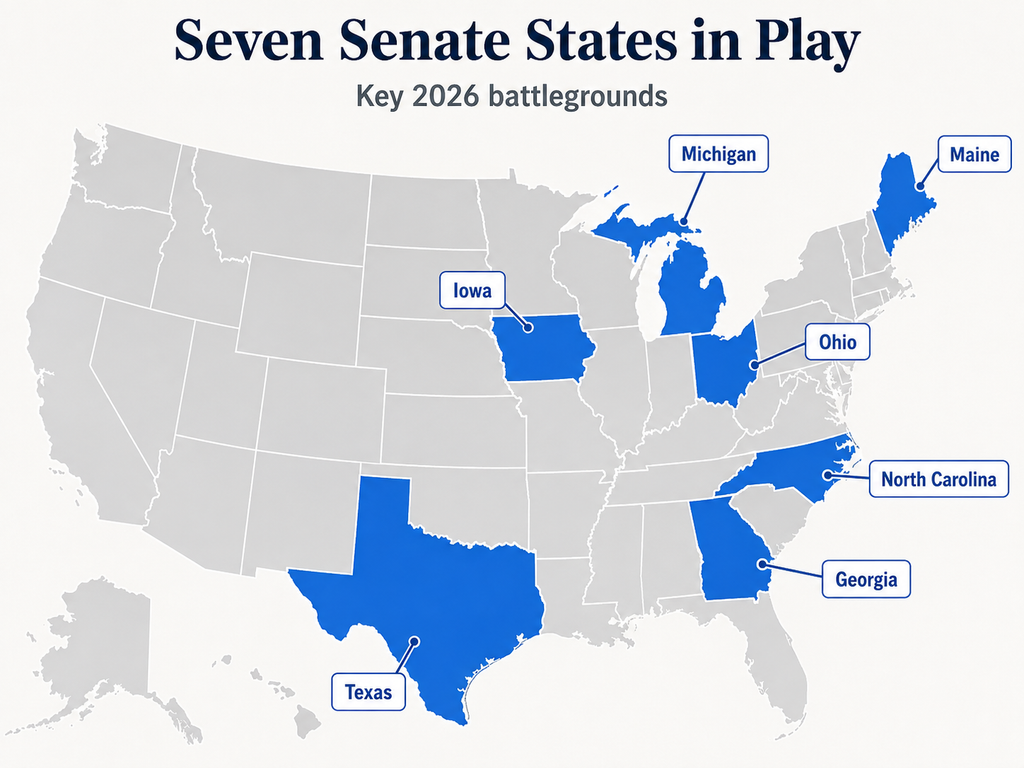
For most of this election cycle, the conventional wisdom was simple: Democrats might win the House, but the Senate was probably beyond their reach.
That conventional wisdom is beginning to look very old.
Republicans hold a 53–47 Senate majority. Because Vice President JD Vance can break a 50–50 tie, Democrats need a net gain of four seats to control the Senate in January.
Four seats once looked like a mountain.
Today Democrats have six Republican-held seats that can reasonably be called competitive — and Democrats are presently leading the public polling in five of them.
North Carolina: This Doesn’t Look Like a Toss-Up
Former Democratic Gov. Roy Cooper isn’t merely leading Republican Michael Whatley. He is leading him comfortably.
The current 270toWin average has Cooper at 52 percent to Whatley’s 42 percent — Democrat plus 10. Recent individual polls have put Cooper ahead by 7, 9, 11, and 13 points.
North Carolina was supposed to be one of the great Senate battles of 2026. At the moment, Republicans are fighting simply to make it close.
Call that Democratic pickup No. 1.
Ohio: Sherrod Brown Came Back With a Vengeance
Ohio has moved steadily toward Republicans over the past decade. Donald Trump carried it three times.
Yet former Democratic Sen. Sherrod Brown currently leads Republican Sen. Jon Husted in the two most recent polls by 4 and 8 points. The current average is Brown 50.5, Husted 44.5 — Democrat plus 6.
A Democrat sitting above 50 percent in Ohio is not something Republicans can casually dismiss.
That gives Democrats a very plausible pickup No. 2.
Maine: Susan Collins Is Behind
Susan Collins has survived difficult elections before, so nobody should pronounce her finished in August.
But she is losing.
The two recent qualifying polls have Democrat Troy Jackson ahead 48–46 and 49–46, producing an average of Jackson 48.5, Collins 46.
Even more troubling for Collins, a Fox News poll found 55 percent of Maine voters concerned that she has aligned herself too closely with Trump.
If the election followed today’s polling, Maine would become pickup No. 3.
And suddenly Democrats would need only one more.
Texas: Yes, Texas
This is where the Senate map becomes extraordinary.
The current five-poll average has Democrat James Talarico ahead of Republican Ken Paxton 47.8 percent to 45.8 percent.
Those five polls include Talarico margins of +4, +2, +2 and +3, with only the newest Emerson survey showing Paxton ahead by a single point.
Texas has become competitive enough that on August 20 the Cook Political Report moved the race from Lean Republican to Toss-Up. Iowa moved with it.
A Ted Cruz-linked super PAC has now jumped in with $1.7 million in advertising to help Paxton. Republicans do not normally have to spend emergency money defending a Texas Senate seat.
If Talarico wins Texas after Democrats take North Carolina, Ohio and Maine, there it is:
51 seats. Democratic Senate.
Alaska: Then There Is Mary Peltola
Democrats don’t necessarily need Texas.
Mary Peltola gives them another route.
The newest Alaska general-election poll has Peltola leading Republican Sen. Dan Sullivan 47–41.
Then Alaskans actually voted.
In Tuesday’s nonpartisan primary, Peltola finished ahead of Sullivan. With about 80 percent counted, the result stood at roughly Peltola 48 percent, Sullivan 42.8 percent. Reuters described Peltola as the top vote-getter and said the result makes her a viable Democratic pickup opportunity.
Primary elections are not general elections, particularly under Alaska’s ranked-choice system. But Republicans cannot dismiss a result in which the Democratic challenger just received more votes than their incumbent senator.
Now Democrats potentially have five Republican seats where they either lead current polling or have just demonstrated extraordinary strength at the ballot box.
They only need four.
Iowa: The Sixth Door Opens
Iowa is not yet a Democratic polling lead, and the numbers deserve to be stated accurately.
The latest public Emerson poll has Republican Ashley Hinson ahead of Democrat Josh Turek 48–45. But the previous Fox poll had Turek ahead 50–46, and earlier polling has repeatedly shown a close race.
More importantly, Cook looked at the total political environment and moved Iowa to Toss-Up on August 20. Cook called the current environment “uniquely challenging for the GOP” in the state.
Iowa is therefore not one of the four seats Democrats must win.
It is something more dangerous for Republicans:
insurance.
And Georgia Is Looking Better, Not Worse
Democrats also have to protect their own seats. Georgia was supposed to be one of Republicans’ best opportunities.
Instead, Sen. Jon Ossoff is presently sitting on an eight-point polling average lead, 51–43, over Republican Mike Collins.
The latest InsiderAdvantage poll has Ossoff ahead 50–43. AARP had him ahead 52–43. Fox earlier measured a remarkable 56–43 Ossoff advantage.
That does not mean Georgia is over. Georgia is Georgia.
But Republicans were supposed to be forcing Democrats to spend the year desperately defending Ossoff. Instead, Ossoff currently looks considerably stronger than a number of Republican senators.
Then Michigan Changed
Michigan was the development that briefly appeared capable of wrecking the Democratic Senate strategy.
Abdul El-Sayed emerged from a difficult Democratic primary, and the first major post-primary Fox poll had Republican Mike Rogers ahead 51–47.
Then came three newer polls.
TIPP: El-Sayed +3.
Susquehanna: El-Sayed +7.
AARP: El-Sayed +1.
The current five-poll average now has El-Sayed ahead 45.8–45.0.
That is one of the most important developments on the entire board. Democrats cannot take four Republican seats and then hand Michigan back.
For now, the newest polling says they may not have to.
Count the Seats
Forget predictions for a moment and simply look at today’s numbers.
Democratic seats:
Georgia — Ossoff ahead.
Michigan — El-Sayed ahead in the three newest polls and narrowly ahead in the average.
Republican seats:
North Carolina — Cooper +10 average.
Ohio — Brown +6 average.
Maine — Jackson +2.5 average.
Texas — Talarico +2 average.
Alaska — Peltola +6 in the newest poll and ahead of Sullivan in the actual primary vote.
Iowa — Toss-Up, with public polling divided.
The arithmetic is almost startling.
Democrats need four pickups.
They presently have five Republican-held seats where the newest evidence favors the Democrat, plus Iowa sitting there as a sixth opportunity.
Win North Carolina, Ohio, Maine, and Texas: 51.
Replace Texas with Alaska: 51.
Win North Carolina and Ohio and take any two of Maine, Texas, Alaska, or Iowa: 51.
And if an actual Democratic wave carried all five currently favorable Republican targets while Democrats held Michigan and Georgia, Democrats would reach 52 seats.
Add Iowa and it becomes 53.
Nobody should engrave those numbers on the Senate chamber doors in August. Polls move. Campaigns stumble. Tens of millions of dollars are about to be spent trying to change precisely these numbers.
But something important has already changed.
On August 20, the consensus Senate forecast tracked by 270toWin reflected six competitive Republican-held seats, and Cook’s movement of Texas and Iowa into Toss-Up territory made an already difficult Republican map significantly worse.
Four months ago the question was whether Democrats could somehow find four Republican Senate seats to defeat.
On August 21, the question is becoming very different:
Which four do they want?
That may be premature.
But for the first time in this election, it doesn’t sound ridiculous.