Something extraordinary happened in New York after World War II.
Hundreds of thousands of Puerto Ricans left the island and came north. They brought Spanish, family, food, politics, and music. They carried the sounds of an island whose culture had been shaped for centuries by Spain, the Caribbean, and Africa.
But their children did not grow up only with Puerto Rico.
They grew up in New York.
In 1945, New York City had about 13,000 Puerto Rican residents. A year later, there were more than 50,000. By 1955, nearly 700,000 Puerto Ricans had moved to the continental United States, and by the middle of the 1960s the number had passed one million. Cheap commercial air travel made possible what the Library of Congress calls the first great “airborne migration” in American history.
They did not arrive culturally empty-handed.
Long before the airplane carried Puerto Ricans to New York, African drums were sounding in Puerto Rico.
The Africa Puerto Rico Carried North
Bomba, one of Puerto Rico’s oldest musical traditions, developed among enslaved Africans and their descendants during the colonial period. Smithsonian historians trace it directly to African traditions brought to the island during slavery. Plena, which arose much later among working-class Puerto Ricans, also carried a powerful African inheritance.
These were not simply styles of entertainment.
Bomba could be dance, celebration, spiritual expression, and resistance. Plena became a kind of musical newspaper, telling stories about ordinary people, scandals, politics, protest, and daily life. The rhythms survived because people carried them from generation to generation.
Then Puerto Ricans carried them onto airplanes.
They landed in a city where another branch of the African musical family had been growing for generations.
Jazz was there.
Blues was there.
Gospel, rhythm and blues, doo-wop, and eventually soul were there.
Puerto Rican children in New York didn’t have to choose between those sounds and the music their parents brought from the Caribbean. They heard both.
That may be the most important part of the story.
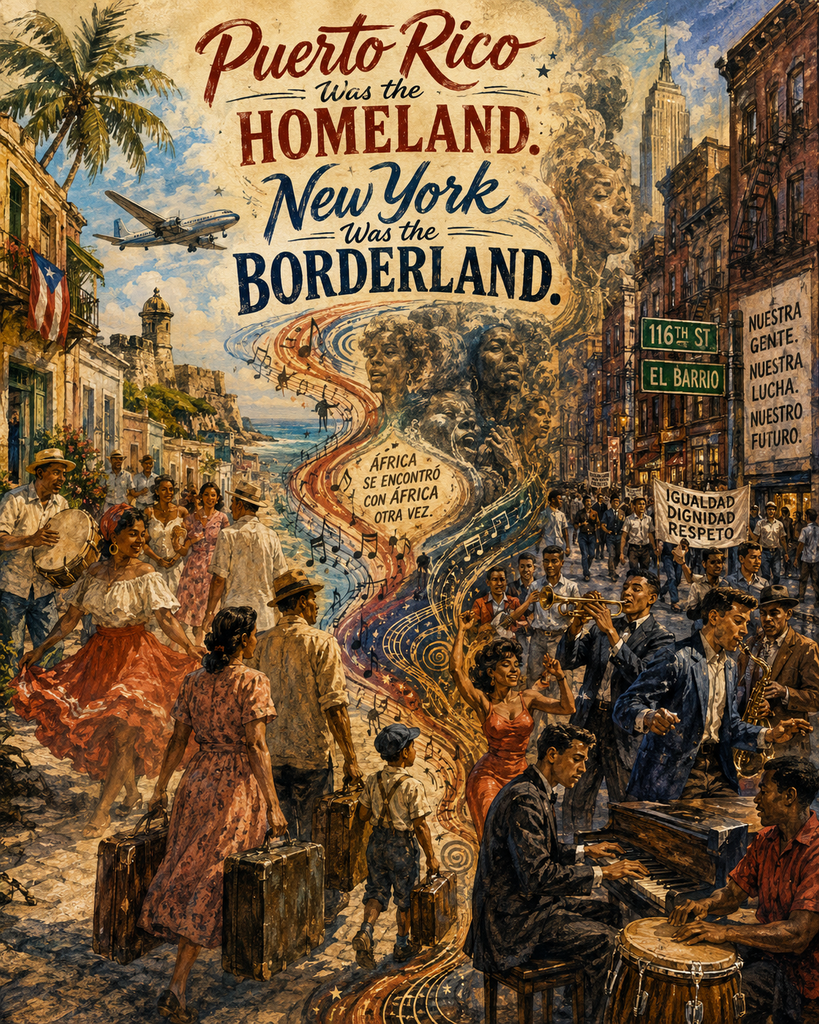
Africa met Africa again in New York.
One branch had traveled through slavery into Cuba and Puerto Rico, becoming bomba, rumba, son, plena, mambo, and other Afro-Caribbean forms.
Another had traveled through slavery into the United States, becoming spirituals, blues, jazz, gospel, rhythm and blues, and soul.
Centuries after those routes had separated, their descendants were living on the same New York blocks.
The Kids Heard Something the Adults Didn’t
The older generation had its orchestras, dance halls and musical rules.
The kids had the streets.
Puerto Rican, Cuban and Black teenagers attended the same schools, lived in neighboring communities, listened to many of the same radio stations and danced to many of the same records. They didn’t hear musical categories as rigidly as record companies sometimes did.
By the middle of the 1960s, something new was coming out of that world.
PBS describes it as the creation of largely Puerto Rican, Cuban, and African-American young people living alongside one another, fusing traditional Caribbean rhythms with blues, funk, and other Black American music.
The music practically announced what had happened culturally.
Spanish mixed with English.
Sometimes there was Spanglish.
Cuban mambo and son collided with R&B, soul, and doo-wop. The piano might be Latin. The vocal hook could sound like something coming from a Black radio station. The percussion came from the Caribbean. The attitude came from New York.
Joe Cuba’s sextet exploded with “Bang Bang.”
Pete Rodríguez and his young Bronx musicians answered with “I Like It Like That.”
Fania’s history of the Rodríguez recording describes boogaloo as young New York Puerto Ricans mixing montunos and other Latin forms with funk and R&B—the music of two communities living together.
It wasn’t Puerto Rican music abandoning Puerto Rico.
It was Puerto Rican-American music discovering America.
Then They Called It Salsa
Boogaloo’s commercial moment was brief, but the cultural mixing didn’t disappear.
During the late 1960s and 1970s, New York became the great laboratory for what the world increasingly called salsa.
Salsa did not suddenly appear out of nowhere, nor did New York invent all its ingredients. Its foundations were deeply Afro-Cuban and Caribbean, with generations of Cuban son, mambo, guaracha, and other traditions behind it. Puerto Rican musicians and Puerto Rican New Yorkers, however, became some of the principal people who reshaped, performed, and popularized those traditions in the New York environment.
That distinction matters.
Puerto Rico was the homeland.
New York was the borderland.
It was a place where cultures touched one another every day and where the children of migrants could take something inherited and make something their parents had never quite heard.
You can hear that borderland in Willie Colón.
You can hear it in Héctor Lavoe.
You can hear it in Eddie Palmieri.
And before salsa fully arrived, you could hear it in boogaloo—the sound of young Latinos who had one foot in the Caribbean and another on a New York sidewalk.
Music Wasn’t the Only Thing Crossing the Street
The same exchange was taking place politically.
Puerto Rican young people coming of age in New York were watching the Black freedom struggle around them. They saw civil-rights demonstrations, Black Power, community organizing, and the Black Panthers.
The New York Young Lords grew partly from that world. The New York Public Library notes the movement’s connections to both the Chicago Young Lords and the Black Panther Party as its members organized around racial justice, health care, and conditions in Puerto Rican neighborhoods.
One man almost perfectly represents the intersection.
Felipe Luciano became a leader of the Young Lords. But Luciano was also a poet associated with the Original Last Poets, part of the revolutionary Black artistic world emerging in Harlem. NYPL records show him performing alongside Black poets Gylan Kain and David Nelson in the group associated with the 1971 film Right On!
Music, poetry, race, and politics were crossing the same streets.
That is why separating the musical history from the civil-rights history misses part of what was happening.
The children were talking to one another.
Santana Heard It Too
Years later, Carlos Santana explained the connection in almost exactly those terms.
Growing up in Mexico, he remembered hearing what people then called música tropical—music from Cuba, Puerto Rico and the Caribbean. Later he came to understand its deeper origin.
“It’s always been African music,” Santana told PBS, describing music that traveled from Africa into Cuba and Puerto Rico. When he visited Ghana in 1971, he heard musicians perform a pattern that immediately reminded him of Mongo Santamaría’s “Afro Blue,” later famously recorded by John Coltrane. The Ghanaian musicians essentially told him: this was ours before those records existed.
Santana suddenly heard the journey backward.
Africa to the Caribbean.
Africa to Black America.
And then those musical descendants meeting each other again.
Santana himself would make a career out of refusing to recognize the walls supposedly separating them. He could hear Tito Puente and B.B. King and understand that they belonged in the same musical universe.
The Puerto Rican kids in New York had already been doing something similar.
Africa Met Africa Again
Migration stories are usually told with maps.
People left one place and arrived in another.
But people carry invisible things with them.
A rhythm.
A language.
A way of dancing.
A grandmother’s song.
A drumbeat whose history may stretch farther backward than anyone in the family can remember.
After World War II, Puerto Ricans carried those things to New York in unprecedented numbers. Their children encountered Black Americans whose ancestors had carried another part of the African musical inheritance through a very different American history.
Neither culture remained untouched.
Out of that encounter came friendship, tension, politics, poetry, boogaloo, Latin soul and eventually some of the musicians who would define New York salsa.
It was not simply Puerto Rican music becoming American.
It was something more interesting.
Africa had crossed the Atlantic centuries earlier by different routes. In New York, some of its grandchildren found one another again.


