
Monica de la Cruz and Donald Trump seem to favor the communist way of getting cheap labor. Below is an argument that is similar to arguments that I have been making for decades, back in 2024, before NAFTA was adopted: America should not deport workers and then turn around and bring back workers to do the same jobs. We either believe in capitalism or we don’t; that includes the large tech companies. Nearly half a million such workers are here in the United States right now.
For the tech/engineering side, the numbers are huge: 255,250 approvals were for computer-related occupations, and another 40,669 were architecture/engineering/surveying occupations. If they can’t find workers here and they think they can do better elsewhere, do what people do: move there.
Perhaps Monica De La Cruz and Donald Trump should try capitalism too.
Deport the Workers — Then Import Their Replacements?
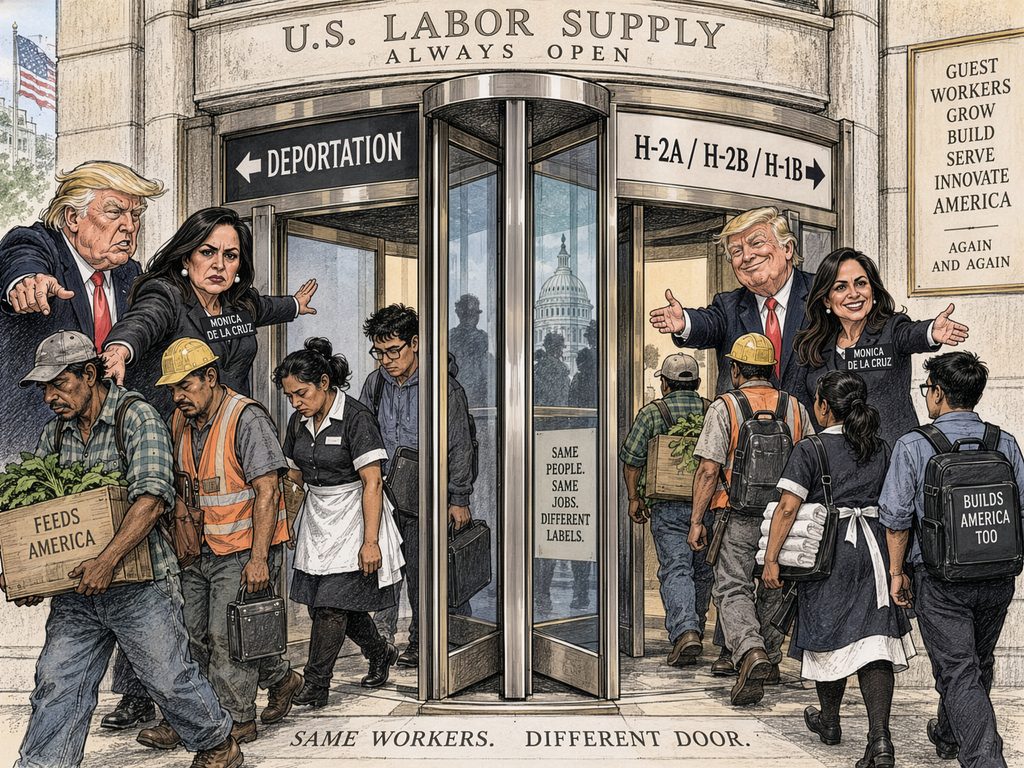
Donald Trump and Republicans say they are going to deport millions of people who entered or remain in this country illegally. Fine. If that is going to be the policy, then American businesses should also have to live with the economic consequences of that policy.
If farmers cannot find enough workers, let them raise wages. If hotels cannot find housekeepers, let them pay more. If construction companies cannot find laborers, let them improve the job. If technology companies say they cannot find enough engineers or programmers, let them compete for the workers already here. That is how capitalism is supposed to work.
What should not happen is this: deport one group of workers and then have the federal government help employers import another group to replace them.
That is already happening.
In 2025, South Texas Republican Congresswoman Monica De La Cruz introduced legislation she proudly called the Bracero Program 2.0 Act. Her proposal would streamline H-2A applications, expand the program to additional agricultural businesses, allow year-round contracts, and establish a new wage formula. De La Cruz said farmers needed the legislation because of “workforce shortages challenging our communities.” (De La Cruz for Congress)
Then she went further. In December 2025, De La Cruz introduced another bill designed to make H-2A workers easier and less expensive for agricultural employers to obtain. She said the legislation would “ease agriculture worker shortages facing Texas farmers.” (De La Cruz for Congress)
Trump has been moving in the same direction. His administration opened a new pathway in 2026 allowing dairy farms access to foreign agricultural workers after years of lobbying by the dairy industry. The Washington Post reported that the change came as farmers complained about labor problems created in part by stricter immigration enforcement. (The Washington Post)
Even more revealing was what the Trump administration tried to do with wages. It changed the H-2A wage system in a way that reduced pay for foreign farmworkers by roughly $5 to $7 an hour, openly arguing that cheaper foreign labor would save farmers money as they dealt with the effects of tougher immigration policies. A federal judge ruled the policy unlawful in August. (The Washington Post)
Think about that for a moment. Government immigration policy removes workers from the labor market. Employers then complain that workers are scarce. Instead of allowing scarcity to do what scarcity normally does in capitalism — raise the price of labor — government steps in and helps employers obtain another supply of cheaper foreign workers.
Republicans preach the free market until labor becomes expensive.
There is nothing new about this fight. Mexican American civil-rights leaders were warning about it generations ago.
Dr. Héctor P. García and the American G.I. Forum understood that an abundant pool of vulnerable foreign labor could hurt Mexican American workers already living in the United States. García was not hostile to Mexicans. His life’s work was fighting discrimination against Mexican Americans and establishing their rights as Americans. The American G.I. Forum he founded in Corpus Christi in 1948 grew into one of the most important Mexican American civil-rights organizations in the country. (Texas State Historical Association)
That distinction matters. García could fight discrimination against immigrants and Mexican Americans while still believing that American employers should not be allowed to use an unlimited supply of vulnerable foreign labor to undercut workers already here.
Congressman Henry B. González of San Antonio fought the same battle. When Congress tried during the 1990s to create another large agricultural guest-worker system, opponents warned that it would give agricultural companies access to hundreds of thousands of exploitable workers, increase unemployment among American workers, and push down prevailing wages. The congressional record from the 1996 fight explicitly warned that the proposed system would allow companies to bring in “hundreds of thousands of new, exploitable workers.” (Congress.gov)
González’s opposition went back even further. After his death, the Congressional Record remembered him as a politician who had “successfully opposed the Bracero Act” and had spent his career fighting anti-worker legislation. (Congress.gov)
Barbara Jordan made perhaps the strongest argument of all.
Jordan chaired the bipartisan U.S. Commission on Immigration Reform. In 1995, the commission unanimously concluded that creating another large guest-worker program would be a “grievous mistake.” President Bill Clinton adopted that position and said such programs would reduce opportunities for American citizens and legal residents and “depress wages and work standards for American workers.”
One argument from that period deserves to be asked again today:
“Where is it written, in this free market economy, that agricultural employers need not improve wages and working conditions to attract and retain an adequate supply of labor?”
That was the question critics of the proposed Bracero revival were asking in 1995. Their answer was simple: let supply and demand force growers to offer better pay, longer employment and meaningful benefits instead of using government immigration policy to provide another cheap workforce. (Los Angeles Times)
Thirty years later, we are having almost exactly the same argument.
And it should not stop at farmworkers.
H-2A supplies agricultural labor. H-2B supplies workers to landscaping, hospitality, seafood processing, and other industries. H-1B brings in programmers, engineers, and other highly skilled workers. The salaries and occupations are different, but the economic question is the same: should government increase employers’ access to foreign labor whenever the domestic price of labor becomes inconvenient?
If American engineers become scarce, their salaries should rise. More young Americans then have an incentive to study engineering. Employers have an incentive to train people, recruit more broadly, and retain experienced workers. That is the price mechanism conservatives claim to believe in.
Government stepping in to guarantee employers another supply of workers interferes with that mechanism.
Meme, Manuel, considers that no better in principle than what communist governments have done when they manipulate the labor supply for favored industries. China provides the extreme example. Its government has operated labor-transfer programs involving Uyghurs and other ethnic minorities in Xinjiang, programs that U.S. authorities and human-rights organizations have described in many cases as coercive or forced labor. Nobody should pretend America’s guest-worker programs are equivalent to China’s coercive system, but the lesson is worth remembering: workers should not become units of labor for governments to move around according to the needs of industry.
There is another reason temporary-worker programs deserve scrutiny. The worker’s legal ability to remain in America can depend heavily upon continued employment. That changes the normal relationship between employer and employee. An American worker who tells the boss to go to hell may lose his job. A temporary foreign worker can have much more at stake.
That was one reason the old Bracero Program became notorious. Even some supporters of legal guest workers acknowledged that the original system heavily favored growers and produced extensive abuse and exploitation. (Los Angeles Times)
The political contradiction today could hardly be clearer. Republicans tell voters that immigration has flooded the labor market and harmed American workers. They promise mass deportations. Then the moment farmers and businesses complain that workers are disappearing, those same politicians start looking for ways to bring foreign workers back through another door.
You cannot have it both ways.
If Americans really want mass deportation, there will be consequences. Lettuce may cost more. A hotel room may cost more. A roof may cost more. Some businesses may fail. Other businesses will automate. And wages for workers who remain may finally rise.
That is the market working.
Dr. Héctor P. García understood that. Henry B. González understood it. Barbara Jordan understood it.
Perhaps Monica De La Cruz and Donald Trump should try capitalism too.


