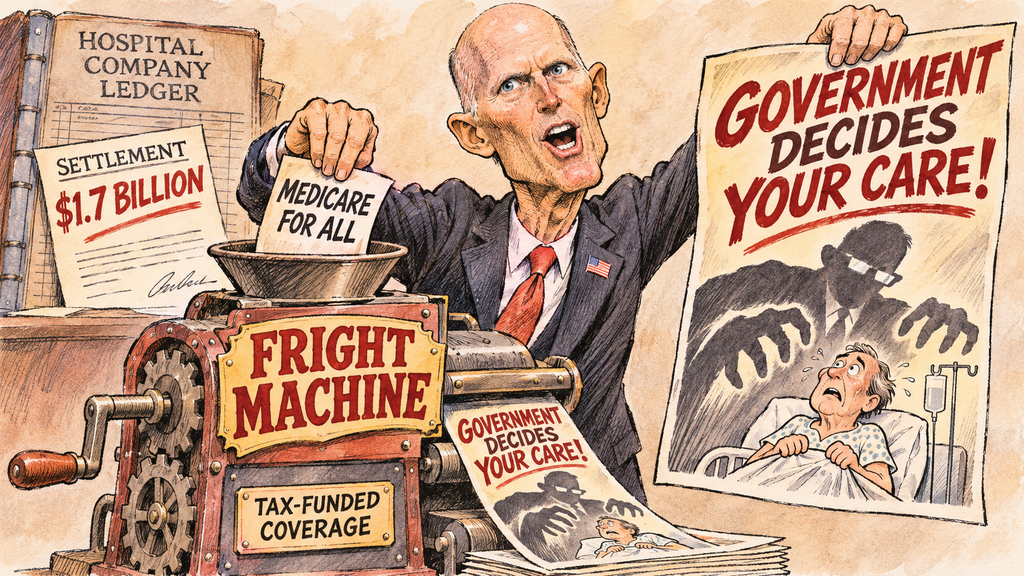
Rick Scott’s Medicare-for-All Warning Comes With a $1.7 Billion Asterisk
Sen. Rick Scott says “free” health care means the government—not you—will decide your care. That is a frightening line. It also blurs two different questions: who pays for health care and who gets to choose a doctor or treatment.
“Free” doesn’t mean the care has no cost. It means patients wouldn’t pay premiums, deductibles, and copays at the point of service for covered care. The system would still have to be financed. The debate is over how we pay for it and what the program covers—not whether medical care somehow becomes costless.
Coverage rules aren’t the same as choosing your doctor
A public plan would set coverage rules. That is a legitimate subject for debate. But it does not follow that a government official would personally choose your doctor or dictate every treatment.
The 2025 House Medicare for All bill, for example, bars cost sharing and prior authorization for covered benefits. It still establishes standards for what the program covers and a process to appeal coverage decisions. Those are rules about paying for care. Scott’s slogan turns them into a claim that the government would take over your medical decisions.
I have Medicare, but that doesn’t mean I’m forbidden from seeking care outside its coverage and paying for it myself. I also use my city vision plan for glasses, and my Medicare Advantage plan for the eye doctor. People already make choices about which coverage to use and when to pay out of pocket. A universal program could still require everyone to contribute to its financing, even if someone chose to pay privately for care elsewhere.
Scott’s record deserves to be part of the discussion
Scott built his fortune in the hospital business. He led Columbia/HCA as chairman and chief executive until he resigned in 1997, while the company was under federal investigation. When he left, Columbia/HCA agreed to a compensation package worth $9.88 million: a $5.13 million payment plus $950,000 a year for five years.
After he left, two company subsidiaries pleaded guilty to criminal charges involving conduct at HCA hospitals, including fraudulent Medicare billing and kickbacks. By 2003, the Justice Department said the government’s total recovery from HCA had reached $1.7 billion. Scott was never personally charged with wrongdoing, and that distinction matters. But the company he led became the center of one of the largest health-care fraud cases in U.S. history.
So when Scott warns that public health care means bureaucrats will control your care, remember who is making the warning. He once ran a private health-care empire that paid billions to resolve fraud claims involving Medicare and other public programs. He now promotes a different arrangement that keeps private insurance in place and directs public support through health accounts and insurance plans.
The honest debate is about costs, taxes, coverage, and the rules insurers or public programs impose. Scott can argue against Medicare for All. But calling it “free” and claiming it means the government makes all your medical decisions is a scare line—not a serious explanation of what the proposal says.