History, politics, memory, and commentary from a Tejano point of view.
They can take your property, they can take your money, but they cannot take your knowledge.
August 21, 2025
The history of the Tejanos is too long and complex to be fully documented in a single day.
History of the Tejanos.
I am the oldest in my family, and I am the first person on my mother’s side of the family to have finished high school. Neither of my parents received much of an education, but they knew the value of an education. The words of the title were some of the words of wisdom that my father would give to me. It took me a long time to understand why he would say those words. Only when I started reading about the history of the Tejanos in Texas did I begin to realize that the Gabachos had come and taken the properties that had been given to many of them by the Spanish government. My family, like many others, owned property on both sides of the Rio Bravo.
Years ago, I started researching our family history. On my father’s side, they were one of the families that settled in the Border Region. On my mother’s side of the family, they were one of the original settlers of the New Mexico Territory. When the boundary changed, many of the people living in what is now the United States returned to the Mexican side; others chose to stay. My ancestors chose to stay, and they faced hardships, including indiscriminate killings and their properties being taken from them—the King Ranch, which was at one time the property of one of their great-grandparents.
One of the first Tejano heroes was called a bandit by the Gabachos
Juan Cortina invaded the United States decades before Pancho Villa. But if you were to ask Cortina or the Tejanos, they would say that he is a Mexican Robinhood. Juan Cortina took over Brownsville. Juan Cortina was a distant cousin of my family.
In 1859, Juan Cortina rode into Brownsville and seized control of the town. Cortina had established himself as a champion of Mexicans living along the border in the years after the Mexican War. The incident that ignited the first so-called Cortina War occurred on July 13, 1859, when Cortina saw the Brownsville city marshall, Robert Shears, brutally arrest sixty-year-old Tomas Cabrera, who had once been employed by Cortina. Cortina shot the marshall in the impending confrontation and rode out of town with the prisoner. Early on the morning of September 28, 1859, he rode into Brownsville again, this time at the head of some forty to eighty men, and seized control of the town. Five men, including the city jailer, were shot during the raid, as Cortina and his men raced through the streets shouting “Death to the Americans” and “Viva Mexico.” Over the next several years Cortina fought Texas Rangers and U.S. regulars. His band threatened the stability of the Valley until 1861, when he was finally defeated. Thereafter he confined his activities to Mexico, where he died in 1894.
Texas Rangers claimed it only took one Ranger to control a mob; it may have been true of Gabacho mobs, but undoubtedly not true of Tejanos. They often kicked their ass, which is why they had to call the army.
King Ranch
My father was born on the King Ranch. My great-great-grandfather, a French immigrant (my name is Renaud, after all), lost almost twenty thousand acres to the King Ranch after the U.S.–Mexican War. He had inherited the land because of his French-Mexican wife, and he came to Texas as a smuggler to make his fortune. My great-grandfather, a former cowboy, was shot in the back on the King Ranch. He married an indigenous woman who never knew her people. His death was witnessed by his sons, one of whom was my grandfather. This is an old story.
My late father told me a secret so I wouldn’t forget. It is a story about the King Ranch that everyone knows but doesn’t say: Not only did the Kings steal our land after the U.S.–Mexican War—almost a million acres that define Texas—they stole the prettiest women.
To the victor goes the spoils, right? After the war that made Texas what it is today, land owned by Mexican-Americans was legally and/or violently taken by scions of the founding father, Captain Richard King, who established one of the largest ranches in the world, today comprising 825,000 acres. Cattle. Oil. Cowboys. Chili con Carne. This is the story of an undocumented, uncrowned princess from that place. Let’s call her Gertrudis, or Gerty. (She is a composite of two women I know.) Source
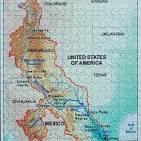
The Gabachos changed the name to the Rio Grande.
AI Overview
The Rio Grande and Rio Bravo are actually the same river, but with different names used in different regions. In the United States, it’s commonly called the Rio Grande, while in Mexico, it’s known as the Rio Bravo del Norte. This dual naming stems from a historical ambiguity regarding whether the river’s upper and lower sections were connected, and it became solidified with the adoption of different names by Anglo settlers in Texas and by Mexicans.
Here’s a more detailed explanation:
Historical Context: Spanish explorers in the 16th century initially referred to the river as Rio Bravo del Norte, meaning “Fierce River of the North”.
Anglo Adoption:
American settlers in Texas, however, began using the name Rio Grande, meaning “Big River”.
Despite the treaty, the names persisted, with Americans generally using Rio Grande and Mexicans using Rio Bravo del Norte.
Modern Usage:
Today, the river is commonly called Rio Grande in the United States, while in Mexico, it is widely known as Rio Bravo del Norte, though some Spanish speakers also use Rio Grande in deference to American usage says Riverfront Times, says Dallas Observer.