MAGA loves to claim that non-whites are welfare recipients, but conveniently forget that the largest group of welfare kings are farmers, especially the millionaires and billionaires who own the “farming” land.
They pay them not to grow crops. They pay them if they don’t sell the crops. It is a racket, as Beth Dutton explained to the hedge fund owner. When she finishes telling him how it works, he states it sounds like a Ponzi scam. Beth states yes with the government at the bottom. Well, folks, we, the taxpayers, are financing welfare for farmers.
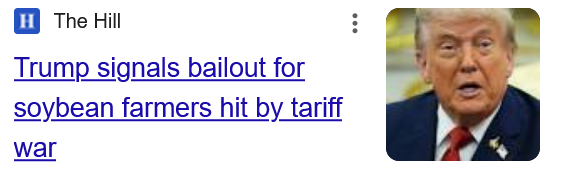
President Trump on Wednesday said he planned to use money brought in from tariffs on imports to provide aid to soybean farmers who have been hurt by a trade dispute with China.
“The Soybean Farmers of our Country are being hurt because China is, for ‘negotiating’ reasons only, not buying,” Trump posted on Truth Social. “We’ve made so much money on Tariffs, that we are going to take a small portion of that money, and help our Farmers.”
We pay farmers not to plant crops.
Question: Why does the government pay farmers not to grow crops?
Robert Frank: Paying farmers not to grow crops was a substitute for agricultural price support programs designed to ensure that farmers could always sell their crops for enough to support themselves. The price support program meant that farmers had to incur the expense of plowing their fields, fertilizing, irrigating, spraying, and harvesting them, and then selling their crops to the government, which stored them in silos until they either rotted or were consumed by rodents. It was much cheaper just to pay farmers not to grow the crops in the first place.
Of course, paying people not to do work is bound to be politically awkward (think of the old New Yorker cartoon of an accordion player on a subway platform with a sign next to his cup that read, “Will not play Lady of Spain, 25 cents”). So the government described the program as an environmental one rather than an income maintenance scheme. As described to the public, it was compensation to farmers for retiring acreage to reduce fertilizer and pesticide runoff into the nation’s water supply.
They give them property tax breaks that we city dwellers can only dream of.
If you’re a farmer, you’re no doubt familiar with the complicated tax landscape for farmers in this country and you may even use a tax accountant to help you get as many tax breaks as you’re eligible for. If you can prove that you farm as a business and not just for recreation, you can get both property tax breaks and income tax breaks.
But you don’t have to be a full-time farmer to take advantage of agricultural tax breaks that will help you with your property taxes. In some cases, all you need is a piece of land that’s not currently being used. You can say that the land is preserved wilderness, or put it to some kind of agricultural use to save on property taxes.
The size of agricultural property tax exemptions varies from state to state because property taxes aren’t administered at the federal level. Qualifications for agricultural tax exemptions vary from state to state, too. Some states base eligibility on the size of the property, while others set a minimum dollar amount for agricultural sales of goods produced on the property. Many use a combination of gross sales and acreage requirements. Grazing a single cow on your property can be enough to trigger tax breaks in some places.
If you qualify, an agricultural tax exemption could knock thousands off your property tax bill. Depending on your state’s rules, one way to execute this tax strategy is to offer use of your land to a local farmer. For example, you could allow a nearby farmer to harvest hay on acres you’re not using or rent your land to a farmer. You don’t necessarily have to do the work yourself to claim the exemption for your property. You may, however, have to renew your application for a farm assessment each year, depending on your local tax assessor’s rules and state requirements.
Not too long ago, there was a large tract of land on Westheimer Blvd. here in Houston. If one were to drive by there, one could see that there were a few cows in that land. Those cows were there because they lowered the taxes on that very expensive piece of property by tens of thousands of dollars a year.
The property just happened to belong to the husband of one of our former U.S. senators. It was sold to Houston Community College for a large sum of money. I don’t believe that HCC ever developed the land, but I could be mistaken. But the owners did quite well on the sale of the property.
The reference to “Westheimer property k bailey cows” most likely relates to Bob Smith’s ranch, which was located in the area of Westheimer and Gessner in Houston. The “k bailey” part of the query is likely a misinterpretation of “Bob Smith’s Bailey”.
Key details about the property and its history:
- Ranch owner: The property was part of a larger ranching empire belonging to prominent Houston rancher and philanthropist Bob Smith.
- Location: The ranch was located west of downtown Houston, near what is now the intersection of Westheimer and Gessner. In the 1970s, many locals remember seeing cattle grazing in fields in this area.
- Development: In 1969, a portion of the Smith family’s land was sold to Friendswood Development (a division of Exxon) to create the Woodlake residential development. The Westchase Corporation purchased 760 acres from the Smith family in 1973 for the Westchase development.
- Westheimer Road: A poster on a Houston forum recalls Westheimer being a two-lane dirt road west of Gessner, serving as a farm market road for cattle drives. This corroborates the presence of ranch land in the area