
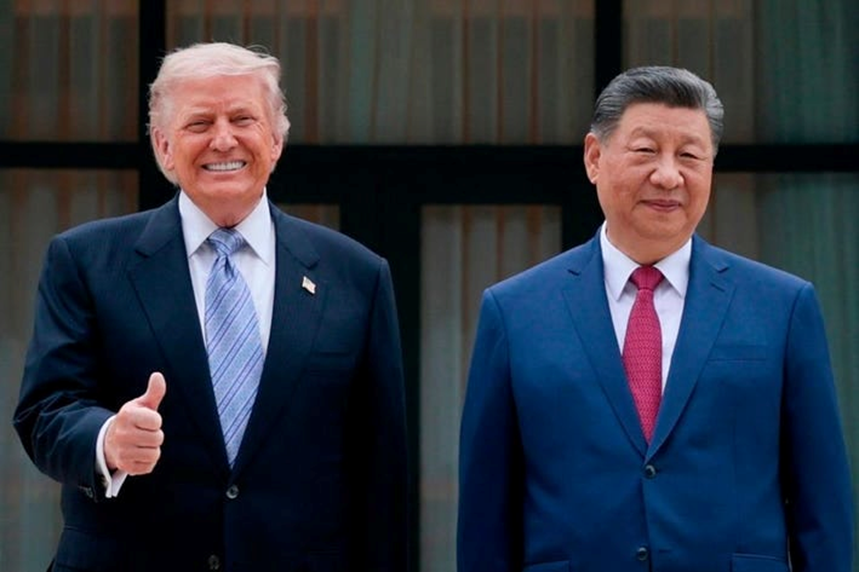
China’s Xi met with both the USA and Iran, and it now seems that Iran has become emboldened and has started attacking their neighbors, which encouraged Trump to attack Iran.
Does China want to get the US to use up the missiles it would rely on? The missiles that would take years to replace?
They play three-dimensional chess in Asia and the Middle East, and Trump does not even understand checkers.
.
When the leaders of the world’s two most powerful nations met in Beijing, Chinese Premier Xi Jinping spoke about the lessons of history:
Can China and the United States transcend the so-called ‘Thucydides Trap’ and forge a new paradigm for major-power relations?” Donald Trump, on the other hand, spoke about fast food
United States missile stockpiles have faced severe depletions. The extensive use of crucial air defense and offensive missiles during the prolonged war with Iran—expending between $17 billion and $24 billion worth of munitions—has critically drained defense inventories. [1, 2, 3]
A breakdown of the severe drawdowns shows:
- Patriot Interceptors: The U.S. has fired nearly 50% of its Patriot interceptors. Out of a total inventory of roughly 2,330, between 1,060 and 1,430 were expended, pushing the remaining stockpile below the 50% threshold.
- THAAD Interceptors: At least 50% of the U.S. inventory of Terminal High Altitude Area Defense (THAAD) missiles has been fired. Production constraints mean that fewer than 100 of these missiles are typically built annually.
- Precision Strike Missiles (PrSM): The U.S. military has utilized at least 45% of its Precision Strike Missile stockpile.
- Cruise Missiles: Approximately 30% of the Tomahawk stockpile and 20% to 30% of the long-range Joint Air-to-Surface Standoff Missiles (JASSMs) have been used. [1, 2, 3, 4, 5]
Replenishment Timelines and Strategic Concerns:
Replacing these complex munitions is not an instant process. According to an analysis by the Center for Strategic and International Studies (CSIS), ramping up the defense industrial base to replenish these stockpiles will take 1 to 4 years. In the case of highly complex systems like Tomahawks and JASSMs, replenishing expended inventories could take more than three years. [1, 2]
This depletion poses a significant strategic concern. With global commands in Europe and Asia already drawing down their regional stockpiles to support the Middle East, Pentagon assessments point to a near-term vulnerability should the U.S. be forced to confront a near-peer adversary before the supply chain can catch up.