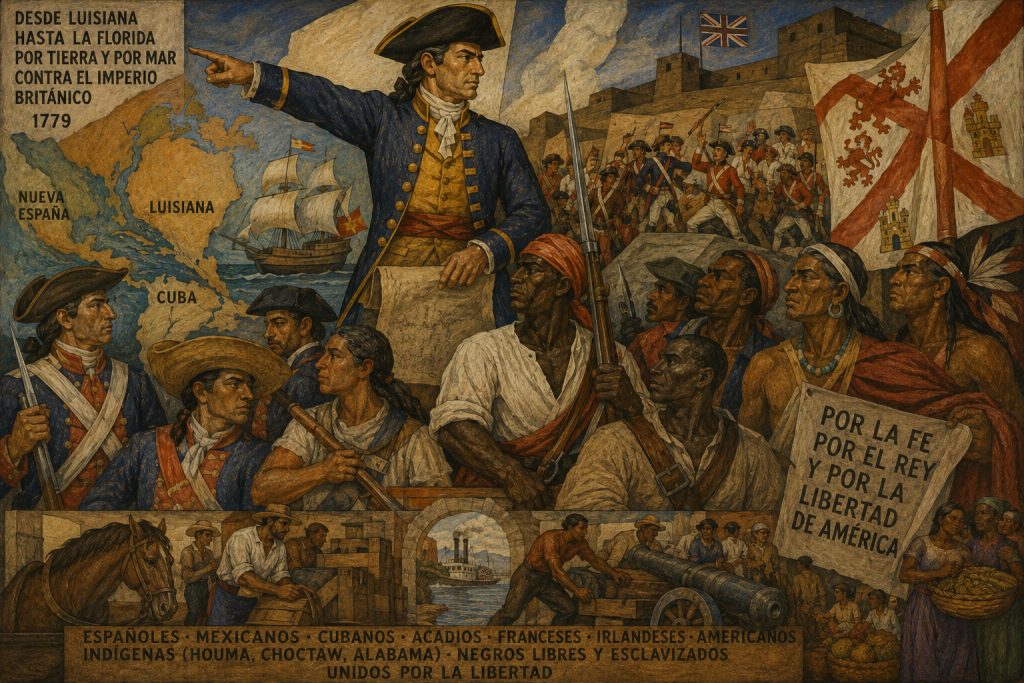
Latinos and others were part of the war against the British.
The nation is approaching the 250th anniversary of its independence at a moment when Latino people have been targeted, harassed, and fatally neglected by two Trump administrations over the past decade. Recent studies by Pew Research have found that more than 55% of Latinos are concerned about their place in the U.S.
Perhaps it should be no surprise that in such a climate, the events in Pensacola, like many other parts of the Hispanic past of the United States, continue to lie in the historical shadows, resulting in an inaccurate and compartmentalized version of U.S. history.
When the first shots of the Revolutionary War were fired in Massachusetts, the future United States was a strip of British colonies bordering an enormous Spanish empire and multiple Indigenous nations. Events on the eastern coast were just one part of a dynamic landscape across North America, and without repeated interventions by the people of Spanish territories, those events might have played out very differently.
Bernardo de Gálvez was the governor of Louisiana and in charge of its troops. That vast territory had been under French control before it was passed to the Spanish in 1762 to keep it from falling into British hands, though Florida would become Britain’s the following year. California — or Alta California, as it was then — was also under Spanish control, with the first mission in San Diego erected in 1769. Gálvez’s uncle was one of the architects of Spanish expansion into California and later helped to direct Spain’s involvement in the American Revolution.
Spanish officials understood that something profound was taking place in the British colonies, and the Continental Army saw a potential ally in Spain. When Benjamin Franklin was in Paris in late 1776, he met with Spain’s ambassador. By that point, Spain had already been assisting the Continental Army by funneling arms, supplies, and money through New Orleans. More active aid would come after France declared war on Britain, and Spain followed suit in 1779.
Even as colonists resisted the British Empire in the battles familiar from U.S. history books — Lexington and Concord, Bunker Hill, Long Island, Trenton, Yorktown — parallel conflicts to the south and west were key to driving the British out of the future United States.
From Louisiana, Gálvez turned his gaze to British-held West Florida, seeing a chance to disrupt the British strategy in the Mississippi basin — and to regain Florida for Spain.
Gálvez led three successful campaigns in quick succession, drawing on troops from other parts of Spain’s empire, such as Mexico and Cuba — local militia, Irish, American and French-speaking Acadian recruits, as well as enslaved and free Black soldiers. On the first mission in September 1779, as they marched toward the westernmost outpost of British West Florida, Ft Bute, they were joined by Native Americans, including the Houma, Choctaw, and Alabama peoples. They captured that fort and two more before returning to New Orleans.
Related Articles
Contributor: The untold Hispanic history that made US history possible