The following is from the Texas Tribune:
REDFORD — As a teenager, Joe Carrasco would help his father pick onions and cotton on the family’s 40-acre ranch on the banks of the Rio Grande. On the weekends, he would mount his horse and wade across the river into Mexico, where he would race his horse and drink beers.
Today, Carrasco is 71, retired after 26 years working in the oil fields, sitting under a carport with a Michelob Ultra beer and staring at the mountains while his cows graze on his alfalfa farm.
“I like what I see,” he said.
But he doesn’t like what he sees coming.
Carrasco is one of an estimated 400 landowners in the Big Bend region whose land has been targeted by the Trump administration. Like other property owners along the Rio Grande, Carrasco received a letter from U.S. Customs and Border Protection earlier this year asking him to let contractors on his land to survey it or risk losing it through eminent domain.
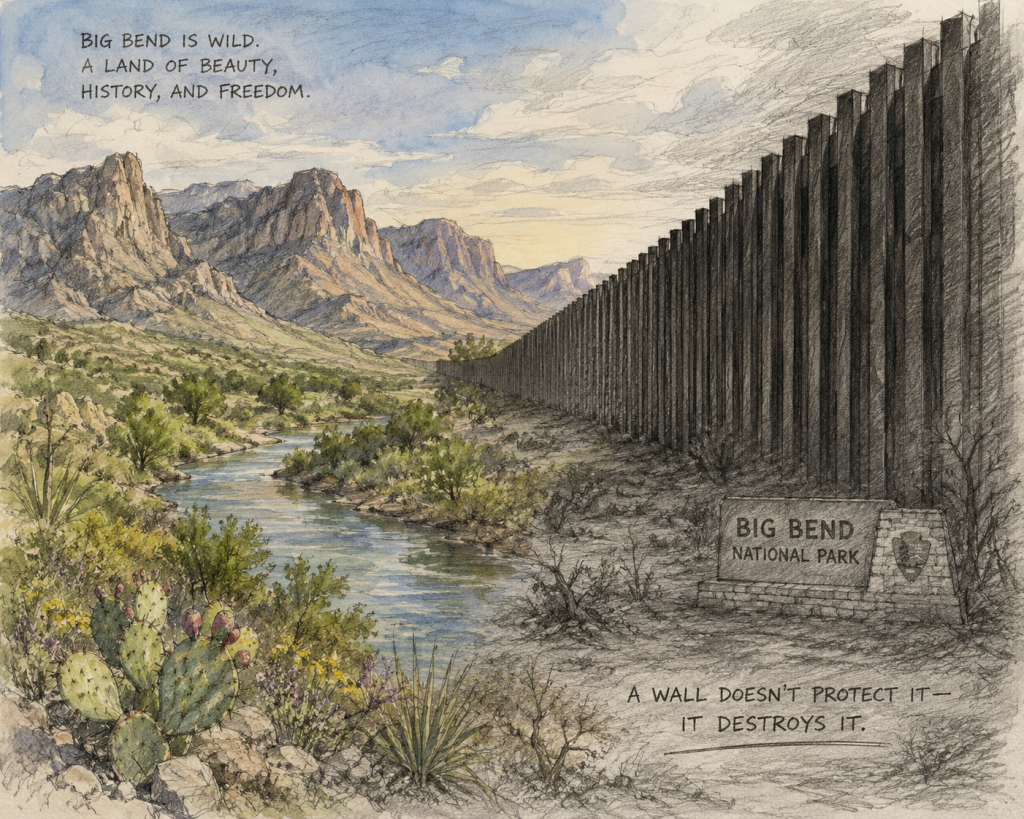
Over the past year, the Trump administration has sent mixed signals about its plans to erect border barriers in this rugged, mountainous region, saying that it prefers other infrastructure, such as cameras, sensors, and vehicle barriers, inside Big Bend National Park and the neighboring Big Bend Ranch State Park.
Even though immigration officials have claimed they’re not building a wall in the parks, the federal government has awarded billions of dollars worth of contracts to companies that have previously built border walls for work within the parks.
It has also waived environmental laws in the state and national parks to speed up the process. And contractors are seeking permits to access sufficient water to house hundreds of workers in the area who will build border security infrastructure.
But what is clear is that the federal government has threatened to seize land along broad swaths of the Rio Grande away from the parks. And that’s causing alarm up and down the river.
Big Bend is the largest Border Patrol sector, covering 77 Texas counties and 517 miles of the 1,954-mile-long U.S.-Mexico border.
It is also the least busy.
Mario Peña, 62, was born and raised in Redford. He grew up on his family’s farm, where he grew onions and cantaloupes. Like Carrasco, he left to work in the oil fields, then started his own business as an oil field contractor.
The Peñas have not received any type of communication from CPB, but their neighbors on either side have. Peña said he expects the federal government will also want a piece of his farm.
“I’m willing to die to protect my land,” Peña said, sitting in a metal chair under a carport that overlooks the lush green farm that stretches to the river.
As his children got older, he said he began to miss the 40-acre farm, which he had inherited after his father died. Shortly before the start of the COVID pandemic, Peña began revisiting the farm and laid an irrigation pipe to pump river water to the alfalfa fields. At the height of the pandemic, Peña moved into his childhood home full-time. His son joined him later that year.
“I always wanted to come back home,” he said. “I have to do something for my dad before I die. To get the farm all green up to the river — that’s my goal.”
…………………………….
One has to wonder when the grifting and stealing from the taxpayers will stop. When will this present administration stop hurting our country? When will Trump stop turning beautiful things as ugly as his thoughts?
…………………………….
Spent most of the day fixing ad ware that managed to get through my defenses. My fault, I had Windows 11 protection, but failed to turn on my Norton Protection on a new computer.