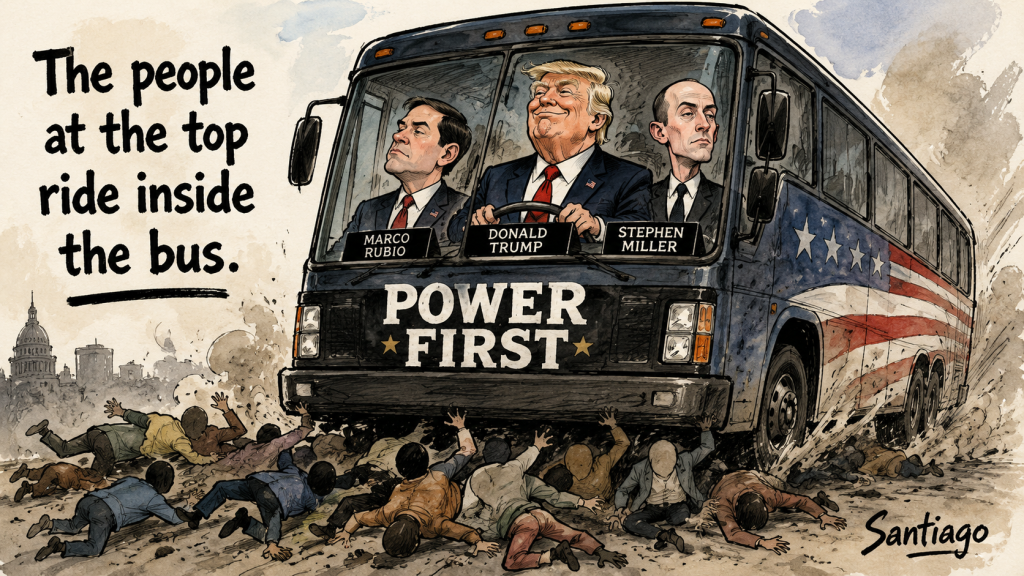
The Bus Is Already Warming Up
Standing on a stage at the Conservative Political Action Conference outside Dallas, the man who had served as Donald Trump’s personal criminal-defense lawyer—and now runs the Justice Department as acting attorney general—told the crowd:
“Everybody’s afraid that the next administration, if we don’t win, we’re going to all be investigated and indicted.”
He meant it as a rallying cry.
What he delivered was a confession.
People who believe they have obeyed the law do not normally stand before a cheering crowd and announce that they are afraid of indictment. They may fear losing an election. They may fear being fired. They may fear that a new administration will reverse their policies.
Indictment is different.
You do not spend your evenings bracing for criminal charges unless some quiet part of you already knows where the bodies are buried—or at least who signed the paperwork.
A reckoning may be coming for the people who crossed legal lines for this president, and they can feel it. But the men standing on the CPAC stage will not be the first ones sacrificed.
They never are.
The first people thrown under the bus will be those on the lowest rung: the agents who carried out the raids, the officers who pulled the triggers, the prosecutors who signed questionable filings, the supervisors who approved operations, and the government employees who followed orders without asking whether those orders were lawful.
Today, they are praised as patriots.
Tomorrow, they will be called rogue employees.
The officials at the top will say they never ordered anyone to violate the law. They will claim their words were misunderstood, their policies were misapplied, and their subordinates exceeded their authority. Men who demanded absolute loyalty will suddenly discover the importance of individual responsibility.
They will not say, “We did it.”
They will say, “He did it.”
The agent who believed the administration would protect him will learn that protection lasts only while he remains useful. The officer who wrote a false report because a supervisor told him to “clean it up” will discover that the supervisor remembers the conversation differently. The lawyer who stretched the law beyond recognition will be reminded that his name—not the president’s—is on the filing.
And when investigators begin asking questions, the people at the top will develop poor memories and excellent lawyers.
That is why the statement at CPAC matters.
It reveals that fear has already entered the room. The people directing these policies understand that elections do more than change administrations. Elections can change who controls the evidence, who appoints the prosecutors, and who decides whether “following orders” is an explanation or an admission.
They are warning one another now because they know the government leaves a paper trail.
Emails survive.
Text messages survive.
Orders survive.
Video survives.
And frightened subordinates eventually talk.
The people carrying out the administration’s harshest commands should listen carefully to what their leaders are saying. They are not promising to stand beside them forever. They are warning that everyone may be investigated.
Everyone, of course, does not mean everyone equally.
When the bus begins moving, the powerful will be inside it.
The people who followed their orders will be underneath.