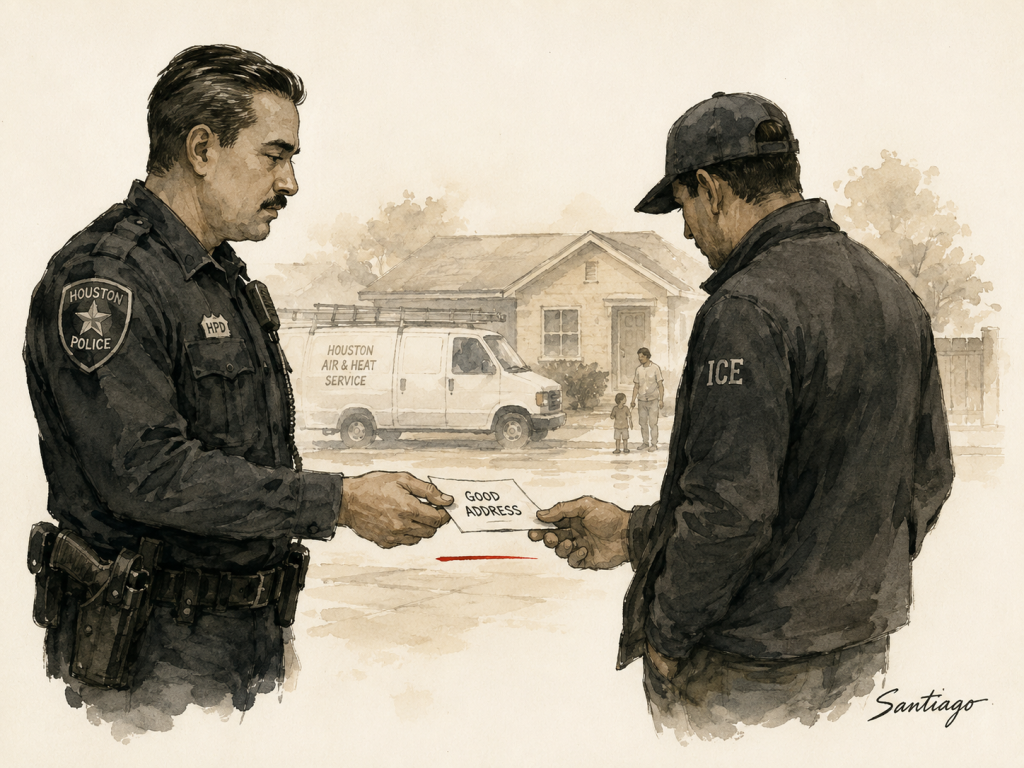
How a “Good Address” Can Put the Wrong Man in the Wrong White Van
A Houston police officer stopped a Honduran woman for driving 58 miles per hour in a 40-mile-per-hour zone.
He ran her name through a national database and found a civil ICE warrant. The ICE agent was an hour away and apparently did not want her badly enough to come immediately.
But he gave the officer an instruction:
Obtain a good address.
Get a good address, release her, and ICE might visit the next day.
The woman sat beside the road for more than 90 minutes—five times longer than an ordinary Houston traffic stop—before being released with tickets for speeding and driving without a license. We do not know whether ICE later went to the address she gave.
But what exactly is a good address?
Does it mean the woman actually lives there?
Does it mean the address is printed on an old license?
Does it belong to her mother, a cousin, a former boyfriend or a friend willing to receive her mail?
Or is it simply the address a frightened woman was willing to give while sitting beside the road, watching a Houston police officer talk to ICE?
I once represented a man arrested for failing to appear in court on traffic violations.
There was only one problem.
He had never received the tickets.
His brother drove without a license and had developed a useful habit: whenever police stopped him, he gave them his brother’s name and address.
The officers entered the information into their reports.
The tickets became official.
The missed court appearances became official.
The warrants became official.
Then the wrong brother was arrested.
The information had been false from the beginning, but once the government placed it inside a computer, every officer who saw it afterward treated it as the truth.
Today, stolen and borrowed identities are far more common. Names, Social Security numbers, licenses and addresses pass between relatives, strangers, employers, criminals and identity thieves.
A man stopped in Houston may give his brother’s name.
A woman may give an address where she lived three years ago.
A worker may give the house where six men meet every morning before leaving for construction jobs.
A driver may give the address of the innocent person whose identity he stole.
Then an officer types it into a report.
HPD sends it to ICE.
ICE places it into a federal database.
And somewhere along the way, bad information becomes intelligence.
That possibility matters because ICE recently investigated a tip involving an address associated with an intended target. Agents reportedly saw two white vans at that address. Later, while heading toward it, they saw another white van and a man inside who supposedly resembled the person they wanted.
The van belonged to Lorenzo Salgado Araujo’s work crew.
Salgado was not the target.
His brother was not the target.
But ICE attempted to stop the van, and an agent shot Salgado dead. Federal officials say he used the van as a weapon. Witnesses have challenged that account. What nobody has publicly explained is where the original address came from and how ICE decided it was reliable.
We do not know that HPD supplied that address.
It could have come from a tipster, an employer, surveillance, immigration paperwork, a commercial database or another police agency.
But what if it came from a traffic stop?
What if an HPD officer had previously been instructed to obtain a “good address” from the intended target—or from someone using his name?
What if the address belonged to a brother, a cousin, an old tenant or an identity-theft victim?
What if several white construction vans came and went from that location every morning?
What if agents took an uncertain address, added a vehicle description and a vague physical resemblance, and began treating the combination as probable truth?
And what if Lorenzo Salgado died at the end of that chain?
Again, we do not know.
That is why someone must ask.
Houston police called ICE at least 290 times between January 2025 and late April 2026, mostly after traffic stops. More than two-thirds of the encounters lasted at least an hour. In at least 17 cases, officers arrested or transported people to ICE even though city officials later acknowledged that the officers had violated HPD policy.
This is not an occasional telephone call.
It is an information pipeline.
Names move through it.
Addresses move through it.
Vehicle descriptions move through it.
And sometimes people move through it—first into a patrol car, then into ICE custody, then out of the country.
Houston officials should answer several simple questions.
Was the address used in the operation that killed Lorenzo Salgado ever collected, confirmed or updated during an HPD traffic stop?
Had the intended target—or anyone using his name—ever been stopped by Houston police?
Does ICE record where each address came from and whether it was independently verified?
How many “good addresses” supplied by local officers later proved outdated or false?
How many belonged to relatives, previous tenants or victims of stolen identities?
And before ICE agents follow another white van, does anyone check whether the driver is actually the man they want?
An ICE administrative warrant is civil. It is not signed by a judge and does not, by itself, authorize Houston police to arrest, transport or continue holding someone after the lawful purpose of a traffic stop has ended.
Yet Houston officers are being used to gather information that may help ICE find people later.
That is immigration enforcement, regardless of what Mayor John Whitmire chooses to call it.
“Obtain a good address” sounds harmless.
So does “routine traffic stop.”
But a bad name and a bad address do not become true because a police officer enters them into a government computer.
They merely become more dangerous.
And when federal agents begin choosing between similar faces and identical white vans, one bad address may be all it takes to kill the wrong man.
Reporting note: This commentary relies substantially on the Houston Chronicle investigation by Matt deGrood, Caroline Ghisolfi and Sam González Kelly, based on Houston Police Department records and data analyzed by Caroline Ghisolfi. Reporting concerning the fatal ICE shooting of Lorenzo Salgado Araujo comes from Chronicle immigration reporter Julián Aguilar, including statements from Rep. Sylvia Garcia, ICE and the Associated Press.
The possible connection raised here between addresses collected during HPD traffic stops and faulty ICE enforcement information is my question and interpretation. The Chronicle has not reported that HPD supplied the particular address used in the Salgado operation.
.