
For more than a year, the United States kept Mexican cattle out because federal officials said the danger was too great: New World screwworm was moving north through Mexico, and bringing infected livestock across the border could help the flesh-eating parasite return to the United States.
The worm came anyway.
Now, with 42 confirmed U.S. cases and 41 of them in Texas, the Trump administration has decided it is time to start bringing Mexican cattle back across the border. (The Texas Tribune)
Beginning Aug. 24, the U.S. Department of Agriculture will reopen the cattle crossing at Douglas, Arizona. Crossings at Santa Teresa and Columbus, New Mexico, are expected to follow. USDA says every animal will be inspected and that continued reopening depends on Mexico complying with a joint screwworm-control plan. (APHIS)
There is an economic reason for taking the chance.
American cattle supplies are historically low, beef prices have reached records, and closing the Mexican border removed an important source of cattle from an already tight market. Reuters reports that the ban contributed to supply disruptions and added pressure on an administration looking for ways to bring food prices down. (Reuters)
A cheaper hamburger suddenly has competition with another concern:
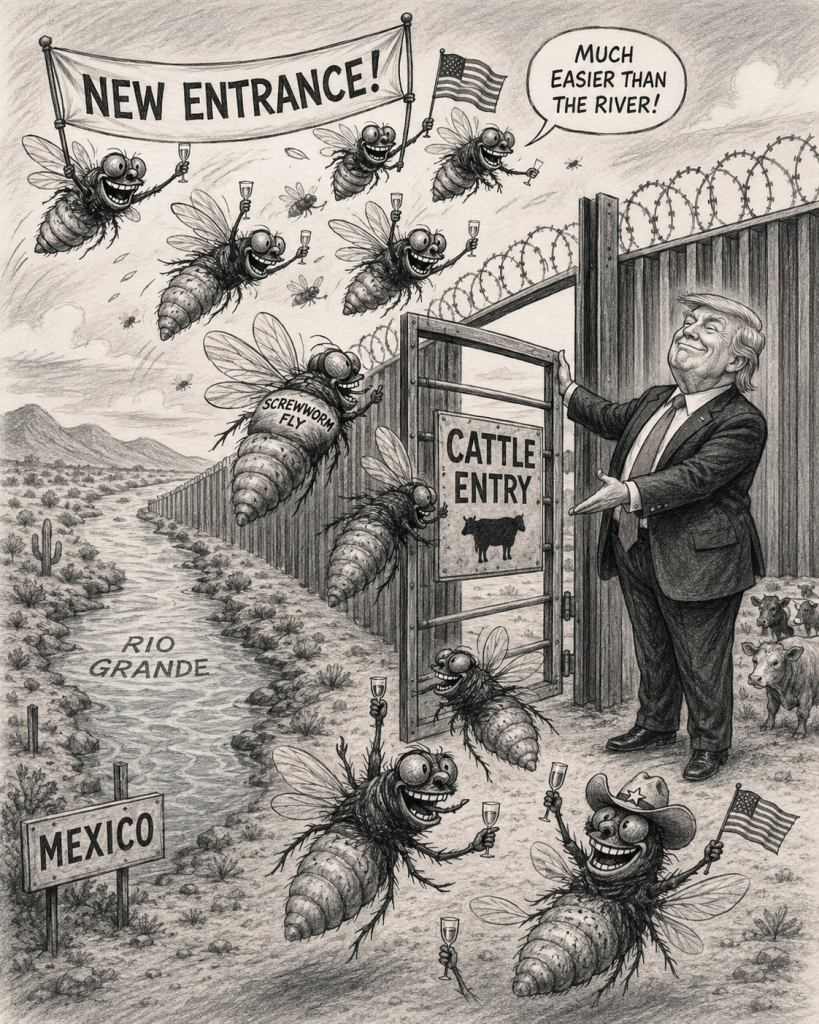
How many more screwworms are Americans willing to risk importing to get it?
That question would be less troubling if the United States already had the machinery necessary to wipe out an infestation quickly.
It doesn’t.
The principal weapon against screwworm is not pesticide. It is another screwworm fly.
Scientists raise enormous numbers of flies, sterilize the males and release them over infected areas. Female screwworm flies generally mate once. When they mate with sterile males, there are no offspring. Release enough sterile males for long enough and eventually the population collapses.
It works. It helped eradicate screwworm from the United States decades ago. But eradication takes time and an enormous number of flies. The Southwest campaign began in 1962, and the United States was officially declared free of indigenous screwworm in 1966. Even afterward, sterile-fly releases and a barrier farther south were needed to protect the country from reinfestation. (National Agricultural Library)
This time, America wasn’t ready with enough flies.
Agriculture Secretary Brooke Rollins acknowledged that problem herself. Experts estimate that roughly 500 million sterile flies a week may be necessary to push the current infestation back. At the time of congressional hearings in June, the government was producing about 100 million a week, all from the long-established facility in Panama. (The Texas Tribune)
Rollins told senators that when she warned President Trump about the approaching threat, she explained the shortage bluntly: “everyone took their eye off the ball years ago.” (The Texas Tribune)
That may prove to be the most important sentence in the entire screwworm story.
The United States does have a new facility at Moore Air Base near Edinburg. But it is primarily a dispersal facility — a place from which sterile flies can be released — not the massive domestic production plant needed to manufacture hundreds of millions of them every week. USDA says new production capacity is being developed, but a major domestic production facility is not expected to be operating until late 2027. (APHIS)
In other words, the government is fighting the infestation while still building the weapons factory.
And now it is reopening the cattle door.
USDA argues that the reopening is cautious. It starts in Arizona, not Texas. It is limited. Animals will be inspected. Mexico must continue its eradication program. The government can close the crossings again if conditions deteriorate. (APHIS)
All true.
But another fact is equally difficult to ignore.
The border was closed because screwworm was considered dangerous enough that American livestock had to be protected from Mexican cattle.
Today the parasite is already here, federal officials acknowledge that the country does not yet have enough sterile flies to eradicate it quickly, and the administration is preparing to allow Mexican cattle back in anyway.
Perhaps every precaution will work.
Perhaps not another screwworm will cross with an imported animal.
But screwworm eradication is measured in years, not election cycles, and once a reproducing population establishes itself among cattle, deer, wildlife, pets and other warm-blooded animals, getting it back out becomes enormously harder.
Trump wants cheaper beef.
American consumers want cheaper beef.
Texas ranchers certainly want a functioning cattle market.
But somewhere between the price of hamburger and a parasite that eats living flesh lies a question worth asking before the gate swings open:
Are we lowering the price of beef — or merely postponing a much larger bill?