Mexican workers said no and gave a reason, in writing. That is what makes the story exceptional. They said the Japanese workers had stood beside them, shared hardship with them, helped them after a Mexican striker was killed, and that accepting a union charter that excluded the Japanese would betray both their comrades and the principle of unionism itself. (California Digital Library)
They said no.
Did you know that more than sixty years before César Chávez and Dolores Huerta became synonymous with farmworker organizing, Mexican and Japanese farmworkers in California joined together, went on strike—and won?
It happened in Oxnard, California, in 1903.
And what happened after they won may be the more remarkable story.
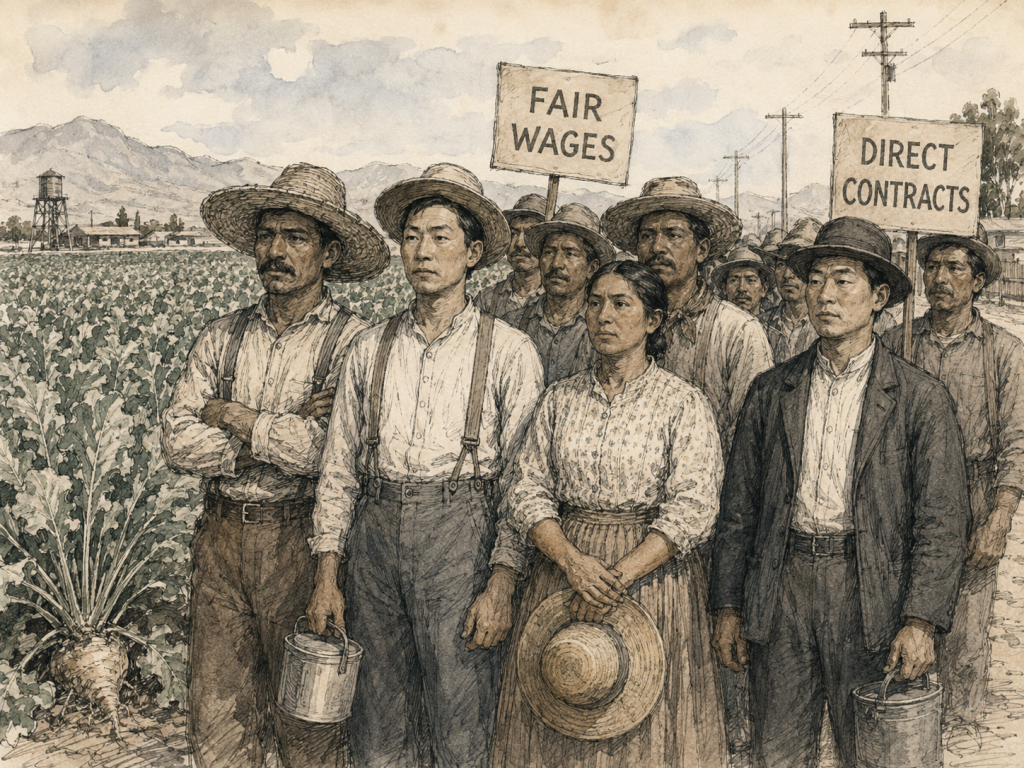
The sugar-beet industry around Oxnard depended heavily on Mexican and Japanese laborers. Workers complained that a powerful labor-contracting company was cutting wages, charging workers through a subcontracting system, and forcing them to buy goods at inflated prices.
So they did something employers probably did not expect.
They joined together.
On February 11, about 500 Japanese and 200 Mexican workers organized the Japanese-Mexican Labor Association. They spoke different languages and often needed interpreters to communicate. Nevertheless, they managed to organize across language and race around something they understood perfectly well:
They were doing the work, and somebody else was controlling what that work was worth. (Wikipedia)
Their union grew rapidly. Within weeks, it had more than 1,200 members and represented most of the area’s sugar-beet labor force. The strike threatened to shut down the beet crop at a critical point in the growing season. (Wikipedia)
Then it turned violent.
On March 23, during a confrontation involving strikebreakers, gunfire erupted.
Mexican union member Luis Vasquez was killed. Two Mexican and two Japanese union members were wounded. (Wikipedia)
The workers did not quit.
A week later, on March 30, the strike ended in victory. The contracting company’s control was broken, and workers regained the ability to contract directly with growers. (Amigos805)
Then the union made what seemed like the logical next move.
It asked to join the American Federation of Labor, then the most powerful labor organization in the country.
AFL president Samuel Gompers was willing to take the Mexican workers.
There was a condition.
Leave the Japanese behind.
Gompers told the union that it could enter the AFL, but it could not accept Japanese or Chinese workers as members. (Chicago History Museum)
Think about what the Mexican workers were being offered.
They had just fought a bitter strike.
One of their men was dead.
They had won.
Now one of America’s most powerful labor organizations was offering them recognition, legitimacy, and a place inside organized labor.
All they had to do was abandon the Japanese workers who had fought beside them.
They refused.
And we don’t have to guess why.
They told us.
J.M. Lizarras, secretary of the Mexican branch, wrote back on behalf of the Mexican workers.
He reminded Gompers that the Japanese had been among the first to recognize that the workers needed to unite. They had worked together, planned together and survived on short rations together. After Vasquez was killed, the Japanese workers had also shown tangible generosity toward their Mexican comrades.
Then came the principle.
Lizarras wrote that they would be “false to them and to ourselves and to the cause of Unionism” if the Mexicans accepted privileges denied to the Japanese. (California Digital Library)
They wanted a charter for all the field workers, regardless of race.
Nothing else would do.
The Mexican workers were not merely saying, These Japanese men are our friends.
They were saying something considerably larger:
You cannot build a workers’ union by allowing the powerful to decide which workers count.
And remember when this happened.
1903.
California was entering a period of intense anti-Asian politics. Hostility toward Japanese immigration was growing, and organized labor itself was deeply involved in anti-Asian campaigns. Only a few years later, the United States and Japan would reach the Gentlemen’s Agreement restricting Japanese immigration, and California would eventually pass laws aimed at preventing Japanese immigrants from owning land. (National Park Service)
The easy choice for the Mexican workers would have been to take what was offered.
Someone was essentially telling them:
You can come inside. They can’t.
Instead, they stood outside with the Japanese.
There was also hard-headed wisdom in that solidarity.
Employers have always understood something workers sometimes forget:
Two groups fighting each other are easier to control than two groups fighting together.
Mexican and Japanese workers in Oxnard had previously been competitors in the same agricultural labor market. In 1903 they recognized that whatever differences existed between them, their immediate economic problem was the same. (Wikipedia)
The union itself did not last long. The AFL never gave them the interracial charter they demanded, and changing labor conditions eventually caused the organization to disappear. (California Digital Library)
But that almost makes the story more remarkable.
They did not know that historians would someday write about them.
There was no César Chávez yet.
No United Farm Workers.
No television cameras.
No social media.
Just Mexican and Japanese laborers working the sugar-beet fields of California who had discovered that they were stronger together.
Then somebody offered the Mexicans a better seat at the table if they would leave their Japanese coworkers outside.
They knew exactly what they were being offered.
And they knew exactly why they couldn’t take it.
More than sixty years before the great farmworker movements most Americans remember, these workers had already learned the lesson:
If someone can convince you that the worker beside you is the enemy, you may never notice who is setting both of your wages.
And in 1903, when given the opportunity to save themselves by abandoning the Japanese workers who had stood beside them, the Mexican workers of Oxnard gave America an answer worth remembering:
We don’t leave our people behind.