
The New Well-Funded Cartel, Powered by MAGA
“Pretty sure he’s wet.”
“Tonks everywhere.”
“See bodies, chase bodies.”
These were not messages recovered from a Mexican drug cartel.
According to evidence presented in federal court, they came from American immigration agents discussing people they encountered during raids in Southern California.
The body-camera footage, text messages and sworn testimony offer something the public rarely gets to see: federal immigration agents talking among themselves when they apparently believed the rest of us were not listening.
They were not discussing carefully investigated fugitives. They were discussing “bodies.”
They were not describing individual suspects by name, photograph, criminal history or warrant. When one agent was asked what suspicious people looked like, his answer was reportedly: “Older Hispanic male.” (CalMatters)
That is not immigration enforcement.
That is racial hunting.
The American Civil Liberties Union and other attorneys submitted the evidence while asking a federal judge to stop what they describe as an ongoing campaign of suspicionless and discriminatory detentions.
The records show agents talking about “snatch & grabs,” telling one another to bring extra handcuffs and instructing teams to get out of their vehicles and start grabbing people. One officer reportedly said Border Patrol agents knew only one method: see human bodies and chase them. (Los Angeles Times)
The language becomes even uglier.
One agent referred to a man sitting in a minivan as “wet.” Others used the word “tonk,” a slur that Customs and Border Protection itself warned agents in 2019 was derogatory and inappropriate. The term has reportedly been associated with the sound made when a migrant is struck in the head with a heavy object such as a flashlight. (CalMatters)
…………………………………………Tonk drums…………………………………………………….
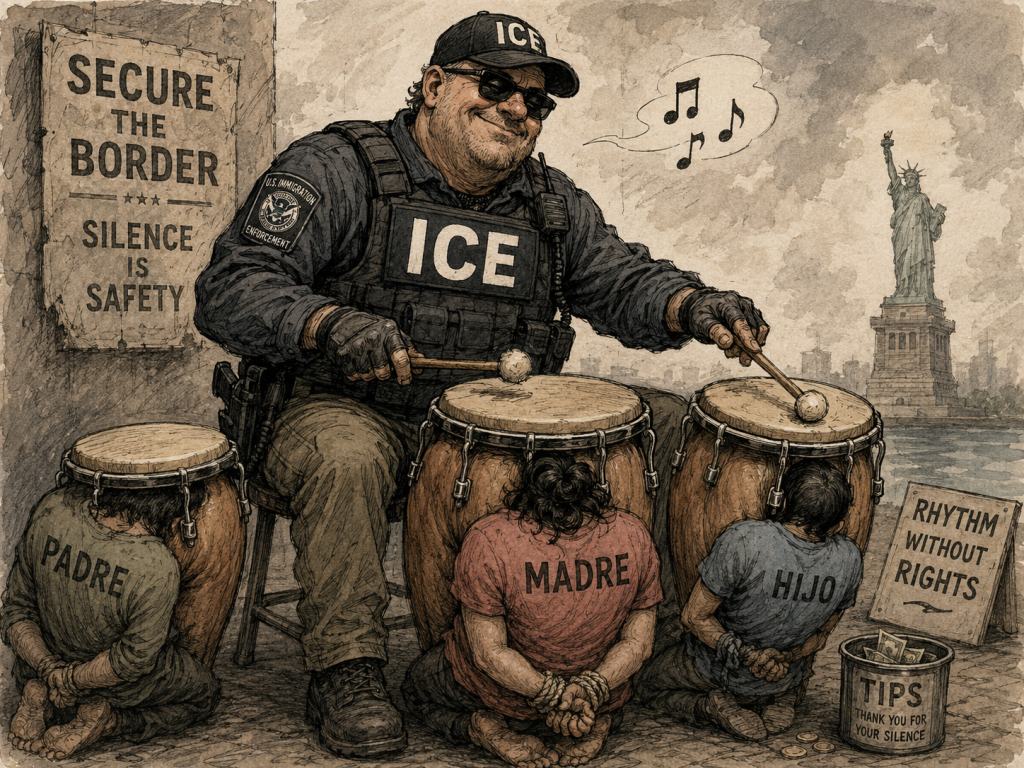
They were not talking about human beings as human beings.
They were talking like hunters discussing game.
Find the right neighborhood. Look around Home Depot. Check the car washes. Spot someone brown, poor, Spanish-speaking or dressed like a laborer. Jump out. Grab him. Ask questions later.
The government has repeatedly insisted that its agents rely on individualized reasonable suspicion rather than race. But the court filing describes a process that appears to work backward.
According to the motion, intelligence teams first visited places such as Home Depots and car washes. They ran checks until they found a few people who might be undocumented. Later, agents selected a day to raid the location, whether those supposed targets were present or not. Often, the original targets were never arrested, while numerous other people were taken instead. (Los Angeles Times)
In other words, they chose the hunting ground first.
Then they created the justification.
That matters because the Trump administration has argued that these operations are based on specific information, not racial profiling. The new evidence, the plaintiffs say, directly contradicts what the government previously told the courts. (CalMatters)
The Supreme Court had temporarily lifted an earlier order restricting agents from relying on race, language, location and type of employment when deciding whom to stop. That decision gave immigration officers broad room to claim they were considering the “totality of the circumstances.”
But what happens when the totality of the circumstances is simply this?
He looks Mexican.
He speaks Spanish.
He is standing outside Home Depot.
Bring extra cuffs.
Civil rights groups say the raids have swept up lawful permanent residents and American citizens. A separate ACLU review of more than 1,200 immigration-enforcement incidents in eight states found more than 400 involving alleged misconduct, including 437 incidents involving likely racial profiling and 155 cases in which U.S. citizens were detained, targeted or otherwise affected. (American Civil Liberties Union)
Those numbers make it harder to dismiss each new case as an unfortunate misunderstanding.
How many misunderstandings does it take before we admit we are looking at a policy?
How many Hispanic citizens must be stopped before we acknowledge that citizenship papers cannot protect someone whom agents have already judged by his face?
How many times must masked officers surround a vehicle, draw their weapons and later claim the driver tried to use the vehicle against them?
In California, Francisco Longoria said masked immigration agents surrounded his truck, broke its windows and fired three rounds as he drove away. He was later accused of assaulting federal officers with his vehicle. The criminal charge was eventually dropped. His family’s lawsuit alleges that the government manufactured accusations to justify what the officers had done. (The Guardian)
Here in Houston, ICE agents shot and killed Lorenzo Salgado Araujo after pursuing the wrong white van. The Department of Homeland Security said the van had been used as a weapon. His brother, who witnessed the shooting, gave a different account. Harris County District Attorney Sean Teare said federal officials withheld reports, evidence and even the names of the agents from the local investigation. (Houston Chronicle)
Once may be an incident.
Twice may be a coincidence.
After a while, the excuse begins to look like part of the equipment.
The word “cartel” usually brings to mind armed men in masks, unmarked vehicles, kidnappings, territorial control and an organization powerful enough to operate without fear of local authorities.
Now consider what Americans are watching on their own streets: masked federal agents arriving in unmarked vehicles, grabbing people without showing judicial warrants, refusing to identify themselves, using racial slurs and obstructing outside investigations when someone is injured or killed.
There is one important difference.
This organization does not hide from the United States government.
It is financed by it.
The ACLU describes the Trump administration as building a $240-billion immigration-enforcement machine. It is recruiting more agents, expanding detention space and placing enormous power in the hands of officers who may see an “older Hispanic male” not as a citizen, father, veteran or grandfather, but as a suspicious body waiting to be grabbed. (American Civil Liberties Union)
The evidence from Los Angeles remains part of ongoing litigation. Not all allegations have been resolved by a final judicial ruling, and the Department of Homeland Security had not responded to the newspapers before their reports were published. That qualification belongs in any honest account. (Los Angeles Times)
But the government’s silence does not erase the recordings.
It does not erase the text messages.
It does not turn “tonks everywhere” into individualized suspicion.
When armed government agents speak of people as “bodies,” choose targets by ethnicity and joke in racial slurs, Americans should stop pretending that only undocumented immigrants are endangered.
A government that can grab a Latino citizen because he looks undocumented can eventually grab anyone after inventing a category that makes him suspicious.
MAGA promised to destroy the cartels.
Instead, it may have created a new one—better armed, better financed and protected by a badge.
And this time, we are paying for it.


