
That is how it started in Nazi Germany.
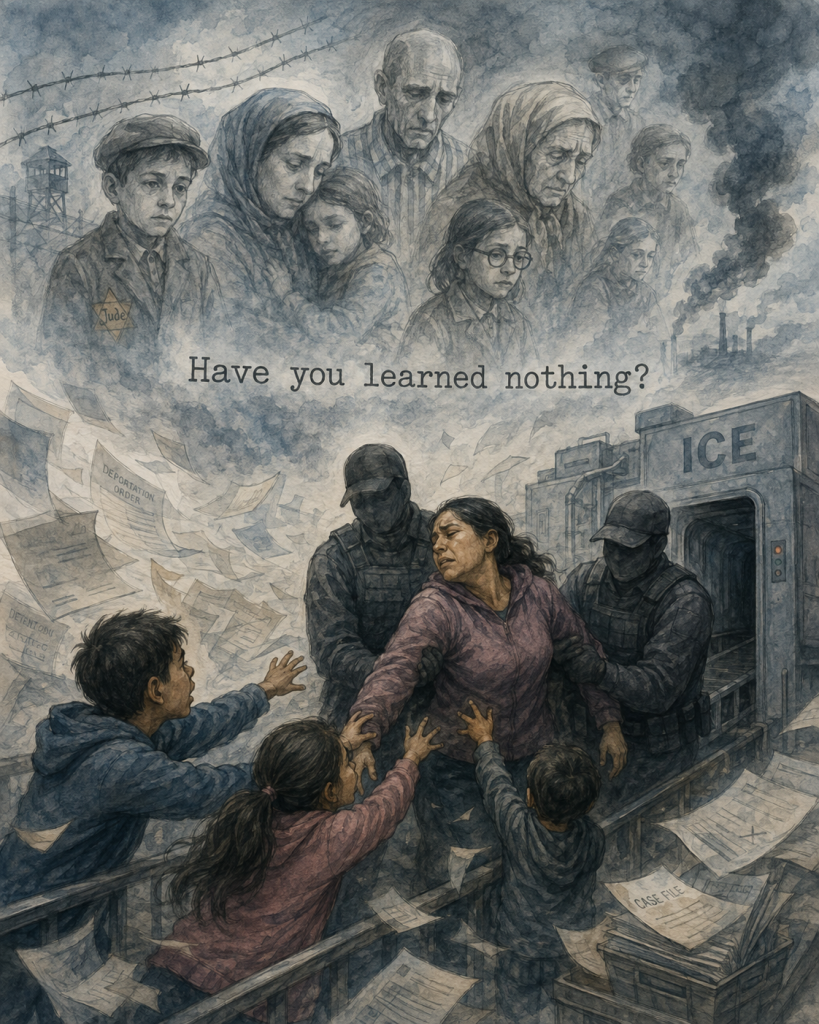
Jessica Treviño’s case sounds like something written as a joke about government bureaucracy.
The Department of Homeland Security deported her to Mexico on March 25. Then U.S. Citizenship and Immigration Services notified her that it intended to terminate her DACA protection because she had engaged in “unauthorized travel outside of the United States” on March 25.
The government forced her out of the country and then used her departure as the reason to take away the protection she had when it forced her out.
Treviño is 34 years old. She was brought to the United States as a child and later received protection under Deferred Action for Childhood Arrivals. DACA does not give someone permanent legal status, but it provides temporary protection from deportation and permission to work. Treviño’s DACA and work authorization were valid through April 2027. (AP News)
She and her husband were arrested after federal agents followed them into a Home Depot parking lot in South Texas. They are now living in Matamoros. Their three children, all American citizens, remain with relatives on the Texas side of the border. (AP News)
The government says Treviño accepted voluntary departure and waived her right to appeal. Treviño says she did not sign the papers and did not agree to leave. Her lawyer has asked a federal judge to declare the removal unlawful, order the government to help bring her home and preserve her DACA protection. (AP News)
I cannot prove that Stephen Miller personally chose Jessica Treviño, saw her name, or ordered anyone to deport her.
I do not need to invent that connection.
Miller is the White House deputy chief of staff and the architect of Donald Trump’s immigration agenda. Reuters reported that he retained control over immigration policy even as leadership changed at the Department of Homeland Security. He has coordinated the pressure placed on immigration agencies to increase arrests and deportations. (reuters.com)
Miller reportedly demanded at least 3,000 immigration arrests every day and told ICE officials to target anyone without legal status. That pressure helped produce broad sweeps through neighborhoods, workplaces and parking lots. The number of people detained without criminal charges or convictions rose sharply as ICE cast a wider net. (reuters.com)
When the person at the top demands 3,000 arrests a day, the number becomes the mission.
The agents below him learn what counts as success. Supervisors learn what pleases Washington. Lawyers learn to search for some regulation, technicality, or piece of paper that can justify what the machinery has already done.
That does not prove Miller ordered Treviño’s deportation. It shows the system in which her deportation occurred.
The cruelty in her case is not hidden behind complicated law. It can be understood in one sentence:
They deported her and then accused her of leaving.
There is another part of Stephen Miller’s story that makes his role especially difficult to understand.
Miller is Jewish. According to his uncle, David Glosser, their ancestor Wolf-Leib Glosser fled anti-Jewish violence in what is now Belarus and arrived in the United States in 1903. He came with little money and no English, then worked to bring additional family members to safety. Glosser has argued that immigration restrictions like those promoted by his nephew could have prevented their own family from surviving in America. (Time)
That does not mean Miller’s policies are the same as the Holocaust, and there is no need to cheapen history by making that comparison.
The contradiction is simpler.
His family knows what it means to be described as unwanted. It knows what it means to escape persecution, cross an ocean and depend upon a country allowing frightened foreigners through the door.
Yet Miller appears to have learned a very narrow lesson from that history: America saved people like his ancestors, but it has no obligation to extend similar mercy to the families arriving now.
Compassion is not inherited. Neither is historical understanding.
A person can know everything that happened to his own family and still decide that another family deserves no consideration. He can remember persecution as something terrible that happened to his people without learning that governments become dangerous when they reduce human beings to categories, quotas, and files.
Treviño’s case shows what happens when the quota becomes more important than the person.
She had DACA protection. She had a work permit. She had three American children waiting for her at home. The government deported her anyway.
Then, instead of admitting that something had gone wrong, another part of the same government looked at her forced departure and turned it into evidence against her.
That is not merely tough enforcement. It is a machine protecting itself from the truth of what it did.
Stephen Miller may never have heard Jessica Treviño’s name. But he helped build the machinery, demanded that it move faster, and measured its success by the number of human beings it could seize.
The machine found Jessica Treviño.
Then it found an excuse.


