
It is based on a true story.
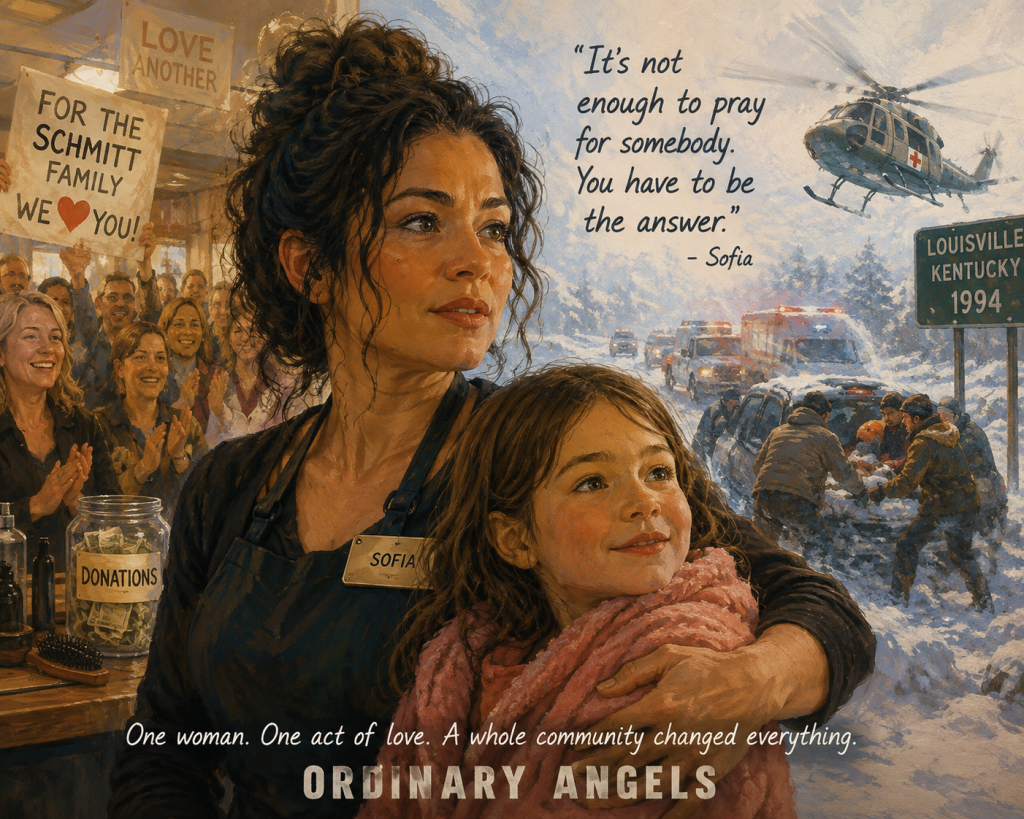
Some movies make us cry because something terrible happens. Others make us cry because, for a few minutes, human beings become better than we expect them to be.
Ordinary Angels belongs to the second kind.
The film tells the story of Sharon Stevens, a Louisville hairdresser whose own life is falling apart, and Ed Schmitt, a widowed father trying to keep his family together while his young daughter fights a life-threatening illness. Sharon does not enter their lives as a saint. She drinks too much, talks too much, interferes where she has not been invited, and sometimes seems to need the family as much as they need her.
That is what makes the story work.
Sharon is not helping because she has everything figured out. She helps because she sees suffering and cannot walk away from it. Her determination becomes a kind of love—not romantic love, but the stubborn human love that says another person’s pain has now become my responsibility partly.
Hilary Swank plays Sharon with enough roughness to keep the character from becoming sugary. She is loud, wounded, funny, irritating, and courageous. Alan Ritchson gives Ed a quieter strength. He is a father exhausted by grief, bills, fear, and the knowledge that love alone may not be enough to save his child.
The movie could easily have become a sermon. Instead, its strongest religious message is expressed through action. Faith is not presented as waiting for God to fix everything. It is shown through people picking up telephones, raising money, clearing roads, offering help, and refusing to accept that one frightened family must face disaster alone.
The title matters. The angels in this movie do not arrive with wings. They arrive in work clothes, snow boots, cars, helicopters, kitchens, beauty salons, and crowded rooms. They are ordinary people who decide that somebody else’s emergency is important enough to interrupt their own lives.
Yes, the movie is sentimental. It knows exactly where the tears are hiding, and it goes looking for them. But sentiment is not always dishonest. Sometimes a story earns the emotion by showing us something true: people are capable of selfishness and cruelty, but they are also capable of extraordinary kindness when somebody gives them a reason to act.
I cried.
Not because the movie fooled me, but because I am human. A father’s fear for his child, a damaged woman trying to redeem herself, and a community joining together to save someone they barely know are not abstract ideas. They reach into the part of us that understands how helpless love can feel when the person we love is suffering.
Ordinary Angels is a love story, though not the kind usually advertised that way. It is about a father’s love, a stranger’s love, a community’s love, and perhaps even the difficult act of learning to love oneself enough to change.
The movie’s message is simple, but it is not small:
A miracle may begin when one ordinary person decides not to look away.