
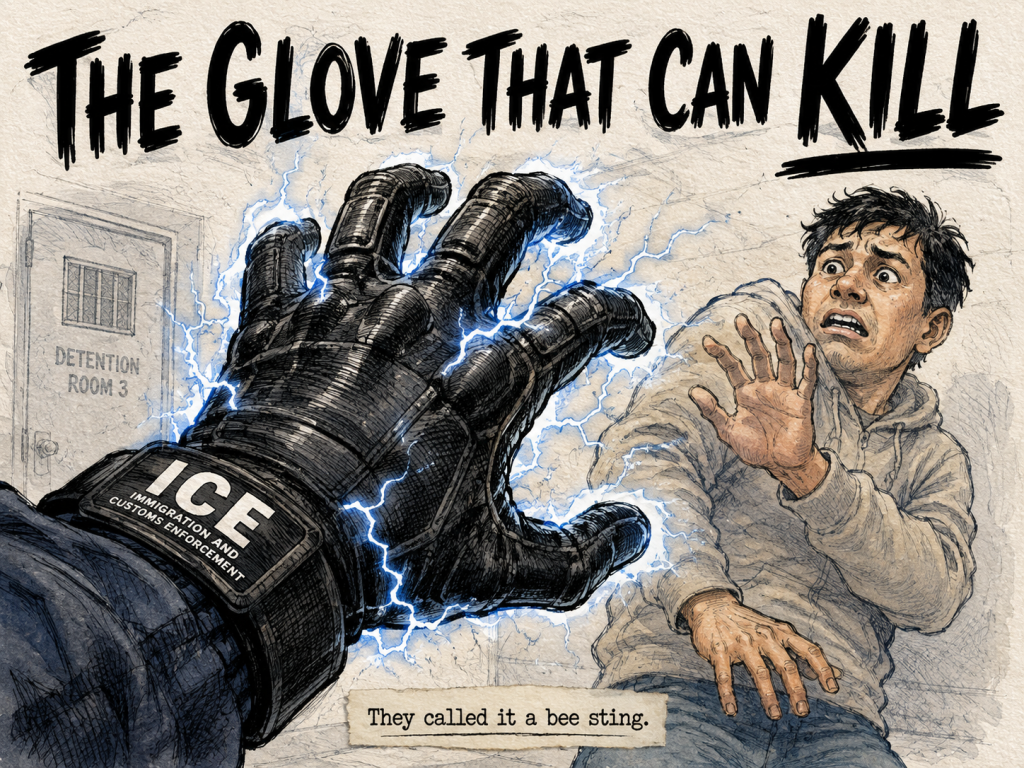
They call it a “de-escalation device.”
One expert compared the pain to a bee sting.
That sounds almost harmless.
Until you learn that a Kentucky man was shocked with one of these gloves 27 times, shocked another 13 times with a Taser, went into cardiac arrest, and died 12 days later.
Now ICE wants thousands of the gloves.
The Department of Homeland Security is preparing a contract worth between $10 million and $20 million to equip Immigration and Customs Enforcement officers with what the government calls “conductive distraction and de-escalation devices.” The purchase could be large enough to put the gloves on most or all ICE officers. (AP News)
The device has an innocent-sounding acronym: G.L.O.V.E. — Generated Low Output Voltage Emitter.
It looks much like an ordinary patrol glove.
Until the officer presses a switch.
Then the hand touching you becomes an electrical weapon.
The glove must make contact with bare skin. According to its manufacturer, the newest model operates at 324 to 362 volts and cannot exceed 380 volts. It fires approximately 30 extremely short electrical pulses every second. The company markets it as a “force multiplier” and an “invisible partner” for law enforcement. (Compliant Technologies)
Invisible is an important word.
Unlike a Taser firing two probes into someone’s body, there may be no dramatic sound or wires hanging from the person being shocked. AP reports that the glove can deliver its electrical pain without leaving the burns or contact marks associated with other electrical weapons. (AP News)
An ICE officer can be holding a person’s arm, press a button, and deliver the shock.
Someone standing several feet away may never know it happened.
John Peters, president of the Institute for the Prevention of In-Custody Deaths, described the sensation to the Associated Press this way:
“I call it like a bee sting.”
But Peters also said the device can produce faster takedowns and shorten confrontations. The manufacturer says it typically forces compliance within seconds. (AP News)
That is quite a bee.
The company says the G.L.O.V.E. achieves what it calls “Neuro Peripheral Interference.” Its purpose is not simply to make someone uncomfortable. The electrical stimulation is designed to distract a person’s nervous system and interfere with coordinated movement long enough for an officer to gain control. (Compliant Technologies)
That helps explain why demonstrations can show people suddenly dropping or losing their ability to resist.
And then there is Johnathan Mansfield.
Mansfield was 43 when he was arrested for public intoxication in Richmond, Kentucky, in September 2024.
According to a wrongful-death lawsuit filed by his wife, corrections officers restrained Mansfield and subjected him to repeated electrical shocks.
Thirteen came from Tasers.
Twenty-seven came from an electric glove.
The lawsuit alleges that officers also piled onto him with a shield, placed him in a full-body restraint device, and covered his face with a spit mask. Mansfield eventually became unresponsive. He suffered cardiac arrest and died 12 days later in a hospital. (Weku)
This is important: it has not been established that the glove alone killed Mansfield.
There were Tasers, physical restraint, and other uses of force. His wife’s wrongful-death lawsuit remains pending.
But what investigators found about the glove should frighten anyone being asked to trust thousands of federal agents with one.
An internal investigation found that two individual applications of the electric glove lasted 45 seconds and 99 seconds.
The manufacturer’s recommended limit is about 15 seconds.
The jail investigation concluded that the excessive electrical applications inflicted unnecessary pain and increased the risk of serious health complications. AP reports that the lawsuit alleges the shocks from the gloves contributed to Mansfield’s death. (AP News)
WEKU reported something even more significant: a University of Kentucky physician and an internal investigation concluded that the overall use of force caused Mansfield to suffer cardiac arrest. (Weku)
So perhaps “bee sting” isn’t the description Americans should remember.
Perhaps they should remember 27 shocks.
Or 99 seconds.
Or a 43-year-old man who never went home.
The manufacturer itself warns officers not to use the glove merely because someone is verbally defiant. It says it should not be used for punishment, torture, or horseplay. It also warns against using it on children, pregnant women, elderly people, and people with severe disabilities. (AP News)
Think about why those warnings exist.
ICE regularly encounters families, children, pregnant women, elderly people, frightened people, people who do not speak English, and people whose medical histories agents may know nothing about.
Now the agency wants to put an electrical compliance device directly on an officer’s hand.
Former acting ICE Director John Sandweg is worried about exactly that.
“It’s too easy for this to get misused,” he said. (AP News)
A Northern Kentucky University law professor raised another obvious danger: if officers have an electrical pain device literally attached to their hands, will they skip less violent methods and reach for the shock first? (AP News)
That is the question Congress ought to be asking before ICE spends as much as $20 million.
Not whether the manufacturer calls it nonlethal.
Not whether somebody says it feels like a bee sting.
And certainly not whether government procurement officers have invented the comforting phrase “conductive distraction and de-escalation device.”
We already know what the glove does.
It shocks human beings until they comply.
We already know it can be abused.
And we already have a dead man whose family’s lawsuit says repeated shocks from one of these gloves contributed to his death.
Maybe the glove was not solely responsible for killing Johnathan Mansfield.
That distinction matters.
But so does this one:
A device does not have to kill every person it touches before we acknowledge that it can kill someone.
Before ICE puts thousands of these gloves on the hands of its agents, Americans deserve to know exactly what safeguards will prevent the next 15-second limit from becoming 45 seconds.
Or 99.
Or 27 shocks.
Because by then, calling it a bee sting will not bring anybody back.


