Donald Trump made Americans a very simple promise.
On the day he returned to the White House, January 20, 2025, he said:
“We will bring prices down.”
Today we’ll discuss food, but if you include everyday expenses, the average American family has paid over $2,000 more since Trump entered office.
An average family with children is now spending roughly $1,700 more a year just to eat the same food and drive the same amount than it would have at the prices Trump inherited.
And that still doesn’t include electricity, natural gas, rent, insurance, clothing or anything else.
Did you get a $2,000 pay increase since Trump came in? That is why many of us are feeling squeezed.
______
He had spent much of the 2024 campaign talking about groceries. Bacon. Eggs. Cereal. Lettuce. Food prices had hurt American families, and Trump understood that voters did not need an economist to explain inflation to them. They saw it every time they walked into H-E-B, Walmart, or Kroger.
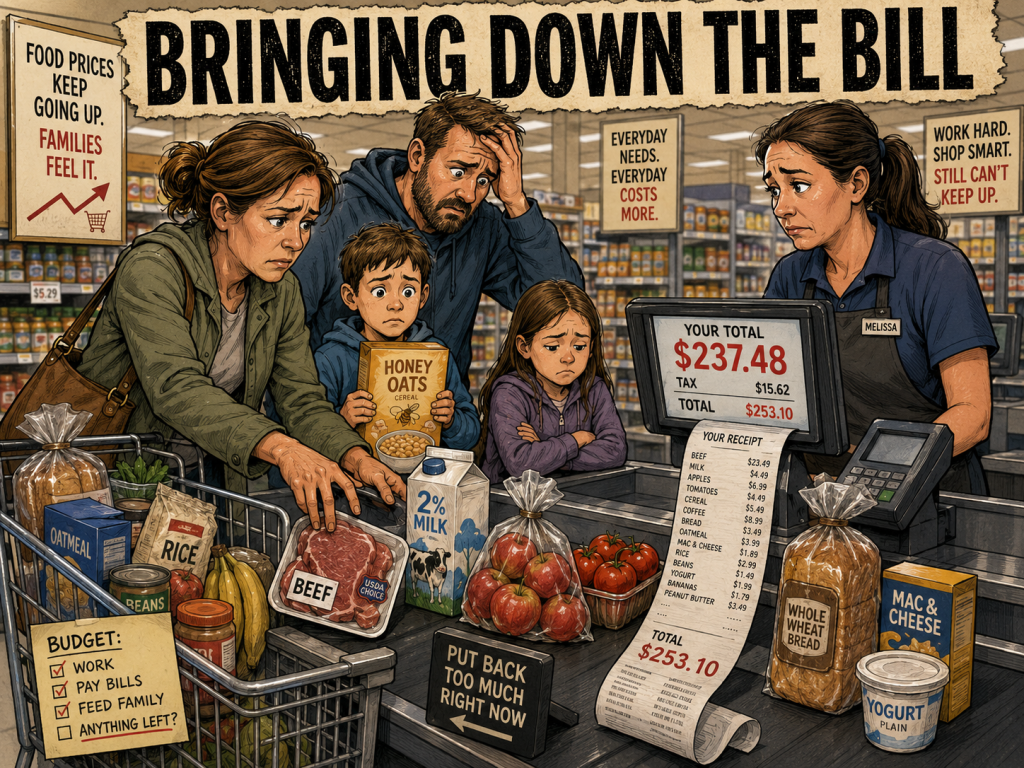
More than a year and a half later, we can check the receipt.
And it did not go down.
According to the Bureau of Labor Statistics, food prices rose 3.1% during 2025. During the first seven months of 2026, they continued rising. Compounding the BLS monthly figures puts the increase in overall food prices since the end of 2024 at roughly 4.8%.
Four-point-eight percent does not sound frightening.
So let’s translate it into English.
The Bureau of Labor Statistics’ Consumer Expenditure Survey shows that in 2024 an average married couple with children spent $15,191 a year on food — groceries plus restaurant meals, takeout and delivery. That is about $292 a week, close enough to the $300-a-week food budget many families would recognize. BLS publishes those figures in its annual consumer-unit composition tables.
If that family bought essentially the same amount and mix of food today, a 4.8% increase adds approximately:
$723 a year.
That is the number I would put on the refrigerator.
Not 4.8%.
$723.
That is roughly $60 every month disappearing from a family budget merely to eat the same food it was eating before Trump returned to office.
And averages hide some much uglier numbers.
Let’s Go Shopping
Start at the meat counter.
During Trump’s first year back in office, the BLS says the price index for beef and veal jumped 16.4%. Ground beef rose 15.5%, beef roasts 17.5%, and steaks 17.8% during 2025.
The increases did not disappear.
As of July 2026, compared with just one year earlier:
Beef and veal: up 9.4%
Ground beef: up 9.0%
Beef roasts: up 13.5%
Steaks: up 9.6%
Those percentages translate into prices people can actually see.
The average retail price of ordinary 100% ground beef reached about $6.89 a pound in July. Choice boneless chuck roast was around $9.63 a pound, and Choice round roast about $9.16.
Hamburger meat is starting to look like steak.
Unfortunately, steak is starting to look like a car payment.
Now walk over to coffee.
Coffee prices soared 19.8% during 2025. Instant coffee rose an astonishing 28%.
And as of July 2026, coffee was still 10.3% more expensive than a year earlier, while instant coffee was up 15.8%.
So breakfast is not safe either.
Milk was up 5.1% over the latest year, with whole milk up 6%. Apples were up 11.1%. Tomatoes were up 12.8%. Fresh vegetables as a group were up 6.3%. Fish and seafood were up 7%.
Even candy was up nearly 10%.
Apparently inflation has reached Halloween.
What About McDonald’s?
Families do not eat every meal at the kitchen table.
Sometimes Mom or Dad works late. Sometimes the kids want hamburgers. Sometimes everybody is tired, and somebody goes through a drive-through.
BLS counts that separately as food away from home.
Those prices are still going up too.
Through July, restaurant food was 3.4% more expensive than a year earlier. Full-service restaurant meals were up 3.4%, and limited-service meals — the category that includes fast-food restaurants — were up 3.3%.
So whether you cook the hamburger yourself or ask somebody at McDonald’s to cook it for you, the family food budget keeps getting squeezed.
Yes, Some Prices Have Fallen
There is good news, and we should say so.
Egg prices have fallen dramatically from their bird-flu-driven peak. By July they were 25.7% lower than a year earlier. Chicken prices were down. Cheese was down. Butter was down substantially.
Trump has repeatedly pointed to falling egg prices as evidence that his policies are working.
Fair enough.
If eggs go down, he gets to say eggs went down.
But Americans do not live on eggs.
They buy meat, milk, vegetables, fruit, coffee, bread, and cereal. They occasionally take their children out to eat. The number that matters at the end of the month is not whether one item dropped from an extraordinary temporary high.
It is the total food bill.
And the total food bill is higher.
The Promise Matters
Presidents do not personally set the price of hamburger meat.
Drought affects cattle herds. Disease affects chickens. Weather affects vegetables. Coffee grows in countries whose crops can be damaged by drought and extreme weather. Labor costs, transportation, tariffs, processing, corporate decisions, and worldwide supply and demand all contribute.
So I am not arguing that Donald Trump personally added every penny to your grocery receipt.
That would be foolish.
I am making a simpler argument.
He made the promise.
During the campaign, Trump told voters he would get grocery prices down. On Inauguration Day he again promised that his administration would “bring prices down.”
Voters were entitled to believe him.
In fact, food prices mattered enormously in the 2024 election. AP VoteCast found roughly seven in ten voters were very concerned about food and grocery costs, and Trump won about six in ten voters who described themselves as very concerned about those prices.
The grocery bill helped elect him.
That makes the grocery bill a perfectly fair way to judge him.
Look at the Receipt
Washington loves percentages.
Politicians talk about inflation rates declining. Economists explain that inflation slowing does not mean prices are falling. Presidents choose whichever statistic makes them look best.
Families have a simpler accounting system.
They look at what is left in the checking account.
For an average married couple with children spending roughly $15,000 a year feeding the family, today’s food prices translate into approximately $700-plus more each year to purchase the same food.
That is almost two extra weeks of groceries.
It is a utility bill.
It is several tanks of gasoline.
It is school clothes.
It is money you can’t spend twice.
And some of the foods Americans notice most have climbed far faster than the overall average.
Beef.
Coffee.
Apples.
Tomatoes.
Restaurant meals.
Trump once understood exactly why groceries were politically powerful.
He used the word constantly during the campaign because almost every American buys groceries.
He was right.
So perhaps we should keep using his word.
Groceries.
He promised their prices would come down.
The receipt says otherwise.