
I had wondered about salt domes before, but apparently not enough to actually investigate them. Then I discovered Santiago, and one question led to another. How do we store hundreds of millions of barrels of America’s emergency oil underground? Are those enormous caverns natural? Why don’t they collapse? And when we pump the oil out, what keeps the hole from becoming an enormous empty space under Texas and Louisiana?
The first surprise was the simplest. The salt domes are natural. The caverns are not. We make them.
A salt dome is a huge mass of salt buried deep underground. Millions of years ago, ancient seas evaporated and left thick layers of salt behind. Later, other rock and sediment piled on top. Because salt behaves strangely under tremendous pressure, it can slowly push upward through the surrounding rock, producing a large underground formation called a salt dome.
Along the Gulf Coast, particularly in Texas and Louisiana, there are plenty of them. That geology eventually gave engineers an idea: instead of building gigantic steel tanks above ground to store America’s emergency supply of crude oil, why not put the oil underground inside the salt?
There was only one problem. There wasn’t necessarily a giant empty room waiting for us.
So we made one.
Engineers drill a well thousands of feet down into the salt and pump fresh water into it. Salt dissolves in water, just like salt disappears when you stir it into a glass in your kitchen. The increasingly salty water, called brine, is pumped back to the surface while more fresh water is sent down.
Keep doing that long enough, and you literally wash a cavern out of solid salt.
These are not little caves. The Strategic Petroleum Reserve has dozens of these man-made caverns at sites in Texas and Louisiana. A typical cavern can hold millions of barrels of oil and may be hundreds of feet across and well over a thousand feet tall. Some are so large that a skyscraper could fit inside one.
That raised my next question: why in hell doesn’t it collapse?
The answer is another unusual property of salt. Deep underground, under enormous pressure, salt doesn’t behave exactly like the hard chunk sitting in your saltshaker. Over long periods, it behaves somewhat like extremely stiff putty. It can slowly bend and move instead of simply shattering, and small cracks can gradually close themselves.
Salt also does a very good job of keeping oil from escaping. That combination—strong, nearly impermeable, and able to slowly seal small fractures—is what makes underground salt formations unusually good storage containers.
But engineers don’t simply create a gigantic cavern, pump oil into it, and leave a big air bubble underneath. That was the part that surprised me most.
Oil floats on water.
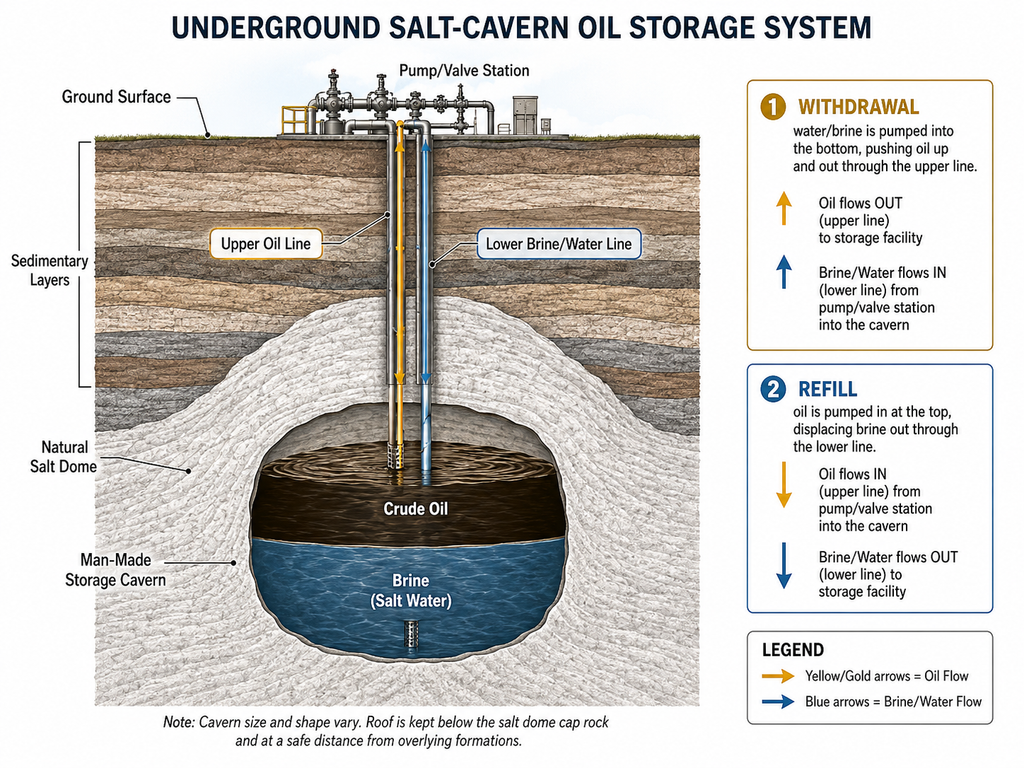
Inside the cavern, the crude oil sits above salty water, or brine. There are pipes reaching different levels of the cavern. When the government wants to remove the oil, water is pumped toward the bottom. The heavier water stays beneath the oil and begins raising the oil level.
As more water goes in, the oil is pushed upward and out through another pipe. There is no need for some gigantic pump sitting at the bottom of a cavern sucking millions of barrels of crude upward. Water does most of the work.
Think of a glass containing oil floating on water. Stick a straw down to the bottom and start adding water. Eventually the oil at the top has nowhere to go except out.
Then I wondered what happens when they refill the reserve.
They reverse the process. Oil is pumped back into the cavern, where it floats above the brine. As more oil enters, it pushes the brine downward, and the displaced brine is forced back up through another pipe. Depending on the facility, that brine can be stored, reused, or handled through approved disposal systems.
So the cavern normally doesn’t become a gigantic empty hole when we sell the oil. One liquid replaces another.
That doesn’t mean these caverns last forever. Salt is slowly moving all the time. The enormous weight of the earth above causes the walls of the cavern to creep inward very slowly, gradually reducing the amount the cavern can hold.
Taking oil out can also change the cavern. Fresh water used during the withdrawal process dissolves additional salt. Over many cycles of filling and emptying, the shape of a cavern can change. Engineers have to watch for thinning walls, changes in the roof, connections developing between neighboring caverns, and other problems.
And, yes, a salt cavern can fail.
That does not mean America’s Strategic Petroleum Reserve is sitting on top of dozens of holes about to swallow Texas and Louisiana. These caverns are heavily monitored, and engineers control their pressure and continually study their shape and condition. But salt-cavern failures and sinkholes have occurred elsewhere, so the danger is real enough that nobody simply pumps in the oil, locks the gate, and comes back twenty years later.
The Strategic Petroleum Reserve itself grew out of the 1973–74 Arab oil embargo, when Americans suddenly discovered what could happen when foreign suppliers turned off the faucet. Congress created the reserve in 1975, and the first oil went underground in 1977. The Gulf Coast was an obvious place to put it because the region already had salt formations, oil pipelines, refineries, and decades of experience handling petroleum.
And that brings us back to the salt.
Somewhere beneath Texas and Louisiana are enormous chambers that human beings created by pumping water into formations left behind by ancient seas. We dissolved the salt, pumped out the brine, filled the resulting holes with crude oil, and figured out how to use water to push that oil back to the surface whenever we need it.
It sounds complicated until somebody explains it.
Nature made the salt dome. We made the hole.
_____________
In case you are wondering how they get the water to raise all that oil thousands of feet back to the surface, the answer is simpler than it sounds. The oil line is open through controlled valves while water is pumped into the bottom of the cavern. They are not trying to pressurize a sealed underground bottle. As the heavier water enters underneath the oil, it takes up more and more space and forces the lighter oil upward and into the outlet pipe.
The great depth actually helps. Thousands of feet of water in the injection pipe create tremendous pressure at the bottom simply from the weight of the water itself. The pumps keep the water moving and overcome resistance in the system, while the open oil line gives the displaced oil somewhere to go. In effect, the water going down helps push the oil coming up.