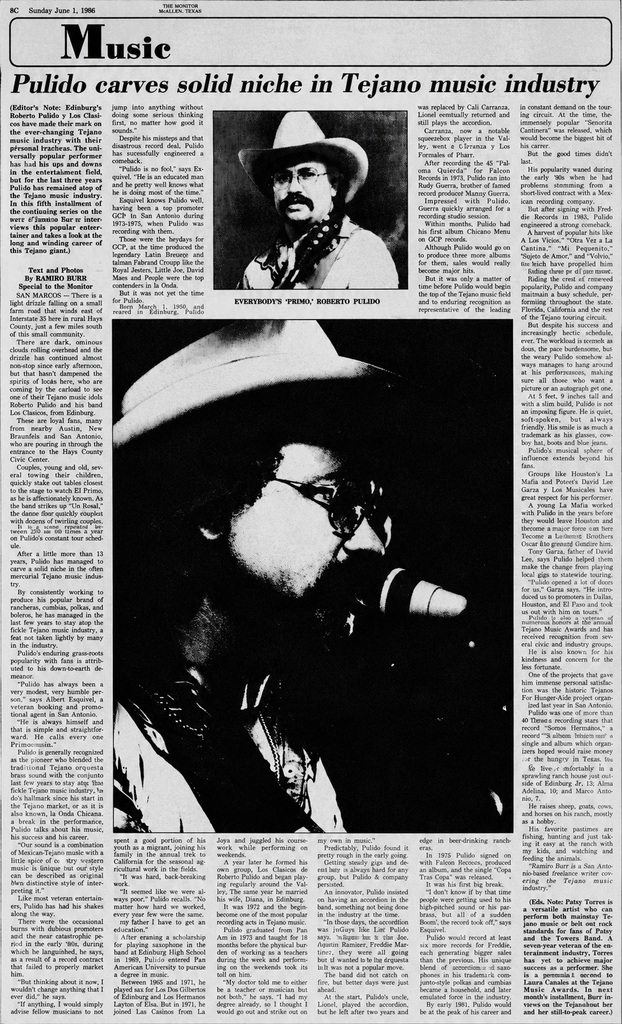
Before Bobby Pulido became a star, his father Roberto was El Primo to Tejano audiences across South Texas. He called people primo—cousin—and they called him that in return. For many of us who grew up in Corpus Christi, the Valley, and San Antonio, his music was part of the sound of home.
In a June 1, 1986, profile for The Monitor, Ramiro Burr follows Roberto Pulido to a show near San Marcos. Rain has been falling all afternoon, yet fans arrive by the carload. Young and old couples take tables near the stage, and when Los Clásicos begin playing “Un Rosal,” the dance floor fills.
A Sound of His Own
Burr credits Pulido with bringing together the accordion of conjunto and the brass of the Tejano orquesta. Pulido kept an accordion in his band when other prominent acts had moved away from it. He added his own touch of country western music, creating a sound that audiences came to recognize as his.
His path to the stage began far from any spotlight. Raised in Edinburg, Pulido traveled with his family to California for seasonal fieldwork and remembered the exhausting labor and persistent poverty. A saxophone scholarship took him to Pan American University. He became a music teacher, but teaching during the week and performing on weekends eventually forced him to choose.
El Primo’s Long Road
Pulido formed Los Clásicos in 1972, and “Copa Tras Copa” gave him a breakthrough in 1975. “Señorita Cantinera” became the biggest hit of his career. After a difficult stretch in the early 1980s, he signed with Freddie Records in 1983 and returned with another run of popular songs.
By the time Burr interviewed him, Pulido was performing 250 to 300 times a year. He still stayed after shows so fans could get a photograph or autograph. Fellow musicians described a man who helped younger groups reach promoters and audiences beyond their hometowns.
The article also names the children waiting at home with Roberto and his wife, Diana. One was 13-year-old José Roberto “Bobby” Pulido Jr. Bobby’s story would come later; in this one, the star on the stage was his father, El Primo.
Source: Ramiro Burr, “Pulido carves solid niche in Tejano music industry,” The Monitor, June 1, 1986
.