
Must a Brilliant Woman Come With a Bottle of Pills?
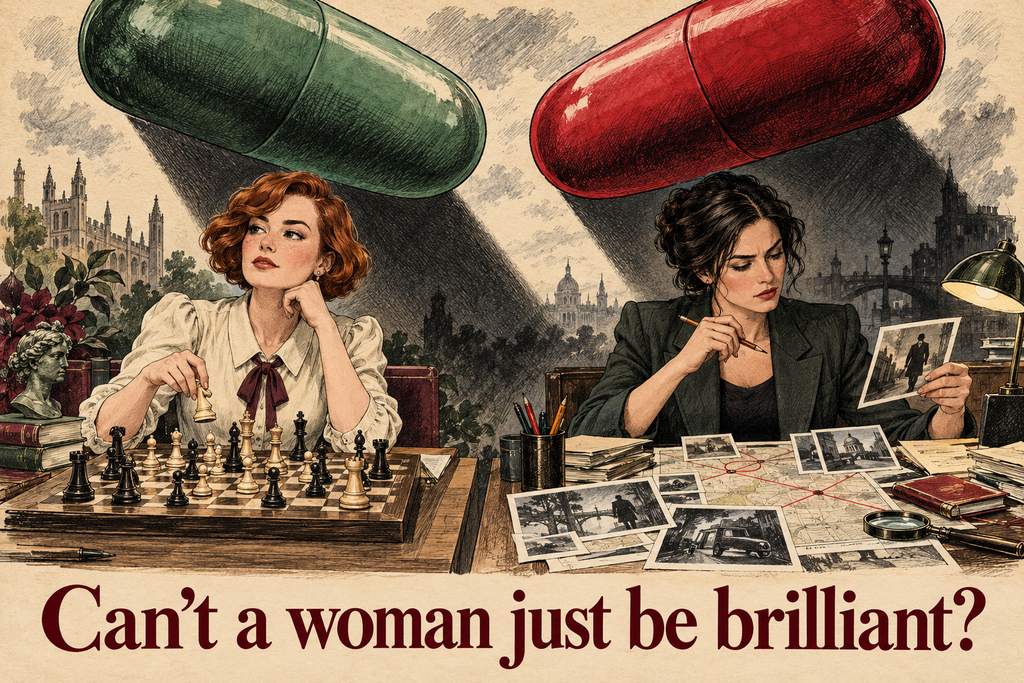
I was watching Red Queen when those big red pills caught my attention. Antonia Scott has an extraordinary mind, but the story makes that mind a source of torment as well as talent. It reminded me of Beth Harmon in The Queen’s Gambit: another brilliant woman, another story in which pills become difficult to separate from the picture of her intelligence.
Beth’s pills are green, so my complaint is not really about the color. It is about the association. Give us a woman who can outthink nearly everyone around her, and apparently we also need to watch her struggle to survive inside her own head.
Even the descriptions supplied by the people selling these shows lean into that idea. Prime Video describes Antonia’s intelligence as both a virtue and a curse. Netflix introduces Beth’s story through the cost of genius, addiction, and obsession. The women’s brilliance is the attraction, but their suffering is part of the sales pitch. Season 1
Now, I am not going to pretend that fictional men are never troubled, addicted, or unstable. That would be an easy argument to knock down. Two television series do not establish that every writer treats women this way, either. But they gave this viewer a reason to ask why extraordinary intelligence so often arrives with a warning label.
A woman can be intelligent without her intelligence being an illness. She can be competitive without being emotionally broken. And when she does suffer, we ought to pay attention to what happened to her rather than assume that being exceptionally smart explains everything.
Beth, for example, is given tranquilizers as a child in an orphanage. The institution introduces the drugs; her talent does not prescribe them. That distinction matters. Her eventual ability to compete without them also challenges the idea that the pills are the source of her brilliance. Netflix Media Center
In the second-season finale of Red Queen, I heard the phrase “queen’s gambit” during a plan to use an assassin as bait, drawing attackers into a position where scarce bullets could count. That is a connection in the language of strategy, not proof that the two shows share a message. But it brought Beth back to mind.
I enjoy watching women take command of stories that once would almost automatically have belonged to men. I just want writers to give them the full range of possibilities—including the possibility of being brilliant without making brilliance itself the problem.
And if defending a woman’s right to be smarter than the men around her makes Meme a defender of women, I can live with that. I would rather watch her put the men in their place than swallow another pill to make her own mind bearable.