Why Crime Suddenly Becomes an Election-Year Emergency
By Manuel Barrera — Opinion
An election approaches, and suddenly crime is presented as the emergency that should determine our vote. The advertisements get darker, the accusations get louder, and candidates compete to convince us that their opponents are putting our families in danger.
Crime matters every day to the people who experience it. What deserves examination is why political attention becomes so intense when votes are available, and whether that urgency produces anything lasting after Election Day.
Fear is useful in a campaign
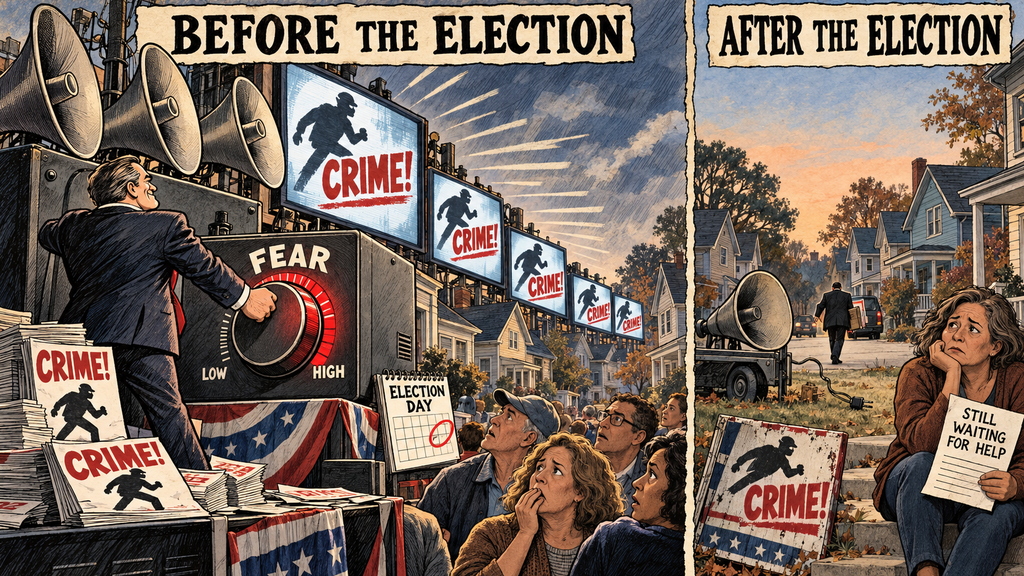
Almost everyone wants less crime and safer neighborhoods. Candidates therefore compete over who deserves the public’s trust to deliver those things. Calling an opponent soft on crime offers a simple emotional message that fits neatly into a television commercial.
A challenger also benefits from steering the discussion toward an issue that puts an incumbent on defense. A single horrific incident can become the centerpiece of that argument, even though determining responsibility requires examining several institutions and decisions.
There is evidence that Republicans have benefited from this strategy. Political scientist Ethan D. Boldt’s study of congressional elections from 1974 through 2008 found that greater prominence of crime brought electoral advantages to Republican candidates, who increased those gains by adapting their messages when concern was high. Ethan D. Boldt, 2019
That helps explain the incentive to keep crime in front of voters. It does not establish whether a particular candidate’s proposed solution will make anyone safer.
Repetition changes what feels urgent
A frightening incident can appear in a campaign commercial, a news report, a candidate’s speech, and a social media post. Seeing the same case repeatedly can make it feel like evidence of an epidemic. The audience may encounter many messages without encountering many different incidents.
Research on the 2016 election found that greater estimated exposure to crime-related campaign advertising was associated with greater worry about crime, even after researchers accounted for local crime rates and other factors. The relationship appeared among Republicans, but not Democrats. journals.sagepub.com
That finding matters because public anxiety can move separately from neighborhood conditions. Campaigns can respond to fear while also helping to amplify it.
The discussion can then reinforce itself. Candidates emphasize crime, news outlets cover the argument, and campaigns interpret public concern as a reason for more crime advertising. My reading is that this cycle rewards the ability to command attention, which is different from demonstrating that a policy works.
A vivid story can outweigh a careful comparison
People remember a family’s suffering, a violent video, or a disturbing account of an attack. A chart comparing several years of crime rates asks more of the audience. That difference gives emotionally powerful examples an advantage in a short campaign message.
Those examples can describe real tragedies and still leave an incomplete picture. An incident does not establish a citywide trend, and a citywide trend does not describe every neighborhood. Sound judgment requires looking at the relevant offense, place, time period, and available evidence.
We should also avoid claiming that Americans always think crime is increasing. Gallup reported in October 2025 that fewer than half believed national crime had risen over the preceding year. Public perceptions can change, and political attitudes are part of that picture. news.gallup.com
Crime is a legitimate election issue
Prosecutors, sheriffs, judges, mayors, and legislators make consequential decisions about public safety. Voters should examine their records. An election is an appropriate time to demand answers about investigations, court delays, police practices, prevention, and support for victims.
But candidates should explain what their office actually controls and how their proposed changes would help. Blaming every offense on one official avoids the harder work of showing which decisions contributed to a problem and which changes could address it.
Nor does crime literally become the number-one issue in every election. Gallup’s 2024 presidential-election polling placed the economy first. An issue can dominate a campaign’s advertising without ranking first among voters’ concerns. news.gallup.com
The test comes after the election
As campaign advertising winds down, the people living with crime remain. A family still needs an investigation completed. A neighborhood still needs effective prevention, and a victim still needs help navigating the justice system.
I want candidates judged by whether they sustain that commitment when there is no immediate electoral reward. Their budgets, staffing decisions, follow-through, and results tell us more than the volume of their campaign accusations.
We should expect year-round attention to public safety. The politicians asking us to vote out of fear should explain what they accomplished before the campaign began—and remain accountable after it ends.