Trump’s Hispanic Voters Didn’t Sign a Lifetime Contract
Republicans are making a dangerous mistake if they think Hispanics who voted for Donald Trump in 2024 signed a lifetime contract with the Republican Party. Voting for Trump did not necessarily mean voting for every Republican beneath him on the ballot. It certainly did not mean promising to support Republicans regardless of what happened afterward.
Trump won an estimated 55% of Texas’s Hispanic vote in 2024, according to exit polling discussed by the University of Texas’s Texas Politics Project. But ABC’s Senate exit-poll table puts Ted Cruz’s Hispanic support at 50%, with Colin Allred receiving 47%. That difference should have warned Republicans against treating Trump’s personal support as a permanent party possession.
Now there is evidence that some of those voters are reconsidering. A Pew Research Center survey, conducted September 28–October 4, found that 65% of Hispanic Trump voters nationally supported their Republican House candidate. Eleven percent supported the Democrat, 14% preferred another candidate, and 10% were undecided. That leaves 35% outside the Republican column at the time of the survey—although it would be inaccurate to call all of them Democratic converts.
Texas has its own warning signs. In Univision/YouGov’s October survey, 31% of Latino Trump voters expressed some doubts, serious doubts, or regret about their presidential vote. Among that dissatisfied group, approximately 44% supported James Talarico and 34% supported Gina Hinojosa. Across Latino respondents overall, Talarico led Ken Paxton 55%–37%, while Hinojosa led Greg Abbott 52%–43%. Those are polling estimates, but they hardly describe a Hispanic electorate locked into Republican loyalty.
Higher turnout could compound Republican defections. For the arithmetic, suppose Hispanic participation finishes 35% higher than the comparison election (Present numbers indicate that is already happening). I am treating that as a scenario, not an independently established final turnout figure. The important questions are who those additional voters support and how many previous Republican voters change sides.
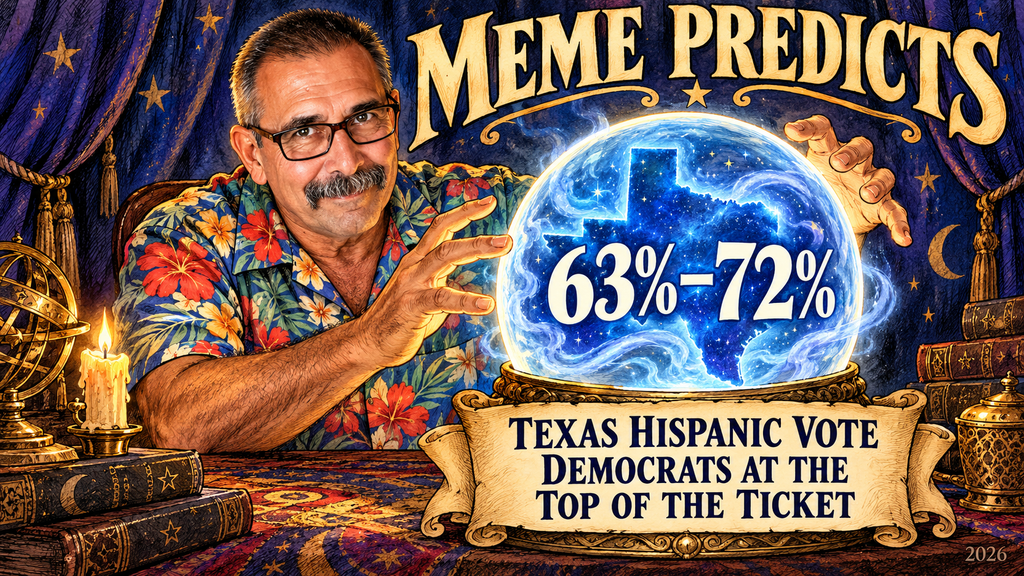
Start with 100 voters: approximately 45 for Harris and 55 for Trump. Add 35 voters, all Democratic under our deliberately strong assumption, and Democrats have 80 of 135 votes—59.3%. If 11% of the original Trump voters also switch Democratic, the Democratic share rises to approximately 63.7%. A 30% crossover would produce approximately 71.5%, but the evidence we examined does not establish that much Democratic crossover.
My prediction is that Democrats regain a clear majority of Texas’s Hispanic vote at the top of the ticket, with Talarico particularly well positioned. My judgment is that dissatisfaction will bring some previous Trump voters across and motivate others who previously stayed home. I would put more faith in that combination than in the Republican assumption that 2024 settled Hispanic political loyalties.
That alone does not settle the statewide election. White voters, Black voters, Asian voters, rural communities, suburban families, and turnout across the entire state still determine the result together. But Republicans cannot comfortably defend close races while assuming every Hispanic voter Trump attracted will return for Abbott, Paxton, or the rest of their ticket.
While in law school, I wore a T-shirt that said, “If you can’t dazzle them with your brilliance, baffle them with your bull.” Santiago has now supplied the research and arithmetic, and I have supplied the prediction. If we are right, remember that Meme saw it coming. If we are wrong, that pendejo Santiago has some explaining to do. I use OpenAI for assistance; it can run through numbers in minutes what used to take me hours.