John Whitmire can say we are not working with ICE, but they are. I do have a question: if those ICE warrants have a common name, how in the hell do the police know if it is the same person? For instance, if there is a Jose Garcia, Jose being the most common first name and Garcia being the most common surname.
Below is advice for undocumented people. I want to add something to that.
If you are undocumented, you have the right to remain silent and do not have to discuss your immigration or citizenship status with the police, immigration agents, or other officials. Anything you tell an officer can later be used against you in immigration court.
Why would someone who is undocumented want to bring attention to themselves? Think about it before you call the police; chances are, they will ask for your name and run it through their database, which includes ICE warrants. Don’t hear anything, don’t say anything, don’t see anything. Let the citizens who were born here do the calling if a call needs to be made.
ICE Warrants:
- What is ICE’s new policy on detainers and warrants?
In March 2017, Immigration and Customs Enforcement (ICE) issued a new policy regarding immigration detainers and
administrative immigration warrants, or “ICE warrants.”
This policy directs that all ICE detainers shall be accompanied by immigration warrants (“ICE warrants”) signed by an
authorized ICE officer. The new policy is available at https://www.ice.gov/detainer-policy.- What is an ICE warrant?
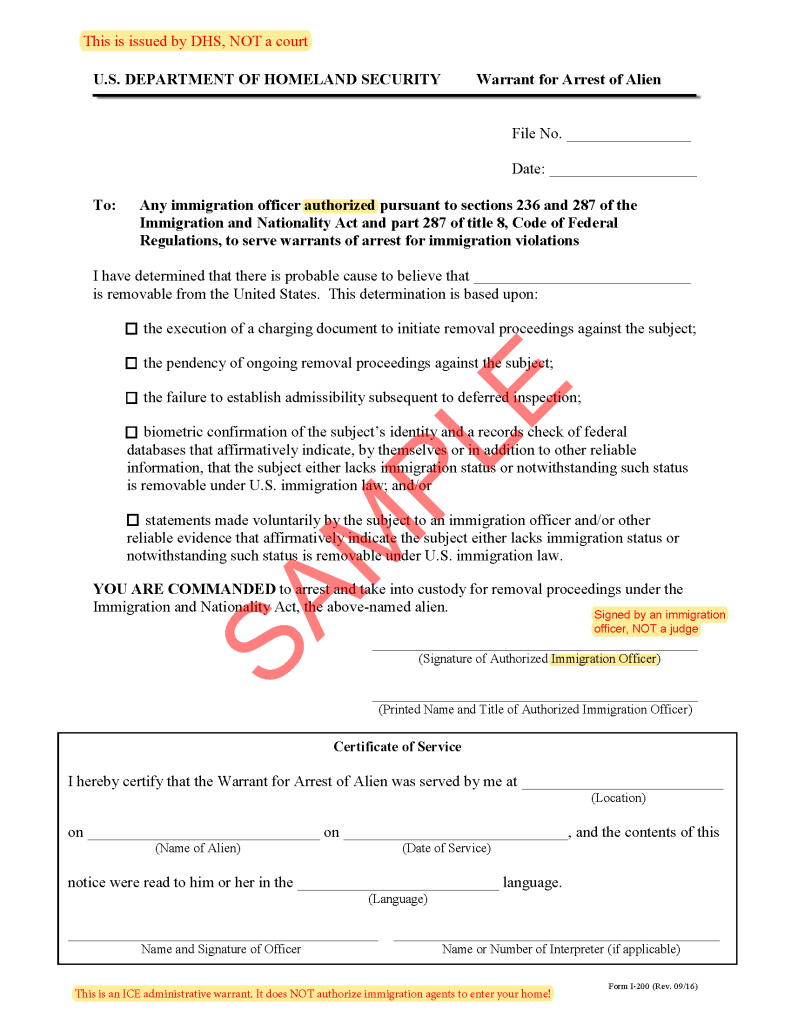
An “ICE warrant” is a form issued by certain immigration officers that names an allegedly deportable non-citizen and
directs various federal immigration enforcement agents to arrest that individual. For an annotated ICE warrant, see:
https://www.ilrc.org/annotated-ice-administrative-warrants-2017.
ICE warrants are issued for civil violations of immigration law, not criminal charges. They are also sometimes called
“administrative warrants.”
An “ICE warrant” is not a real warrant. It is not reviewed by a judge or any neutral party to determine if it is based on
probable cause.
For more analysis of the legal authority of ICE warrants, see: https://www.ilrc.org/legal-analysis-ice-warrants.- What does an ICE warrant do?
An ICE warrant directs various federal immigration enforcement agents to arrest the person named in the warrant.
Because it is not issued by a judge, an ICE warrant does not give the immigration enforcement officer the authority to
demand entry to a home or private space in order to make the arrest.
ICE warrants do not generally provide a basis for a local or state law enforcement officer or agency (LEA) to arrest or
detain anyone. Federal regulations allow a specific list of federal immigration agents to execute administrative
immigration arrest warrants. See: https://www.ilrc.org/annotated-ice-administrative-warrants-2017.- How is an ICE warrant different from an ICE detainer?
An ICE warrant is directed only at authorized DHS officials, while an ICE detainer is a request directed to other law
enforcement agencies. For an annotated ICE detainer, see: https://www.ilrc.org/annotated-detainer-form-2017.
Both an ICE detainer and an ICE warrant are issued based on alleged civil immigration violations and do not provide
probable cause of a crime. Neither document meets Fourth Amendment requirements for arrest or provides authority
for local law enforcement to arrest or detain someone. The combination of both documents together does not add any
new requirements for local agencies. For more analysis of the legal authority of ICE warrants and detainers, see:
https://www.ilrc.org/legal-analysis-ice-warrants.- Are the ICE warrants that come with detainers the same as those ICE brings on a
home raid or other enforcement action?
Yes. Although administrative immigration warrants (another term for ICE warrants) do not provide enforcement authority
beyond what ICE already possesses, they may sometimes issue an ICE warrant before making arrests at homes or in the
street. Because these “warrants” are issued by ICE officers, not a judge, they do not give ICE authority to enter private
spaces without consent.- Source