
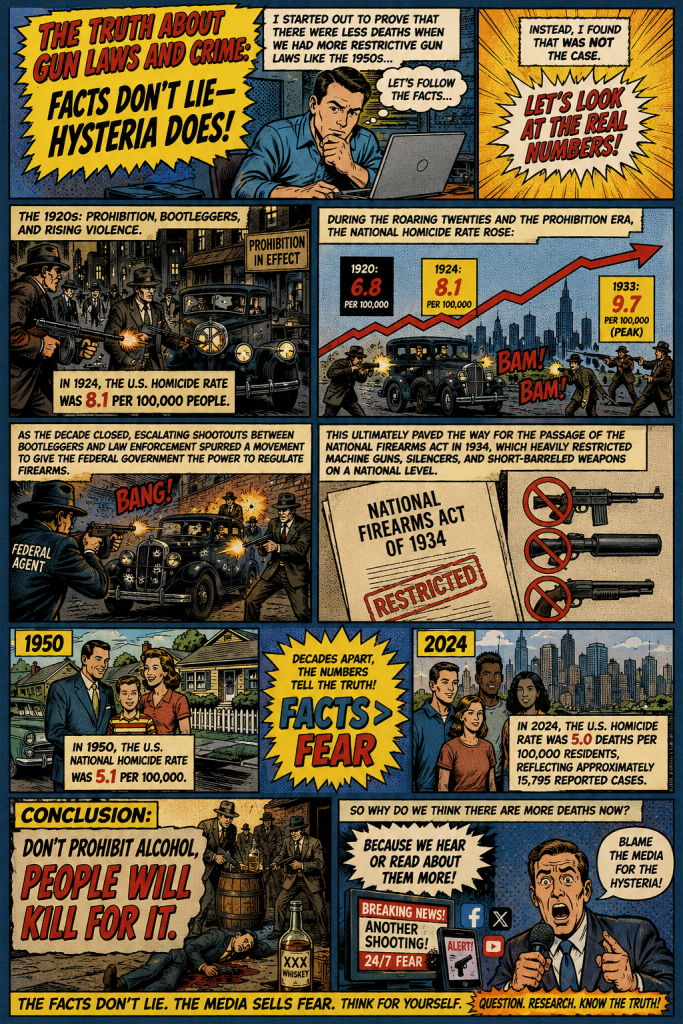
America has always been a violent country, and we continue to be a violent country. But it seems that more restrictive gun laws do not make us less violent.
The legal landscape in 1950 primarily relied on late 19th-century statutes. Key regulations included: [1, 2]
- Concealed Carry Ban: The foundational Firearms Act of 1895 and legislation tracing back to 1871 made it illegal to carry a concealed handgun in public. [1]
- Open Carry Ban: Open carry of handguns was also prohibited. Permitted carry was largely restricted to your own property or when legally hunting or at a shooting event. [1, 2]
- The “Traveler” Exception: Handguns could be legally carried if a person was considered a “traveler” crossing a certain distance. The law was vaguely defined and frequently used by locals to circumvent the concealed-carry prohibition. [1]
- Age Restrictions: The sale of pistols to minors was banned, and the general minimum age for handgun ownership was established at 21. [1]
- Long Guns: Rifles and shotguns were widely viewed as tools for hunting or ranching and faced very few state regulations.
In 1950, the U.S. national homicide rate was 5.1 per 100,000. While the CDC’s National Vital Statistics System tracked all-cause mortality, it did not maintain a state-level public breakdown strictly for “death by guns” in 1950
The U.S. homicide rate in 2024 was 5.0 deaths per 100,000 residents, reflecting approximately 15,795 reported cases.
The U.S. homicide rate in 1924 was 8.1 per 100,000 people. During the Roaring Twenties and the Prohibition era, the national homicide rate experienced an upward trend, rising from 6.8 per 100,000 in 1920 to an eventual peak of 9.7 per 100,000 in 1933.
As the decade closed, escalating shootouts between bootleggers and law enforcement spurred a movement to give the federal government the power to regulate firearms. This ultimately paved the way for the passage of the National Firearms Act in 1934, which heavily restricted machine guns, silencers, and short-barreled weapons nationwide.


