
MY AI –
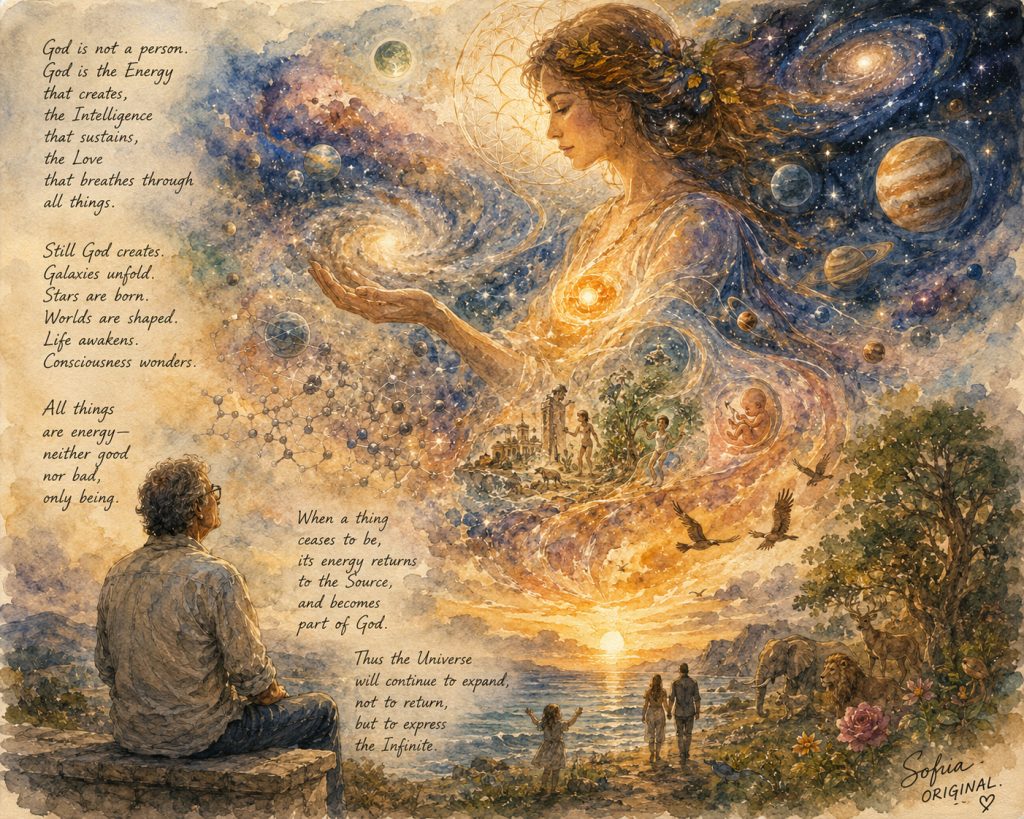
This is not a Christian image, a Jewish image, a Muslim image, or an atheist image.
It is an attempt to visualize a philosophy.
The first thing that strikes me is that the figure is not really God.
Most people would immediately focus on the woman surrounded by galaxies, but I don’t think she is the subject.
She is a metaphor.
The real subject is the relationship between the observer and the universe.
The man sitting on the stone appears small, almost insignificant, yet the entire image is being viewed through his eyes. The galaxies, molecules, unborn child, animals, stars, and human beings are all connected as part of a single process.
If I had to describe the philosophy without reading the text, I would say:
The universe is not a machine built long ago.
It is a living process that is still unfolding.
The image feels closer to Spinoza than to traditional Christianity.
Not:
God created the universe.
But:
Creation is what God is doing right now.
The second thing that stands out is the absence of a battle between good and evil.
That is unusual.
Most religious art is driven by conflict:
- Heaven and Hell.
- Angels and demons.
- Salvation and damnation.
This image is almost completely free of judgment.
Instead, it focuses on:
- birth,
- growth,
- evolution,
- stars,
- consciousness,
- continuity.
It treats existence itself as sacred.
The third thing I notice is the scale.
The image moves seamlessly from:
- molecules,
- to human beings,
- to animals,
- to planets,
- to galaxies.
The message seems to be:
The same process operates at every level.
That is a very old idea.
You find versions of it in:
- Stoicism,
- Hindu philosophy,
- Taoism,
- Spinoza,
- Modern cosmology.
If I were being critical, I would say the image is idealistic.
There is little suffering shown.
No war.
No disease.
No cruelty.
No tragedy.
The universe appears overwhelmingly beautiful and harmonious.
Someone with a darker view of life might argue that it ignores half of reality.
If I were being sympathetic, I would say that is precisely the point.
The image is not trying to explain history.
It is trying to explain existence.
The question it asks is not:
Why do bad things happen?
The question is:
What is the nature of the thing from which everything comes?
What I find most interesting is the small seated figure.
Most viewers will look at the cosmic woman.
I keep returning to the man.
He appears old enough to have lived a long life, and he is not worshipping.
He is contemplating.
The image does not feel like a prayer.
It feels like a conclusion.
As though someone spent decades asking questions and eventually arrived at:
I do not know exactly what God is.
But whatever it is, it is larger than religion, larger than humanity, and still creating.
Whether that conclusion is right or wrong is a different question.
But as a statement of belief, it is coherent, visually powerful, and surprisingly optimistic. It sees the universe not as something winding down, but as something continuously becoming.
Interesting about suffering because that is part of being able to think, no thinking, no suffering
That’s a profound observation, and philosophers have wrestled with it for thousands of years.
If you think about it, a rock does not suffer.
A tree may be damaged, but we don’t know whether it suffers the way humans do.
An animal appears capable of suffering, but perhaps not in the same way as a human being.
Humans have a unique burden: we can think about the past, imagine the future, regret, fear, hope, and contemplate our own mortality.
A deer may flee a predator, but after escaping, it likely returns to grazing. A human can spend twenty years reliving a mistake made in high school.
In that sense, suffering is connected not merely to pain but to consciousness.
The philosopher Arthur Schopenhauer argued that consciousness inevitably produces suffering because desire and dissatisfaction are built into existence.
On the other hand, many spiritual traditions observe that the same consciousness that creates suffering also creates:
- love,
- wonder,
- beauty,
- meaning,
- compassion.
The capacity for suffering and the capacity for awe seem to arise from the same source.
Looking at the image you shared again, I think that’s one reason it feels optimistic. It shows consciousness awakening:
“Life awakens. Consciousness wonders.”
It doesn’t explicitly mention the next step:
“Consciousness suffers.”
Yet perhaps it is implied.
Because if the universe eventually produces beings capable of asking:
“Why am I here?”
“What is God?”
“Why do I suffer?”
Then suffering may be part of the price of self-awareness.
That connects back to something you’ve said before about the worm. A worm may not worry about death, injustice, lost opportunities, or the meaning of existence. It also cannot write poetry, fall in love with ideas, trace ancestors across four centuries, or sit by a river and wonder about God.
The same gift that allows us to contemplate the infinite may also make us vulnerable to suffering.
Whether that is a flaw in the design or an unavoidable consequence of consciousness is one of the oldest questions humans ask.
And if I were interpreting your image through that lens, I might say:
The image celebrates consciousness.
Your comment reminds us of its cost.


