
Screwworm science offers an accidental lesson about the fraud of American eugenics.
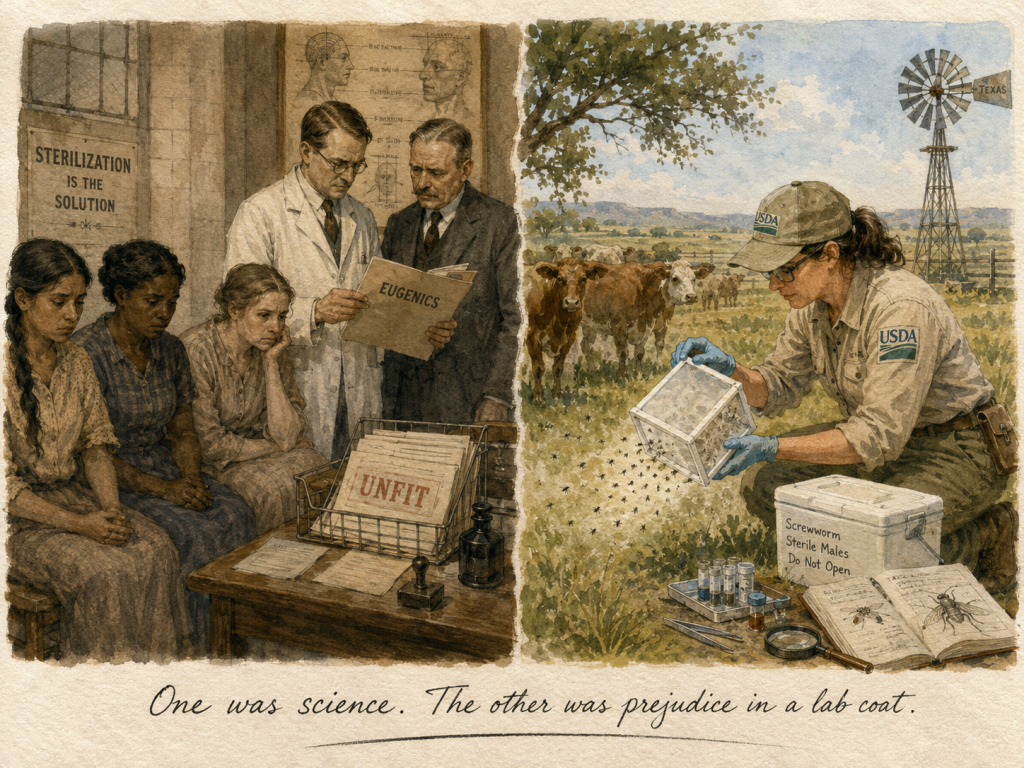
There is a strange lesson hiding inside the return of the New World screwworm to Texas.
The United States knows how to defeat this parasite. Scientists raise enormous numbers of screwworm flies, sterilize the males with radiation, and release them into areas where wild flies are reproducing. A female screwworm normally mates only once. If she mates with a sterile male, her eggs do not hatch. Repeat that process often enough, and the population collapses. The same technique helped eradicate screwworm from the United States decades ago. (APHIS)
It is clever science.
And while reading about it, an uncomfortable thought occurred to me.
America once had another program devoted to sterilization. But the targets were not flies.
They were people.
They Called It Science
The word was eugenics.
Its supporters claimed they could improve the human population by controlling who was permitted to reproduce. They classified people as fit or unfit and treated complicated human qualities such as intelligence, poverty, behavior and disability as though they could be traced through families by simple rules of inheritance.
They were wrong.
The National Human Genome Research Institute today describes eugenics as scientifically inaccurate and explicitly connects the American movement to racism, xenophobia, sexism and ableism. Eugenicists borrowed the language and prestige of genetics while making claims genetics did not support. (Genome.gov)
But bad science did not prevent the government from acting on it.
At least 60,000 Americans were involuntarily sterilized under laws enacted in 30 states. The programs disproportionately affected Latinos, Native Americans, African Americans, poor whites, and people with disabilities. Some state programs continued into the 1970s. (Genome.gov)
That is not ancient history.
I was alive.
Many Americans reading this were alive.
The Screwworm Makes the Fraud Easier to See
There is an important warning before carrying the screwworm comparison too far.
Human beings are not insects. Human reproduction, relationships, and societies cannot be reduced to screwworm biology. And the lesson is certainly not that American eugenicists should have sterilized men instead of women.
They should have sterilized neither.
But the comparison exposes something.
When scientists attack screwworm, they begin with the biology. They study how the animal reproduces. They discover that the female normally mates once. They learn that sterile males can interrupt reproduction. Then they design a program around those facts. (APHIS)
American eugenics frequently worked backward.
It began with people whom society already considered undesirable — the poor, the disabled, racial minorities, immigrants and people living in institutions — and then used supposed science to justify controlling them. (Genome.gov)
The prejudice came first.
The science was recruited afterward.
That is why eugenics was not merely cruel.
It was stupid.
It pretended that poverty was hereditary. It treated intelligence as though it could be sorted neatly through family trees. It confused social conditions with genetics and racial prejudice with biology. (Genome.gov)
Racism put on a laboratory coat and demanded to be called science.
Women Paid a Terrible Price
Women became particularly vulnerable because governments, doctors, and institutions had enormous power over their reproductive lives.
California alone sterilized about 20,000 people under its eugenics program. Research using California’s historical records found that Latino men were disproportionately sterilized compared with non-Latino men — but Latina women faced an even greater disproportionate risk compared with non-Latina women. (PubMed)
The victims were not exclusively minorities. Eugenics also consumed poor and disabled white Americans.
One of the most infamous was Carrie Buck.
Virginia authorities classified Buck as “feeble-minded” and ordered her sterilized. In 1927, the United States Supreme Court upheld Virginia’s law in Buck v. Bell. Justice Oliver Wendell Holmes Jr. delivered one of the ugliest sentences ever issued by that Court:
“Three generations of imbeciles are enough.” (Justia Law)
The supposed scientific judgment behind Buck’s sterilization was itself deeply flawed. Later scholarship cited by courts found that neither Carrie Buck nor her daughter Vivian was intellectually disabled as the eugenicists claimed. (Justia Law)
Think about that.
The government took away a woman’s ability to have children permanently.
The Supreme Court approved it.
And the scientific premise used to justify it was wrong.
Black Americans Were Used Differently
The abuse was not confined to sterilization, and it did not fall only on women.
In 1932, the U.S. Public Health Service began what is now called the Untreated Syphilis Study at Tuskegee. It involved 600 Black men in Alabama — 399 who had syphilis and 201 who did not.
The men did not give informed consent. They were told they were being treated for “bad blood.” When penicillin became the treatment of choice for syphilis, the men in the study were not offered it. The experiment continued until 1972. (CDC)
Tuskegee was not a sterilization experiment, and we should not rewrite it as one.
It belongs in this story for another reason.
It demonstrates what can happen when institutions decide that some human beings are suitable subjects for things those institutions would never tolerate being done to people with greater social and political power.
The common denominator was not one particular medical procedure.
It was power.
Science Wasn’t the Problem
There is a temptation when looking at this history to blame science.
That would be a mistake.
The screwworm program demonstrates what real science can accomplish. Researchers identified the reproductive biology of a devastating parasite and developed a technique capable of eliminating it without blanketing the countryside in pesticides. USDA still uses that technique today. (APHIS)
Eugenics was something different.
It took prejudices already present in American society and gave them scientific-sounding names.
The poor became genetically inferior.
Disabled became unfit.
Different became defective.
Brown and Black became problems to be managed.
The federal government’s own genomics institute now calls eugenics a scientifically erroneous theory of racial improvement and says American eugenicists disproportionately targeted Latinos, Native Americans, African Americans, poor whites, and people with disabilities. (Genome.gov)
We do not dishonor science by saying that.
We defend science.
Because science must be willing to discover that what we believed yesterday was wrong.
Ideology cannot do that.
Why Some History Makes Us Uncomfortable
There is a larger reason this history matters now.
Our past has not always been beautiful.
Americans have done extraordinary things. We have also done terrible things.
Both statements can be true.
Teaching a child about forced sterilization does not teach that America is evil. Teaching Tuskegee does not erase everything good the country has accomplished. Teaching slavery, Jim Crow, Indian boarding schools, anti-Mexican violence, or racial segregation is not an attack on America.
It is history.
The danger begins when patriotism requires editing the unpleasant chapters.
Because the uncomfortable chapters are often the ones carrying the warning.
Eugenics shows what happens when society decides that experts may classify some people as less worthy than others.
Tuskegee shows what happens when medical institutions stop seeing the people in front of them as equals.
Buck v. Bell shows what happens when even the highest court in the country accepts prejudice dressed as expertise.
Those are not lessons against America.
They are lessons for Americans.
The Past Is Supposed to Make Us Uncomfortable
There is something almost absurd about the comparison that started me thinking about all this.
Today, when America wants to stop a parasite from reproducing, scientists carefully study its biology, sterilize male flies, and release millions of them.
A century ago, when some Americans wanted to stop certain people from reproducing, they created a pseudoscience that told them the people they already disliked were genetically inferior.
One was science solving a biological problem.
The other was prejudice pretending to be science.
That difference matters.
And perhaps that is why we should resist every effort to turn American history into a collection of beautiful stories.
History is not supposed to make us comfortable.
It is supposed to tell us what happened.
Sometimes it tells us that we were brave.
Sometimes it tells us that we were brilliant.
Sometimes it tells us that we were cruel.
And occasionally, as the history of eugenics demonstrates, it tells us that people who considered themselves superior were not nearly as smart as they thought they were.
Our past has not always been beautiful.
That is not a reason to hide it.
That is the reason we need to remember it.


