
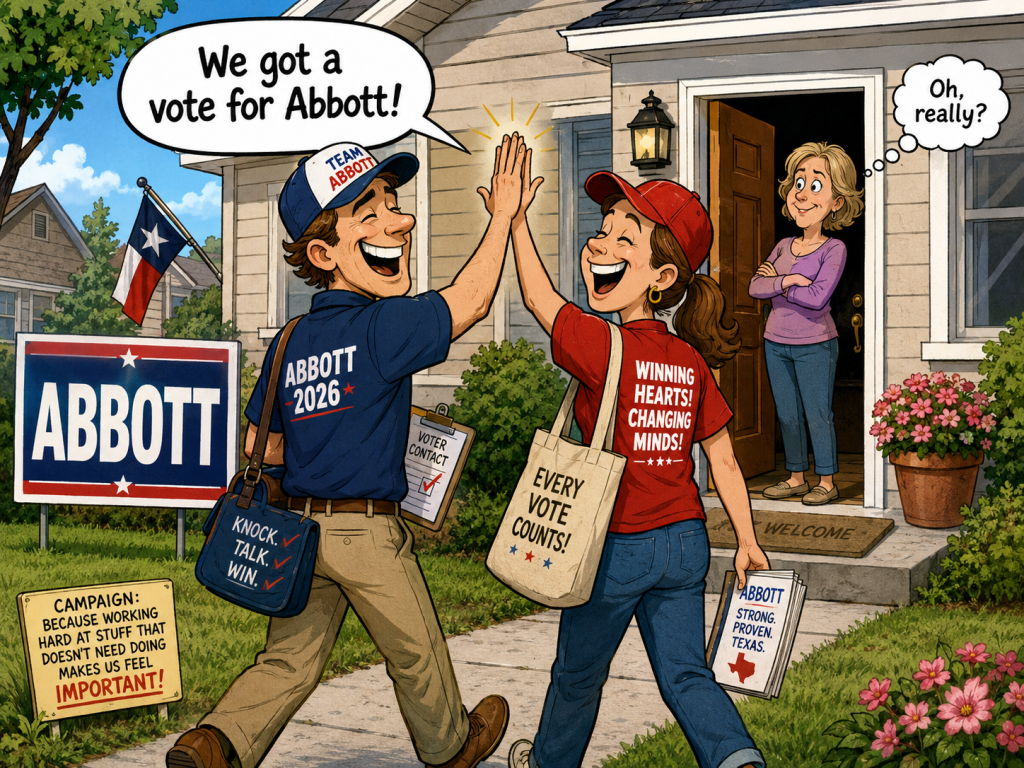
Every election season, political campaigns repeat the ritual. Volunteers gather at headquarters, get voter lists, and head into neighborhoods to knock on doors.
It feels productive. It is personal. And research shows that face-to-face canvassing really can increase voter turnout. Alan Gerber and Donald Green’s landmark field experiment found personal canvassing substantially more effective than direct mail or telephone calls. (Cambridge University Press)
But campaigns may be asking the wrong question.
The question should not be: Which method is most effective when you reach one voter?
It should be: Which method produces the most additional votes for every hour of volunteer time and every dollar of somebody else’s money?
The Door Nobody Answers
Traditional canvassing has a practical problem that anyone who has actually walked a neighborhood understands.
You have to go when people are home—usually late afternoon, evenings or weekends. Then you knock. You wait. Nobody answers. You knock at the next house. Someone answers but is preparing dinner. Another has children demanding attention. Someone else has just come home from work and has absolutely no interest in discussing politics.
A Tufts review of voter-mobilization experiments illustrates the problem. In one canvassing experiment, workers managed about 20 attempted doors per hour but actually contacted only about 13% of the targeted voters—roughly 2.6 conversations an hour. That particular experiment should not be treated as a universal contact rate, but it demonstrates the enormous difference between knocking on doors and talking to voters. (Tufts Circle)
Yet campaigns continue counting doors knocked as though knocking were the objective.
It isn’t.
Votes are the objective.
Knock, Drop and Move
There is another way.
Knock once. If someone answers and wants to talk, talk.
If nobody answers, leave a good door hanger:
Sorry we missed you. Election Day is Tuesday. Here is where you vote. Please remember to vote.
Then move to the next house.
Research suggests that this seemingly weaker contact can still affect turnout. A large Michigan field experiment found partisan door hangers increased turnout by about 1.2 to 1.3 percentage points. (JSTOR)
That is less powerful than a genuine face-to-face conversation.
But that is not the end of the calculation.
Do the Math
The Tufts review summarizes earlier research as producing roughly one additional vote for every 14 successful door-to-door canvassing contacts, compared with about one additional vote for every 77 successful door-hanger deliveries in the Michigan experiment. (Tufts Circle)
That means a personal conversation was roughly 5½ times more effective per contact.
Sounds like canvassing wins.
Not necessarily.
Suppose during the same block of volunteer time you can have meaningful contact at 20 houses or leave literature at 200 houses.
That is ten times the coverage.
Using those experimental ratios simply as an illustration, 20 successful personal contacts would generate about 1.4 additional votes. Two hundred door hangers would generate about 2.6 additional votes.
The less-effective contact could produce about 80% more additional voters simply because it reaches so many more people.
Those exact numbers should not be treated as a prediction for every campaign. Different elections, neighborhoods, candidates, and volunteers will produce different results.
But the principle is difficult to escape:
If one method is five times stronger but another method reaches ten times as many people for the same resources, the weaker method may win.
Campaigns Already Know Where Their Votes Are
There is another reason campaigns should examine this.
Americans are geographically clustered politically. Recent research examining physical partisan proximity found extensive partisan residential segregation in American metropolitan areas. People with similar political preferences are often concentrated in the same places rather than randomly distributed house by house. (OUP Academic)
That does not mean everyone in a neighborhood votes alike.
It does mean campaigns frequently know that certain precincts already favor them strongly.
In those places, the campaign’s problem may not be persuasion at all.
It may simply be turnout.
Why spend precious volunteer hours having lengthy conversations with the relatively small number of people willing to answer their doors when hundreds of other households could receive a simple reminder to vote?
Maybe Campaigns Like What Feels Good
This may be the strangest part.
Political campaigns spend enormous amounts of money gathering data, hiring consultants, and analyzing voters. Yet some campaign practices survive election after election largely because that is how campaigns have always done it.
Door knocking feels like campaigning.
Volunteers come back tired. Organizers report hundreds of doors knocked. Everybody feels that something important happened.
But feeling productive and being productive are not necessarily the same thing.
And perhaps spending other people’s money makes inefficiency easier to tolerate.
The better measurement would be brutally simple:
How many additional votes did we produce per volunteer-hour and per dollar spent?
Run traditional canvassing in comparable precincts. Run knock-and-drop in others. Measure turnout against similar control precincts. Count volunteer hours honestly.
Then follow the numbers.
Maybe traditional canvassing wins.
Maybe knock-and-drop wins.
Maybe each works best under different circumstances.
But campaigns should know the answer rather than repeating an election ritual because somebody taught it to them twenty years ago.
A campaign does not win by knocking on the most doors. It wins by getting the most votes.


