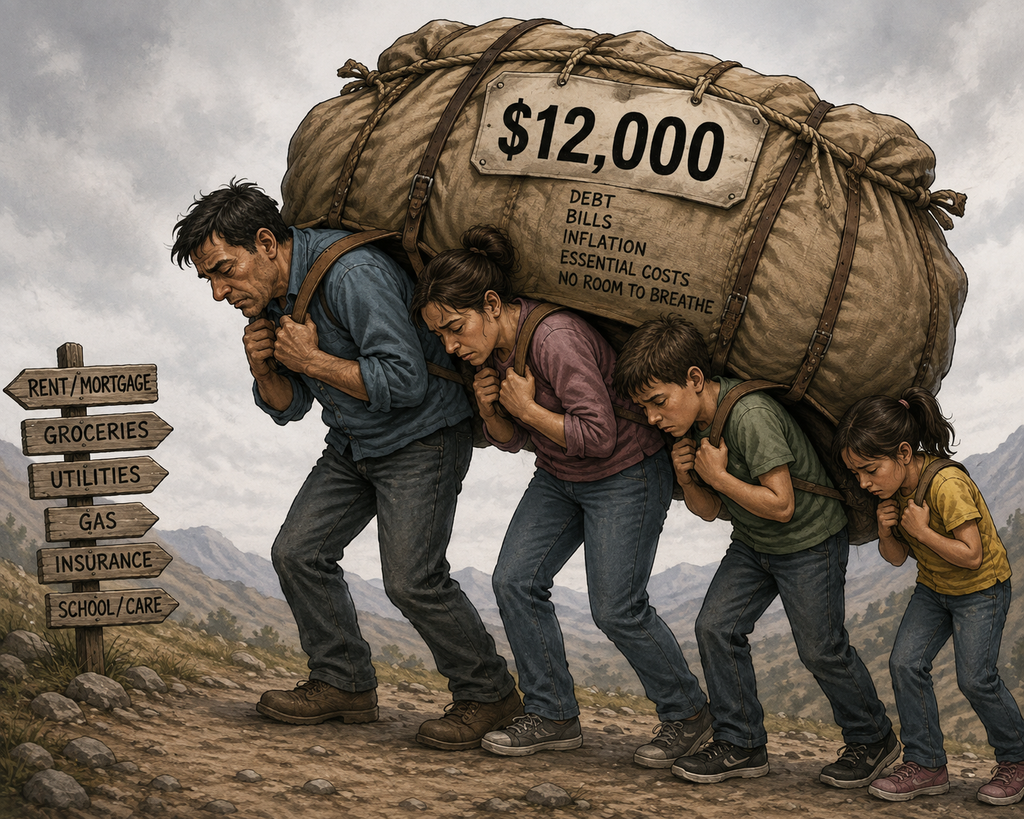
Texas Gov. Greg Abbott says Texans need tax relief. He says families are being squeezed by the cost of living, and he has made lowering taxes one of the centerpieces of his reelection campaign.
There is an obvious question nobody seems to be asking:
Why doesn’t Abbott cut the taxes the State of Texas itself collects?
In fiscal year 2025, Texas collected $84.2 billion in state taxes. It collected another $7.12 billion in licenses, fees, fines, and penalties, according to the Texas Comptroller’s annual cash report. Texas had an average population of about 31.47 million during the year.
Do the simple arithmetic.
That comes to about $2,902 for every Texan, or approximately $11,608 for a family of four.
Call it what it is: nearly $12,000 a year per family of four in state taxes and fees.
That is an average, of course. A particular family may directly pay more or less, and some taxes are collected from businesses rather than showing up as a bill addressed to the family. But this isn’t somebody’s estimate of how heavily Texas taxes its residents. These are the state’s own revenue numbers divided by the state’s own population figure.
Austin is collecting more, not less
Texas likes to advertise itself as a low-tax state because it has no personal state income tax. But no income tax does not mean no taxes.
The state collected $49.1 billion from the sales tax alone in 2025, making it by far Austin’s largest tax. Texans also paid taxes associated with motor vehicles, gasoline, insurance, alcohol, tobacco, and numerous other activities. State tax collections totaled $84.2 billion, up 2.8% from the previous year.
And the money continues to pour in.
In July 2026, Texas collected $4.6 billion in state sales taxes in a single month, a whopping 10.1% increase from July 2025. Through July, fiscal-year sales-tax collections were running 6.42% higher than the previous year.
The Comptroller said the growth was well above general inflation.
So this is not a state watching its revenues collapse while desperately looking for money.
Abbott wants to cut somebody else’s tax
Abbott certainly is talking about taxes.
His current affordability plan promises that his property-tax proposal will save the average homeowner $3,000 a year.
But property taxes are imposed primarily by school districts, cities, counties, and other local governments.
The State of Texas does not levy a statewide property tax.
That distinction matters.
Abbott can stand in Austin and blame local governments for high property taxes while the state government he has controlled for more than a decade continues collecting tens of billions of dollars through its own taxes and fees.
Even the state’s booming sales-tax revenue is being discussed primarily as a way to finance additional property-tax relief rather than as a reason to reduce the state sales tax itself. When July’s sales-tax haul jumped 10.1%, Comptroller Don Huffines said the additional revenue should put the Legislature in a position to provide more property-tax relief.
Nobody suggested Texans might simply be allowed to keep more of the money before it reaches Austin.
Why not cut the 6.25% state sales tax?
Texas controls the 6.25% state sales-tax rate.
The Legislature could reduce it.
Austin controls numerous state fees. It could reduce them.
The state controls motor-vehicle taxes and many of the other taxes that produced that $84.2 billion haul. It could reduce some of those.
Instead, Abbott’s most visible tax-relief proposal centers on using state resources to reduce taxes levied by other governments.
There may be policy arguments for doing that. School property taxes are high, and homeowners unquestionably feel them.
But Texans should still ask the question.
If an average four-person share of Texas state taxes and fees amounts to nearly $12,000 a year, and if state sales-tax collections are growing substantially faster than inflation, why isn’t reducing state taxes part of the governor’s affordability plan?
Abbott says he wants Texas families to keep more of their money.
Austin could start by taking less of it.