
Florida Gov. Ron DeSantis is suddenly worried about Flock cameras.
He should be.
DeSantis, hardly a politician normally accused of being soft on law enforcement, says the public is “right to be concerned” about the enormous network of automated license-plate readers spreading across the country. He has ordered Florida agencies to review their use of the cameras and has warned against allowing America to become a “surveillance state.” (The Wall Street Journal)
Flock now operates roughly 120,000 cameras in 49 states, recording an estimated 20 billion vehicle observations every month. These are not simply cameras taking pictures of suspected criminals. They photograph ordinary people driving to work, church, the grocery store, a doctor’s appointment, or their girlfriend’s house.
Most of us never volunteered for any of it.
Texas Has Already Started Backing Away
DeSantis’ warning comes just as Texas is having its own Flock reckoning.
Gov. Greg Abbott has now ordered Texas state agencies to stop spending state money on Flock cameras, at least while the controversy is examined. Abbott called what is happening around the state a “crackdown” as some Texas cities and counties reconsider their contracts. (The Texas Tribune)
That sounds reassuring until you learn what Texas was doing before the crackdown.
We were paying for the cameras ourselves.
Check Your Car Insurance Bill
In 2023, the Texas Legislature unanimously added $1 a year to automobile insurance policies. Texans were told the money would help combat motor-vehicle crime, particularly the epidemic of catalytic-converter theft.
Nobody stood on the House floor and said:
We are going to use your dollar to create an artificial-intelligence surveillance network that records where Texans drive.
But that is partly what happened.
A Texas Tribune investigation found that at least $30 million generated through the program has helped build the Flock network. The money has paid for or helped finance at least 3,200 cameras, including nearly 1,200 being added by the Texas Department of Public Safety. (The Texas Tribune)
Some local networks were entirely subsidized through these grants. Laredo received funding for 165 cameras. El Paso received funding for 150. Dallas received nearly $1.7 million for 201 cameras. (The Texas Tribune)
The people paying the dollars apparently weren’t the only ones who didn’t understand what was happening.
State Sen. Carol Alvarado of Houston, who voted for the legislation, told the Tribune that she was surprised to learn the money was buying AI license-plate readers. She said surveillance cameras had not been what she had in mind when lawmakers approved the program. Other legislators likewise said the cameras weren’t discussed when the bill passed. (The Texas Tribune)
Read that again.
The Legislature unanimously charged us money for a program, and some of the legislators who voted for it apparently did not know the money would help build this surveillance system.
How were ordinary Texans supposed to know?
These Cameras Know More Than Your License Plate
Calling them “license-plate readers” understates what they do.
Flock technology can create what the company calls a vehicle fingerprint. The system can record the plate, make, model, and color of a vehicle along with details such as dents and bumper stickers. Participating departments can also choose to share information with other agencies, creating a network capable of following vehicles across jurisdictions. (The Texas Tribune)
You don’t have to commit a crime.
You don’t have to be under investigation.
You don’t have to be named in a warrant.
You simply have to drive past the camera.
That is what makes DeSantis’ use of the words “surveillance state” so interesting. For decades, Americans were warned about governments where authorities could routinely track where citizens went.
We built much of the machinery ourselves.
Then we sent ourselves the bill.
And We Don’t Even Know How Many Cameras There Are
Nobody appears to know precisely how many Flock cameras are operating in Texas.
An anti-surveillance group called DeFlock has mapped about 13,000 cameras in the state, although that is not an official count. Flock itself does not publish a complete state-by-state inventory. In late 2023, the company told a Texas state board there were approximately 7,500 cameras here. (The Texas Tribune)
If the 13,000 estimate is reasonably close, Texas residents may have helped finance roughly one out of every four Flock cameras in the state through that little insurance fee.
Most of us probably never noticed the dollar.
That was the beauty of it.
Now Everybody Has Discovered Privacy
The political reaction is becoming bipartisan.
DeSantis is raising alarms in Florida. Republican Sen. Josh Hawley has announced scrutiny of Flock. Democratic Sen. Bernie Sanders has raised concerns as well. Communities around the country have begun canceling contracts or demanding stronger restrictions. (The Wall Street Journal)
Texas is now joining them.
Abbott’s decision to halt state funding is welcome. But it raises an obvious question:
Why did it take years to become concerned?
The cameras did not suddenly learn how to record license plates last Thursday.
They were doing precisely what Texas paid them to do.
The difference is that the public is finally discovering how large the network became.
We Paid to Be Watched
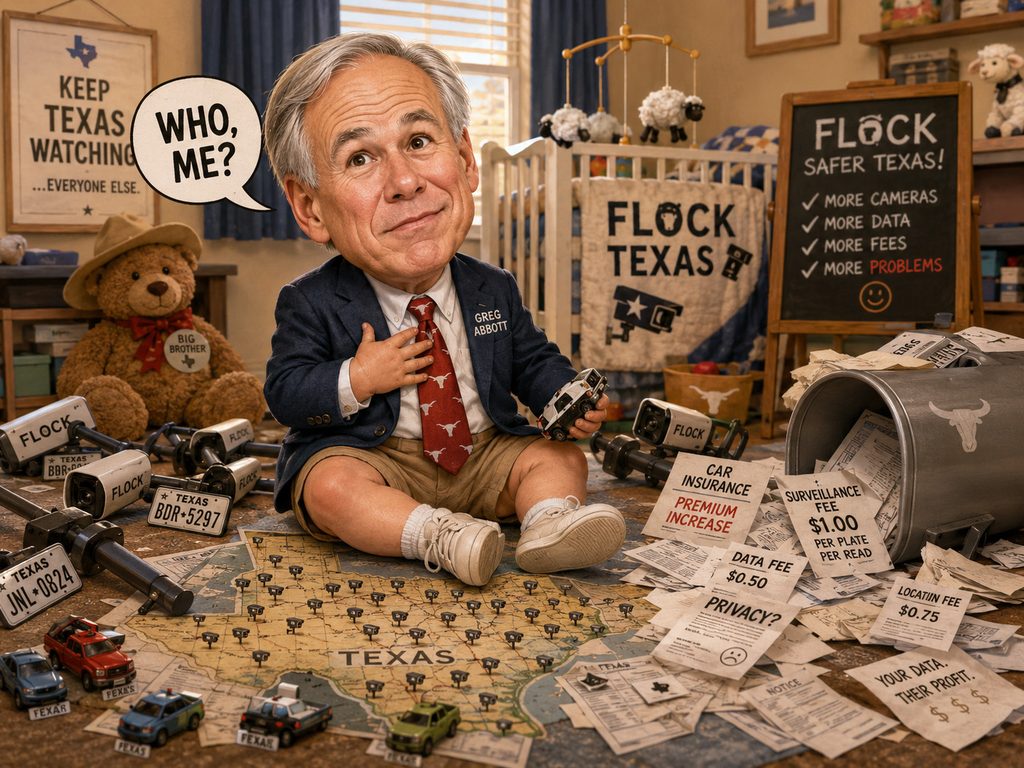
There is nothing wrong with police using technology to find a stolen car, locate an abducted child, or identify a dangerous fugitive. Flock supporters can point to real crimes that these cameras have helped solve.
But there is an enormous difference between using a camera in a particular investigation and constructing a nationwide searchable record of where millions of innocent people drive.
That debate should have occurred before Texas built the network.
It should have occurred before thousands of cameras went up.
And it certainly should have occurred before Texans were quietly charged for helping pay for them.
Florida is asking questions now.
Texas is finally asking them too.
The rest of us might start with the simplest one:
Why did government have to build a surveillance network before anyone thought to ask the people being watched whether they wanted one?


