
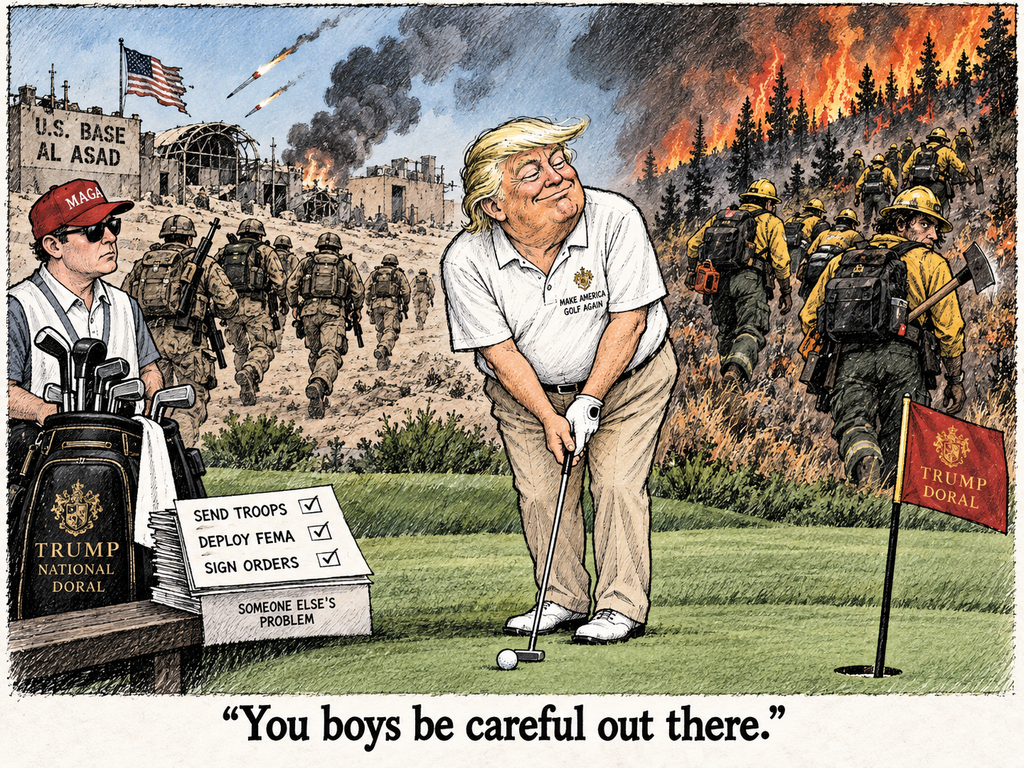
What kinda of DEI fools would start a war without preparing to get hit back? My opinion: Donald and Pete. Nero may have fiddled while Rome burned; Trump prefers to golf.
Donald Trump likes to talk about strength, toughness, and overwhelming force. But the people required to demonstrate that strength are usually somewhere else: American service members living within range of Iranian missiles and drones, or federal firefighters hiking into burning forests carrying tools and heavy packs.
The numbers coming out of the Middle East make it harder to treat the Iran war as something happening safely over the horizon. The Pentagon inspector general’s first report on Operation Epic Fury says the campaign had already cost an estimated $33.4 billion by June 29, including $22.3 billion in expended munitions and $3.7 billion in equipment losses. That figure did not include the cost of repairing damaged military infrastructure. More than 50,000 American service members had been deployed throughout the Central Command region in support of the operation. (U.S. Department of War)
Those Americans were not sitting safely behind an impenetrable shield. From February 28 through June 30, the inspector general reported seven U.S. service members killed in action, seven more killed in non-hostile events, and 417 wounded in action. The report covers only through June 30, meaning later casualties and damage are outside its accounting. (U.S. Department of War)
The physical damage is now becoming visible as well. U.S. Central Command told the inspector general that Iranian attacks damaged or destroyed hundreds of buildings and structures at American bases in Kuwait, Bahrain, Qatar, the United Arab Emirates, Saudi Arabia, Iraq, Oman and Jordan. Dozens of American aircraft were damaged or destroyed, including seven KC-135 refueling aircraft, several fighter and support aircraft, and as many as 30 MQ-9 drones. (U.S. Department of War)
That matters because photographs and satellite images can convey what statistics often cannot. A damaged American base does not look like a television briefing or a map with arrows on it. It looks like a place where American men and women work, sleep, and wait for the next incoming missile warning.
Meanwhile, another federal workforce is being pushed hard much closer to home.
The Government Accountability Office reports that the Forest Service reduced its workforce by about 20 percent in fiscal year 2025 after a February 2025 executive order directing agencies to prepare for large-scale staffing reductions. Between January 12 and June 14 of that year, 5,860 of approximately 35,500 Forest Service employees left the agency, and officials said nearly another thousand departed by September. GAO said those reductions further strained the agency’s workforce capacity. (GAO Files)
Those numbers matter because fighting wildfires requires much more than putting people in yellow shirts on a fire line. Large fires require experienced supervisors, incident-management teams, aircraft coordinators, logistics personnel, and people with years of specialized qualifications. Experienced fire leadership cannot simply be replaced by hiring someone new and handing that person a radio.
By this summer, the strain was showing. From July 18 through September 4, the national firefighting system remained at Preparedness Level 5, the highest level, meaning federal firefighting resources were fully committed for nearly seven weeks. By September 2, the Forest Service and U.S. Wildland Fire Service had spent nearly all of more than $6 billion in fire-suppression authority, even though weeks of dangerous fire weather remained. (U.S. Senator Michael Bennet)
Five western senators said their offices were receiving reports that there were not enough highly qualified personnel, incident-management teams and supervisory staff to sustain operations. They reported teams working more fires than was safe, temporary supervisory arrangements being used because fully qualified people were unavailable, and firefighters working repeated or extended assignments. They also cited the deaths of four wildland firefighters and two pilots during the season. (U.S. Senator Michael Bennet)
At the same time, the Agriculture Department has emphasized a full-suppression strategy, saying fire starts should be attacked quickly to protect forests and rural communities. That policy has defenders who argue that rapid suppression protects homes and lives, while firefighters and fire scientists quoted in recent reporting have raised concerns about asking already stretched crews to attack more fires aggressively when experienced personnel and relief crews are scarce. (USDA)
There is one important fact that should not be ignored. In March 2025, the Trump administration signed into law permanent pay increases for federal and tribal wildland firefighters, replacing temporary supplements that had existed for several years. The Interior Department said the increases were intended to improve recruitment and retention, and better pay was clearly needed. (U.S. Department of the Interior)
But more money cannot instantly recreate experience that walked out the door. You can raise a firefighter’s salary today; you cannot create an experienced incident commander, division supervisor, or veteran crew boss by tomorrow.
That is where the military and firefighter stories meet. Overseas, American troops are serving on bases that have already been struck hard enough to damage hundreds of buildings and destroy or damage aircraft. At home, federal firefighters are being asked to confront a punishing fire season while senators warn that some teams are working beyond what they consider safe limits.
The people making those decisions are not sleeping beside damaged aircraft in the Middle East. They are not hiking into smoke and flames carrying forty pounds of equipment.


