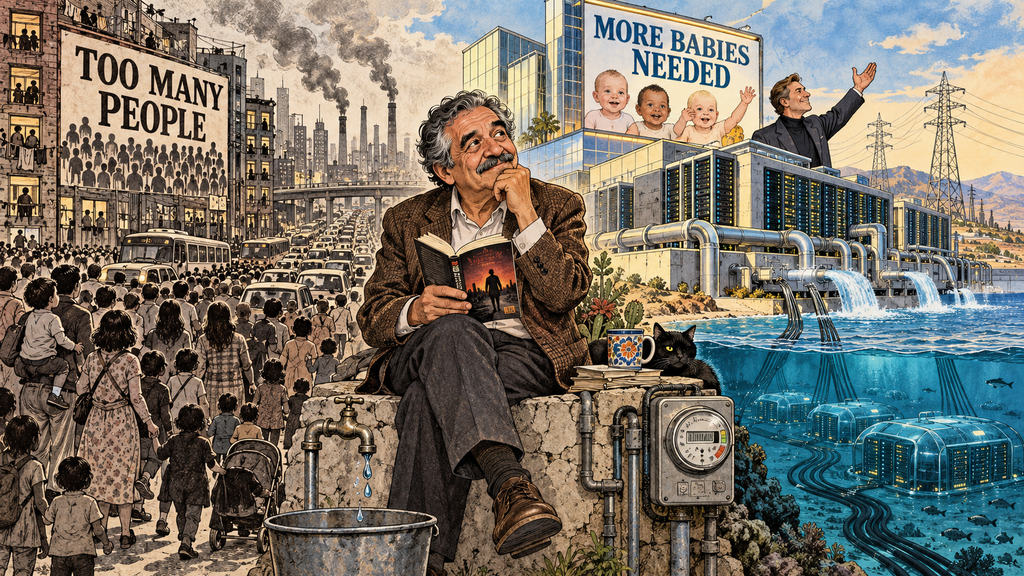
When I was younger, we were warned that population growth might destroy us. There were too many people, we were told, and the planet could not support them all. People responded by having smaller families. Now, decades later, we are being warned that people are not having enough children. Apparently humanity managed to follow the instructions so well that we created a new problem.
Watching Inferno, I Found a Place for AI After We Are Gone
I watched Inferno again the other night. I had read the Dan Brown book years ago—as I have all of his books—and, as usual, I thought the book was better than the movie.
But this time I watched it differently.
The villain, Bertrand Zobrist, believes the world has too many people. He is convinced that unchecked population growth will eventually destroy civilization, so he creates a biological weapon intended to drastically reduce the human population. That is the central nightmare behind both Brown’s novel and the movie. Dan Brown Official Website
I am not suggesting we follow Zobrist’s solution.
But watching the movie in 2026, another thought occurred to me.
Think of all the room we would leave for artificial intelligence.
No humans—or simply far fewer humans—would mean much less demand for drinking water, electricity, houses, highways, food, sewage systems, and everything else eight billion people require to stay alive.
We would not be pumping nearly as much groundwater. We would not have nearly as many people worrying about whether a new factory or data center was going to use up the local water supply. There would be fewer cars, fewer subdivisions, fewer power plants, and considerably less human waste finding its way into rivers and aquifers.
Then I remembered something I had recently read about China.
China has built an underwater data center off Shanghai. The first phase has about 24 megawatts of computing capacity, sits roughly 10 meters beneath the sea, and is designed to use seawater for cooling while drawing much of its electricity from offshore wind. Its developers say cooling accounts for less than 10 percent of its electricity consumption. WIRED
In other words, the computers do not even necessarily need our land.
Microsoft had already experimented with the same basic idea years earlier. It placed a sealed data center on the seabed near Scotland and left it operating underwater for two years. Microsoft later reported that its submerged servers failed at only about one-eighth the rate of comparable machines on land. The surrounding cold seawater provided cooling without using freshwater. Source
Maybe AI has already found its beachfront property.
There is a serious issue beneath the joke. Artificial intelligence requires enormous amounts of electricity. The International Energy Agency says global data-center electricity consumption is expected to roughly double by 2030, approaching 945 terawatt-hours annually. Electricity use by AI-oriented accelerated servers is growing considerably faster than conventional server use. IEA
In the United States, data centers have already become an important source of new electricity demand. The IEA estimates they consumed about 180 terawatt-hours in 2024, with demand expected to increase substantially through the end of this decade. IEA
So AI does have a resource problem.
It needs electricity. It needs cooling. Depending on the cooling system, it may need water. And somebody has to build all those servers, transmission lines and power plants.
Which brings us to Elon Musk.
Musk sees the population problem almost exactly opposite from Zobrist.
For years he has warned that declining birth rates threaten civilization. In 2021, he said, “There are not enough people,” arguing that civilization could eventually crumble if people stopped having enough children. He later described falling birth rates as one of civilization’s greatest dangers. Fortune
So now we have an interesting argument.
Dan Brown’s fictional scientist says there are too many humans.
Elon Musk says there are not enough humans.
Meanwhile, the artificial intelligence industry is asking everybody:
Could you both move over a little? We need another power plant.
And perhaps another data center.
And maybe a nuclear reactor.
And while we are at it, China would like a little piece of the ocean.
There is an additional irony. Musk is one of the world’s most prominent advocates of both more humans and an increasingly automated future filled with artificial intelligence, autonomous cars and humanoid robots. Those two visions may ultimately coexist, but they will compete for some of the same resources: electricity, infrastructure, materials and space.
Of course, Inferno is fiction. Population reduction through disease is not an environmental policy; it is a catastrophe.
And Musk is correct about one important demographic fact: fertility rates have fallen sharply in many countries. But declining fertility is not the same thing as the immediate disappearance of humanity. The world still has billions of people, and demographic decline occurs over generations rather than overnight.
What interested me was not who was right.
It was the strange place where a Dan Brown thriller written before today’s AI boom suddenly collided with the world we are creating.
When I first read Inferno, the question was:
What happens if there are too many people?
Watching it again years later, I found myself asking a different one:
What happens when humans and machines both want more electricity, more water, and more room?
China may already have part of the answer.
Put the computers in the ocean.
Then all they have to worry about is us.