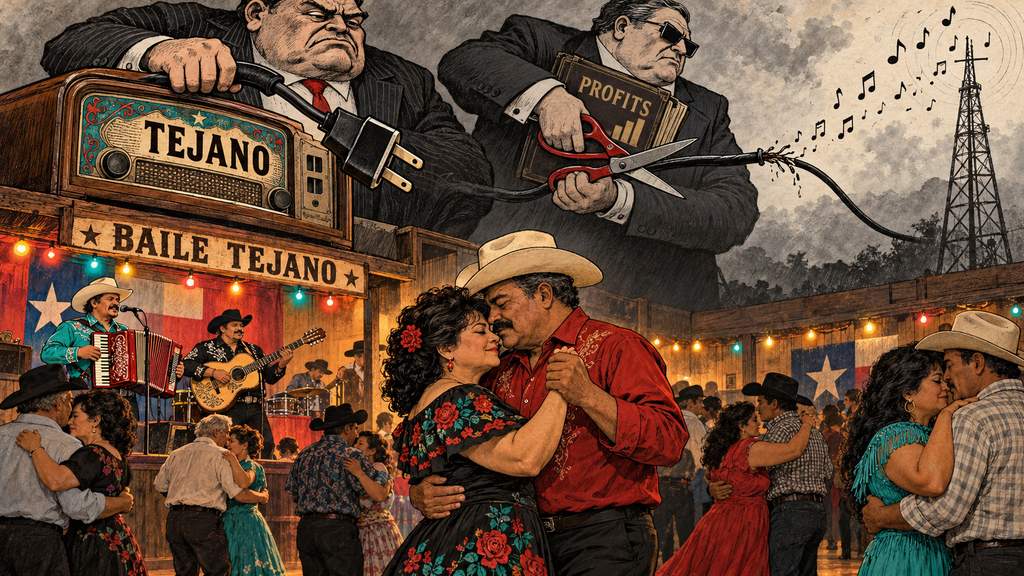
A culture can lose its public voice while its people are still living, working, and raising families. Remove its music from prominent radio stations, weaken the institutions that introduce it to children, and fold its history into a broad label, and its distinct identity becomes harder to see.
That is my argument about Tejano Texas. The 1986 amnesty helped reshape communities and markets. Corporate programming decisions and the promotion of a broad Hispanic consumer identity contributed to the weakening of Tejano culture’s public presence.
One arrival opens a path for others
The Immigration Reform and Control Act legalized nearly three million people already here. Its consequences extended beyond those individuals. Research on its aftermath identified new immigration through family ties to people who received legal status.
One person from a family or village establishes a foothold. Others gain information, somewhere to stay, connections to employers, and assistance making the journey. Research on El Salvador, Guatemala, and Honduras documents how family and peer networks can sustain migration waves even after the conditions that initially prompted departure have changed.
The hope of another amnesty may have influenced some people. Establishing how many is difficult. But an immediate incentive can fade while the relationships established by earlier arrivals continue drawing relatives and neighbors.
Corporate decisions changed what we heard
New arrivals brought their own musical preferences. Broadcasters could pursue those growing audiences, while large corporations could favor programming usable across many markets. Reporting on Tejano radio’s decline identifies changing demographics and corporate consolidation as overlapping forces.
In Houston, Univision sold Puro Tejano 980 in 2008. In San Antonio, it removed Tejano from the main 107.5 FM signal in 2019, retaining it on AM, an HD subchannel, and online. These were identifiable corporate decisions affecting where a community could hear its music.
Calling something a business decision does not settle its cultural consequences. Radio helps create future audiences. When children stop encountering their parents’ music in everyday life, reduced exposure can become reduced demand.
The chronology matters: Tejano reached its commercial heights after 1986. My argument concerns changes unfolding over decades, with legalization contributing to migration networks and subsequent demographic change. The decline came later, through decisions about which audiences and music deserved investment.
When our history became “Latino contributions”
The change also involved how communities were named and marketed.
Sociologist G. Cristina Mora documents how activists, government officials, and media executives helped institutionalize a Hispanic identity during the 1970s and 1980s. Broadcasters could use the combined population to demonstrate a larger advertising market. This process was already underway before the amnesty.
My concern is what happens when that umbrella obscures the people beneath it.
Texas traditions built by Tejanos and Mexicans deserve recognition under those names. When their music, labor, institutions, and struggles become simply “Latino contributions,” the historical community responsible can disappear from the telling. Recognizing other communities should come with equal care about who contributed what, where, and when.
A common language does not make everyone’s history interchangeable. Tejano culture grew from a particular place and experience. Its identity deserves more than a convenient category on an advertiser’s spreadsheet.
What was lost
Tejano culture survives. Corpus Christi’s KSAB recorded the highest audience share among stations listed in the spring 2026 ratings. That success challenges easy explanations that the audience simply disappeared.
The “death” I am describing is the weakening of a public cultural world: its radio presence, its institutions, and its recognition under its own name.
I believe the 1986 legalization belongs in the explanation through its effects on migration networks and changing communities. Corporate consolidation and broader ethnic marketing helped turn those changes into cultural displacement. Connecting those developments into one explanation is an interpretation, with evidence supporting individual links.
A company may call the removal of our music a business decision. We are entitled to judge what that decision cost our culture.