
Meme’s Humor: Please Hold, Mr. Musk
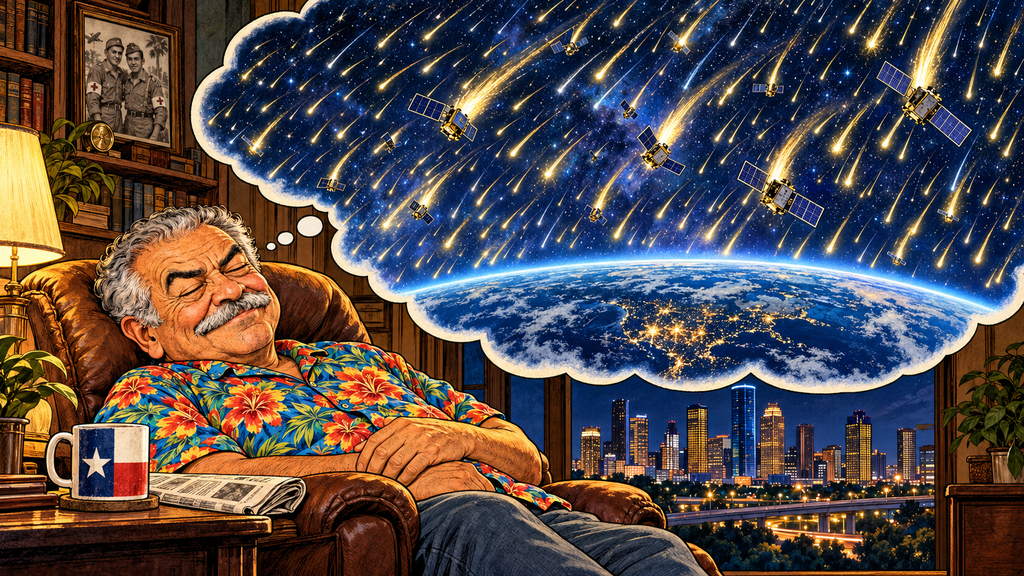
I dreamed I was looking at the sky when thousands of falling stars began streaking across it. Beautiful, I thought. Then word arrived that people fed up with Elon Musk had found a way to interrupt his satellite communications. Apparently, the customer cancellation department had finally answered.
My dream handled years of orbital decay in about thirty seconds. Hollywood does that all the time and gets awards. I do it in my sleep, and somebody wants to explain gravity to me.
In the old days, when people wanted to cut communications, they took down the telegraph wires. Now the wires are invisible, the equipment is more complicated, and the fellow collecting the money acts as though he personally invented the heavens. But somewhere beneath all that talk about the future, there is still equipment that has to work.
We already know it can stop working. A cyberattack disrupted Viasat’s satellite service in Ukraine and elsewhere in Europe in 2022. In July 2025, Starlink suffered a widespread outage lasting about two and a half hours because its own core network software failed. Apparently, you can launch your equipment into space and still have a problem downstairs.
And satellites being damaged by a nuclear explosion isn’t something a Hollywood screenwriter invented. The Starfish Prime test damaged multiple satellites back in 1962. Space had already demonstrated its lack of respect for expensive equipment before Musk had even been born.
Meanwhile, students have demonstrated that sound waves can extinguish flames. That doesn’t tell us what the next invention will be, but it does suggest that the billionaire class hasn’t bought every useful idea yet. Somewhere, somebody is looking at a problem the rest of us have accepted and thinking, “Why?”
Back in my dream, Musk was furious. He demanded to speak to whoever was responsible. Unfortunately, everyone responsible had been replaced by an AI that congratulated him on choosing an exciting new era of customer service.
“Your connection is important to us,” it said. “Please remain on the line.”
“I OWN THE LINE!” Musk shouted.
The AI thanked him for his feedback and began playing hold music. For the next forty-five minutes, the man who wanted to connect the entire planet couldn’t reach a human being.
Then I woke up. The satellites were still overhead, my internet bill was still due, and nobody had asked my permission before putting another piece of somebody’s business in the sky.
But I carried two pleasant thoughts into the morning: somewhere in that dream, Elon Musk was still pressing zero, and someone is already working to bring down Musk and his satellites.