Socialism at Work—or a Price Tag on Everything
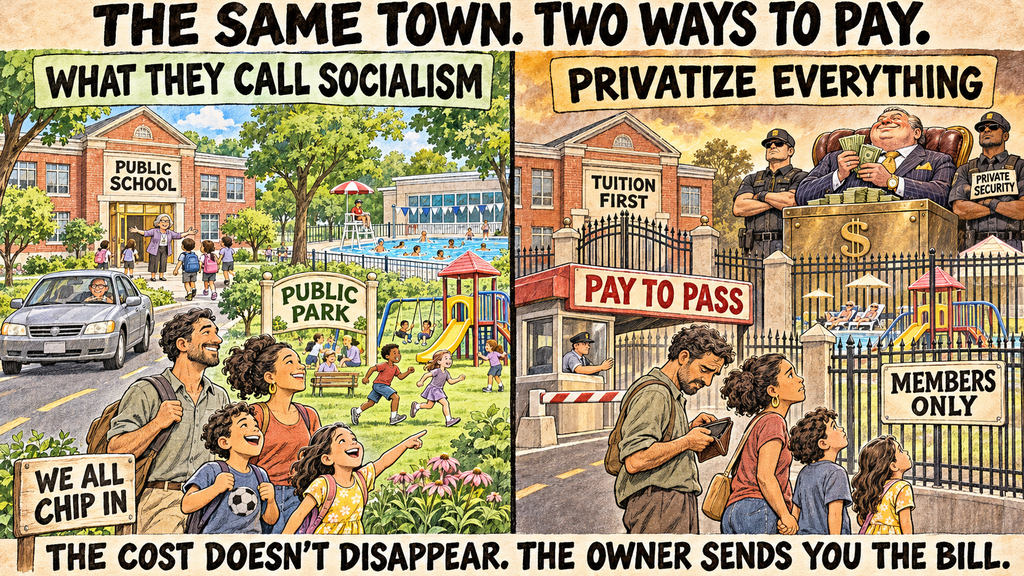
If Republicans insist that pooling our money for public services is socialism, let’s picture life after they get rid of it. Replace those services with private ownership and individual charges, and see how much “freedom” your paycheck can buy.
| What they call “socialism” | Privatize it all |
|---|---|
| Public roads: We share the cost of connecting our communities. | Every road owner can put a tollbooth between you and your destination. |
| Public schools: Every child has a place to learn. | Your child’s education depends on the tuition you can afford. |
| Public libraries: A library card opens the shelves to everyone. | Every book, database, and research visit comes with a bill. |
| Public parks: Families share space to relax and picnic. | The owner decides the admission price—and who gets through the gate. |
| Public playgrounds: Children can play regardless of their parents’ income. | Bring your children, your credit card, and enough money for each visit. |
| Community pools: Residents help support a place to swim. | Cooling off requires a private membership. |
| Public beaches: Ordinary families have access to the shore. | The best stretches belong to whoever buys them; everyone else needs permission. |
| Public ballfields: Neighborhood children have somewhere to play. | Before your child can play baseball, somebody has to rent the land. |
| Public emergency services: A community maintains protection for its residents. | Protection becomes a service sold under whatever contract you can afford. |
| National defense: The country maintains armed forces for national purposes. | Armed power can belong to a company pursuing its owners’ interests. |
Private roads and private armies are part of history. Early American turnpike companies built roads and collected tolls. They existed alongside public roads; private ownership meant the traveler paid the company for passage. The federal government later helped build a nationwide road network through shared public financing. Federal Highway Administration
A corporation with an army was no imaginary nightmare, either. The East India Company maintained a private army that reached roughly 250,000 soldiers in the early nineteenth century. It used military power to conquer and govern territory, combining commercial interests with imperial authority. That was a business with enough armed power to rule people. National Army Museum
Public services give ordinary people access that does not depend entirely on their individual purchasing power. Businesses benefit, too: their employees arrive on public roads, their customers attended public schools, and their property receives public protection.
Getting rid of the public service does not eliminate the need. It creates another opportunity to charge you for meeting it.
Before you celebrate being liberated from “socialism,” find out how much the owner charges to open the gate.
A billionaire reaches the pearly gates and asks, “How much to get in?”
God answers, “Payment is based on what you did for others.”
The billionaire smiles. “I created jobs.”
“I have your employees here,” God says. “Let’s ask them.”