
The primary winner will face García, a Democrat who won the seat in 2020. He did not respond to requests to comment, but he told Ballotpedia in 2020 that he was a lawyer with one of the biggest traffic ticket defense practices in the state of Texas and that he was a “fierce advocate for others from diverse or disadvantaged backgrounds.”
Since taking office, legal documents show that his actions have faced scrutiny. As COVID-19 unleashed a number of funds and regulations meant to protect tenants and pay landlords, García was one of several justices of the peace who was sued by tenant defense lawyers. He was found by a Harris County Civil Court judge to have failed to comply with emergency eviction protections.
In the case, Judge LaShawn Williams concluded that because both the tenant, Christopher Jenkins, and the apartment complex, Adorable Pointe Apartments, were participating in Houston-Harris County Emergency Rental Assistance at the time, the lower court should have frozen the case for 60 days. García argued in court documents that Jenkins had been denied rental assistance and that the apartment complex had told him that it was no longer participating in rental assistance programs.
García was also admonished by the State Commission on Judicial Conduct for using his judicial office to advertise his paid wedding services.
Source
I will be surprised if this story is not a main one come November; the Houston Chronicle started early to let people know that the Justice of the Peace, Israel Garcia, may have had ethical lapses. Who knows what else may come up about him between now and November?
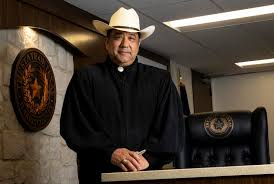
But somewhere along the way, as the emergency of the pandemic subsided, rental assistance ran dry and other protections ended, García’s courtroom evolved into the starkest depiction of the legal churn of Houston’s growing eviction machine.
His case load quickly mounted. Now, it is not unusual for him to work through 300 or 400 eviction cases every Tuesday. On Valentine’s Day, he had 444.
For months he made no effort to connect tenants with lawyers from Lone Star Legal Aid, who took over from the University of Houston and often set up a table at the courthouse offering to represent tenants for free. Their relationship grew hostile after lawyers filed several mandamus suits against García, asking a higher court to review evictions they claim he wrongly approved.
In one such case, a county judge found García had improperly directed a constable to evict a tenant instead of freezing the case for 60 days, the Houston Chronicle reported last July.
García relegated legal aid workers to a small vestibule with no air conditioning between two sets of automatic sliding doors at the building’s entrance, away from the side door tenants are directed to enter. When they tried to set up inside the building, García moved their table himself.
“They know that I’m upset with them and they know that I’m not going to tolerate them, and they know that I’m watching them, and they don’t go to any other court like this in full force,” García said recently. (Legal aid is a regular presence in other courts, though they don’t have the resources to cover every docket.)
Source