The Democratic Party needs to quit listening to those progressives who bleed fake tears of concern for the people who are turned away at the border. Maybe if they had ever worked in a field where they would compete with them for a salary that could support a family, there would have been more concern for those who were already here.
From a local blogger:
And Allred’s personal story doesn’t mean much when he begins to blame families escaping poverty and violence (mostly because of US-Latin American policies in their home countries) for US problems. Instead of making immigration policy the issue, he’s blaming people for simply “yearning to be free.” Those who suffer are the easiest target and this has been added to the Dem playbook.
There’s a reason I didn’t vote for the opportunistic politician in the Primary. Allred is a terribly hard pill to swallow in November if he continues on this track. It’s not a good look for Democrats, especially if Schumer and the Senate are trying to resurrect an already awful “bipartisan” border plan.
While talking to a few Latinos is not a poll, it may uncover what Latinos think. I live in a neighborhood where the majority of the Latinos are blue-collar workers. One of them has a small business laying carpet and often works as a subcontractor for a company. I don’t encourage him to vote because he is likely to vote for Donald Trump. Why? Because he sees every new undocumented as a threat to his way of life.
I have spoken to individuals who are undocumented, and unless the new undocumented person is a relative, they are not interested in more competition for their jobs. How many individuals working in landscaping, can our economy support?
From an article about Latinos in California:
Despite this rich immigrant tapestry, however, California’s Latinos are overwhelmingly U.S.-born and growing more so. California was not exhibiting the measurable rightward shift of Latino voters that was evident in other states until recently, but now it is. It’s just been harder to see due to the state’s large number of older immigrant and left-leaning voters.
Economic frustration could be a key reason for the shift. A recent study reported that only 9% of Latino households could afford the state’s median home price. Fifty-five percent of California families in the bottom 10% of incomes are Latino or Black. By virtually every economic metric, in a state with more Latino elected officials than most, Latinos aren’t doing well.
Housing affordability and other economic issues are moving Latinos off the sidelines and out of their traditional pattern of supporting Democrats in great numbers, so much so that even the Golden State is no longer an outlier. Robb Korinke of California Target Book (a partner in my firm, GrassrootsLab) found measurable Latino voter registration shifts away from Democrats in every one of California’s competitive congressional districts since the midterm election. At the same time, the performance gap between Republicans and Democrats in Latino-dense state legislative districts has closed considerably.
Are we witnessing a transformation of the Latino vote? Registration, turnout and other data point strongly in that direction. It’s time for policymakers, many of whom came of age with the narrative that defined the end of the last century, to recognize that we’re on the precipice of a new Latino political identity in a new Latino century.
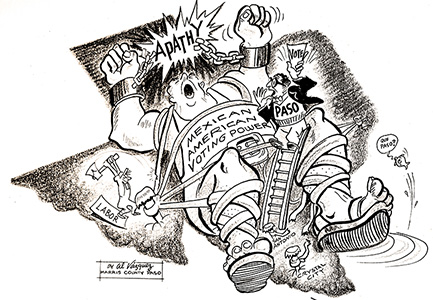
There is no sleeping giant for the Democrats: