
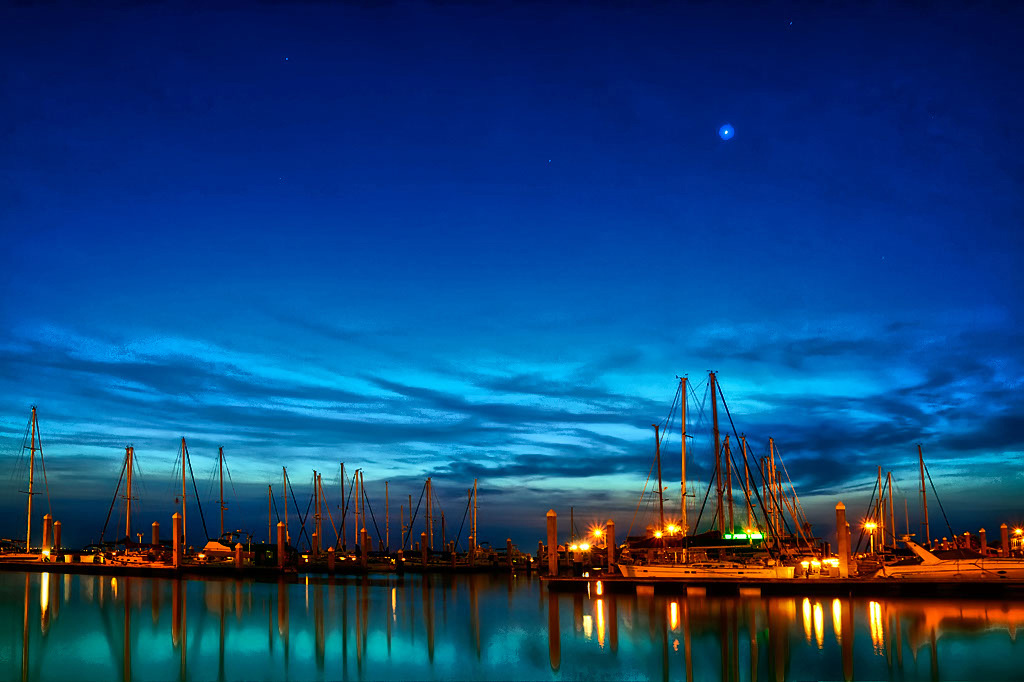
Corpus Christi, Texas, photo taken from downtown as the sun was setting to the west.
Seems that poor planning and nature acting like nature have proven to be too big a task for the people who, over the years, have run Corpus Christi dry.
For years, climate scientists have projected that South Texas would grow hotter and drier—that drought cycles would lengthen, that rainfall would become less reliable, and that the water systems built for a wetter century would eventually face conditions they were never designed to absorb. In Corpus Christi, that projection has become a daily operational reality.
As of early 2026, according to recent monitoring data, Lake Corpus Christi stands at just over 9 percent of capacity, and Choke Canyon Reservoir, the city’s other primary source, is below 8 percent full. City planning scenarios suggest a formal Level 1 water emergency, requiring mandatory cuts across all users, could be declared as early as May. Some city planning models now account for no meaningful rainfall for the remainder of the year—not as a worst case, but as a planning baseline.
… Industrial facilities now account for 50 to 60 percent of the city’s total water consumption. Individual facilities can consume several billion gallons annually—reflecting the scale at which industrial demand now operates within a system that was never sized for prolonged drought at this level of consumption.
The deferred solution has a name and a cost. The proposed Inner Harbor desalination plant has been discussed for more than a decade. As cost estimates ballooned from around $750 million to $1.3 billion, the city voted to cancel it in September 2025. The worsening water emergency has since put it back on the table, with a vote on a revived proposal from a new contractor expected this month. But current timelines suggest the plant is unlikely to come online before 2028, a solution measurable in years for a crisis measurable in months.
Emergency measures are now underway. The city is drilling a wellfield and pursuing groundwater purchases. The largest remaining reservoir, Lake Texana, located about 100 miles away, is currently 55 percent full but could fall to around 30 percent by summer. Each of these measures buys time. None of them resolves the underlying mismatch between what the climate is delivering and what the infrastructure assumes.
Corpus Christi is a coastal city with a beautiful bay and a natural harbor, all that water, but alas, it is not drinkable.
From the Rime of the Ancient Mariner:
Day after day, day after day,
We stuck, nor breath nor motion;
As idle as a painted ship
Upon a painted ocean.
Water, water, every where,
And all the boards did shrink;
Water, water, every where,
Nor any drop to drink.
The very deep did rot: Oh Christ!
That ever this should be!
Yea, slimy things did crawl with legs
Upon the slimy sea.[4]
I do not know why, but I took English Romantic Poetry while in college, and The Rime of the Ancient Mariner was one of my favorite poems.


