
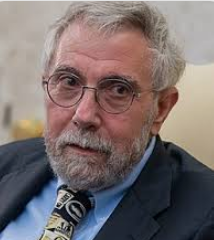
Image of Paul Krugman on the left.
What I will do today is post what Paul Kruman has posted. It is worth reading in its entirety. There is a video if you prefer listening, but it is in English only.
Lisa Graves is a legal activist and the author of a remarkable and terrifying book, Without Precedent, that documents the assault on democracy via the story of John Roberts. I spoke with her about how America has come to its current state, and what the future may hold:
. . .
TRANSCRIPT:
Paul Krugman in Conversation with Lisa Graves(recorded 4/9/26)
Paul Krugman: I’m speaking today with Lisa Graves, author of an incredibly revelatory and deeply disturbing book called Without Precedent, about the Roberts Court and what it has done to America. And…hi, Lisa. Welcome on.
Lisa Graves: Paul, thank you so much for having me on. It’s an honor to be here with you. And thank you for your kind words about my book.
Krugman: I guess I was first sort of seriously alerted to what was happening at the Supreme Court in 2000, with the stolen election and all that. But I have to say, I don’t think I fully appreciated what Citizens United would do. And so why don’t you give us a little background on what has happened, the court and its role and what’s been happening to America?
Graves: Well, I really appreciate your starting with Bush v. Gore, because that in some ways is the beginning of this period. It’s a precursor in a way to what we’ve been experiencing. And that was when the US Supreme Court, in a sharply partisan decision — although not all the Republicans voted to stop the recount — five Republicans voted to stop the recount in 2000, in Florida. And the effect of that was to give George W. Bush the presidency and with it, not just the power to, in essence, make war with the consent of Congress, but also the power to remake the courts, the Supreme Court in particular.
And by the way, as part of my research for the book, I looked into what was happening at that time, and it turned out that Clarence Thomas’s wife Ginni Thomas was working for the Heritage Foundation on the predecessor to Project 2025 — basically Project 2000. And she was screening people for positions in the potential George W. Bush administration. And Clarence Thomas didn’t recuse himself from that case. By the way, that five-four decision — it would have been four-four. The count would have been allowed to proceed. And the count that actually occurred with news organizations after the fact, after Bush was sworn in, showed that Gore would have won Florida and would have become the president of the United States.
By the way, after Thomas voted to effectively make George W. Bush the president, Ginni Thomas was given a promotion as the liaison from the Heritage Foundation to the White House, and she became the highest paid non-board member of the Heritage Foundation. And so she was rewarded very well for her work and, basically, for the consequence of her husband’s decision to vote to stop that recount.
So that was really a moment where I think a lot of people didn’t understand what was happening. And because that decision happened so quickly, there were no motions for Thomas to recuse himself. It just was a very rapid, very political, partisan decision by the court. And it is really a precursor to what’s happened next, which is that George W. Bush was reelected as an incumbent, or elected anew in 2004. And there were two vacancies that came up immediately. It was for O’Connor’s seat and Rehnquist’s seat. And John Roberts got the role of chief justice, and Sam Alito got the role of associate justice.
And then to fast forward to your question about Citizens United, again, this is a 5-to-4 decision issued by the Roberts Court, where Clarence Thomas sat on that case — the fifth vote, in essence, on that case — even though a billionaire named Harlan Crowe had staked his wife Ginni Thomas with $500,000 to launch a group to take advantage of the decision to come in Citizens United, to allow these so-called C4 groups under the IRS code to spend unlimited money to influence elections. And Clarence Thomas did not recuse himself from that case, and even had the audacity to write a concurring opinion saying that disclosure of money being spent by these groups — who the sources are — would chill speech, meaning money, like the money to his wife, which he did not disclose.
And so that decision unleashed a tsunami of cash into our elections, where candidates are routinely outspent by the outside groups. And this has given a disproportionate, and extraordinarily disproportionate, power to billionaires in our society, in America, to secretly influence elections in order to get people into positions of power to advance their interests, like the huge tax breaks that Donald Trump signed into law at the behest of Charles Koch and his groups in the first term of President Trump. And again, similarly, in this second term of Donald Trump, the extension of those deeply unfair and destructive tax cuts for the richest few.
Krugman: You kind of described what Citizens United is, but let’s talk more about that. Citizens United is the birth of super PACs, right?
Graves: Yes.
Krugman: And it’s basically saying that outside players — but it ends up being largely billionaires — can put lots of money with some basically tissue-thin restrictions on what they can do, but can basically put in unlimited amounts of money to influence political campaigns.
Graves: That’s right. And so Citizens United was a decision that basically asserted that under the First Amendment, money is speech, and that outside groups that were not coordinating with the candidate — so-called independent expenditures — they could spend unlimited money, and they were not subject to the rules that the Bipartisan Campaign Reform Act, BiCRA, otherwise known as McCain-Feingold, sought to put in place to deal with this sort of what they were calling soft money — money that was outside the campaigns that was not required to be disclosed.
So Citizens United and its progeny — a case called Speech Now vs. FEC — that’s what spawned these super PACs, where you have enormous money going into PACs, political action committees. That money can be million-dollar, even $10 million checks. For the super PACs that are operating in a particular way, they have to disclose their donors. But for the C-4 groups, which are these other nonprofits, they don’t have to disclose their donors.
And so what it’s created is a situation in which, on the one hand, a billionaire can now give millions to a super PAC in a way that they could not give directly to the candidate. They couldn’t just write a check to the presidential candidate or congressional candidate. They can do it now in an unlimited amount through the super PACs. And then separately, they can give tens of millions of dollars — unlimited money — secretly to a C-4 group that runs so-called issue ads. Those are the ads that say vote for or against this person, or call them because you oppose their policy. But it’s really obviously about influencing the election, and that’s the dark money that’s being spent in our elections.
Krugman: The Times found that 300 billionaires represented 19% of all campaign financing in the 2024 cycle. But I’m not sure how they know. Are the C-4s even in there? It may be more than that, right?
Graves: It’s certainly more than that. And only under certain circumstances can you actually see some of the funding of a C-4, based on how it’s related — who’s funding it, if who’s funding it is known. So for example, if a foundation gives to a C-4, if it has the capacity through a trust or a foundation to give to a C-4, that sort of giving is required to be disclosed. But if an individual, a billionaire like Charles Koch, writes a check to the C-4, that is not disclosed. It’s only if it comes through a nonprofit entity that you can see just a glimpse of the sources of that funding.
So whenever I talk to reporters who are doing those calculations about how much money is being spent by billionaires, I always tell them that their counts are going to be extraordinarily under the actual reality, because we know that these outside groups, these C-4 groups, are spending hundreds of millions of dollars cumulatively in the election cycle, and the only people who know who’s giving to them are the groups themselves. And probably some of the candidates know who’s giving to those C-4s.
Krugman: Wow. So if we look at someone like Peter Thiel, who basically bought a Senate seat for JD Vance. I don’t actually know the number, but the numbers we see may actually be only the tip of the iceberg.
Graves: That’s correct. There are a couple of rules in states and also at the federal level for certain types of independent expenditures, or if you have what’s known as a 527 group under the IRS code, that is allowed to spend directly in elections. But even then, what you see is a shell game. So for example, the Republican State Leadership Committee, RSLC, has created a subgroup to target state Supreme Court races. And it’s the sole funder of the subgroup. So when the subgroup discloses who funds it, it’s disclosing its parent organization. So it doesn’t disclose how much of that money is from Leonard Leo, or how much of that money is from Charles Koch or Koch Industries or the oil companies that goes into the bigger pool of funds.
And so there are all these ways in which I believe that most of the money that’s being spent in our elections in America is not disclosed. It’s not disclosed under the campaign finance reports of the candidates, of the party, or the super PACs, because it’s the C-4 money that is most potent, because it’s the vehicle that allows them to hide the true funders — the biggest funders of these operations.
Krugman: If we look at issues like energy and climate policy, there’s obviously huge amounts of fossil fuel money flowing into elections, but there’s also huge amounts of money going into supporting pseudo research at think tanks, which is a kind of whole universe. And if they’re already supplying a very large part of campaign finance, then add in all of this stuff, and we really live in a political environment that’s very much determined by big money.
Graves: That’s really true, and while the C-4 spending sometimes is not described as political, it’s obviously political. It’s obviously spent around the elections to influence the outcome of the elections. And it’s often spent on ads, which is why there was a bill that was introduced by members of Congress that was called S1 in the previous Congress, which was designed to basically say, if you’re going to spend money around the elections, it really needs to be disclosed.
But as you point out, in some ways that enormous money that’s coming in around our elections is, in a way, the tip of the iceberg, because there’s this whole other structure where fossil fuel companies and fossil fuel CEOs like Charles Koch and others, are spending enormous sums year after year on these so-called think tanks — or as some people call them, “stink tanks.”
Krugman: Heh.
Graves: But really, these are entities that have been stood up over the past few decades to generate research findings that are informed basically by the funders who are funding that research, in order to assail efforts to mitigate climate change, for example.
And when you look at the nonprofit infrastructure in the United States, the United States has a thing that is known internally, in essence, by the experts as “the independent sector.” We have the private sector, the public sector meaning government, and the independent sector—and that’s the nonprofit sector. And it is an enormous part of the US economy. That’s like churches and hospitals and colleges. But a significant portion of that nonprofit spending is going into policy operations, operations that describe themselves as informing the public, as public education — not public schools, but educating the public.
And the fossil fuel industry has played a big role in funding a number of these groups that are at the forefront of basically “studies” — and I’ll use that term loosely — but studies that then are cited by some members of Congress as a basis for objecting to the reality of climate change, or objecting to government efforts to intervene and try to mitigate climate change. And so it’s a massive distortion machine. We sort of swim in a political environment, a political and social environment, which has been greatly influenced, swayed by the amount of so-called research that these groups are putting out in order to advance the industry’s interests.
And this is part of what’s known as a third-party strategy that the tobacco industry really helped pioneer in America, where they were trying to fend off efforts to regulate tobacco and its cancer-causing effects. And so they didn’t want to run ads, for example, saying “tobacco companies say tobacco is just fine” — although they did say smoking was good for you — but they put forward doctors and, you know, so-called studies saying it was safe, even though the actual independent science was showing that there were carcinogenic effects in some instances of smoking.
And so that third-party tactic is what the fossil fuel industry and its CEOs are using. They don’t think that people would believe them if they ran an ad saying, “Hey, I’m Charles Koch. Trust me, all this fossil fuel money that’s making me the 23rd richest person in the world — it’s great for everyone. The planet isn’t on fire, and we can solve everything.” You know, instead, what happens is they fund these groups that do bus tours and they lobby Congress, or they do all these influence campaigns. And the objective is to protect the industry basically at all costs.
And there was a book that was written a couple of years ago about how in Koch world, both the for-profit part of Koch Industries—which is now known as Koch—and in their nonprofit empire, carbon was job one.
Krugman: Right. And there’ve been some studies— I think by Oreskes and others—that demonstrated how among the alleged scientific papers that disputed the consensus about climate change, the percentage funded by the fossil fuel industry was basically 100. That this is an entirely manufactured thing by special interests. So you place a big emphasis on fossil fuels. Tobacco is kind of where the strategy begins. But fossil fuels are, in your view, at the root of this perversion of the U.S. system.
Graves: Well, I think it’s a key component of it. Other than, I suppose, the war industry.
Krugman: Right.
Graves: Which is related. The fossil fuel industry is the most lucrative field of business in the world. And they’ve made so much money, you know, selling fossil fuels. And there’s a real intolerance for any limit. And in fact, when you look at a lot of the groups that have been funded in the US that are part of attacks on the EPA, attacks on the power of the Environmental Protection Agency to regulate carbon, when you trace those back, you can see money from the coal industry and coal barons. You see money from the natural gas—otherwise known as the methane gas—producers, the frackers and the compressing companies for those fracking for the gas and oil industries.
And you can see within that what’s happened: a number of these big CEOs — for example, the largest seller of compressed gas compressors in the United States for these big fracking operations — they’re paid an enormous amount for running these companies. And then they create a nonprofit that then fuels groups like the Heritage Foundation, American Enterprise Institute, and these other entities that are at the forefront of trying to stop congressional efforts to regulate carbon or to mitigate climate change.
Krugman: So, I mean, we’ve seen a lot of certainly favorable tax treatment for fossil fuels forever. But still, you know, I’ve been around for a while. I remember the 70s when, in response to the oil crises, we did get price controls and windfall profits taxes. They may not have been great policy, but it’s kind of unthinkable that we would do that now. What changed, do you think? Why did the U.S. system become so much more porous to this kind of influence?
Graves: Well, I so appreciate your raising that, Paul, because the timing of that coincides with a memo that was written by a person who became a justice on the Supreme Court. It’s called the Powell memo. It was written by Lewis Powell to the Chamber of Commerce. And that was just months before Powell was nominated by Nixon to the Supreme Court. And in that memo, the Powell memo, he wrote that American businesses needed to play a greater role in American society. And I think this is a laughable assertion. He asserted in 1971 that no one had less influence on public policy in America than the American businessman. That wasn’t true then. It’s certainly not true now.
And that memo helped spawn a new generation of investment in trying to capture these levers of power. And so demi-billionaires like Richard Mellon Scaife and others rose to that call to create this apparatus to oppose government regulation. For example, Scaife helped fund some of these early think tanks in the 1970s. But another key figure in that time was Charles Koch, when he had just inherited his father’s company in the late 1960s. He was very involved in these early right-wing movements. He personally, actively objected to those price controls. He started seeding groups in the Libertarian Party, an adjacent movement, before he ultimately tried to co-opt the Republican Party and move this into the mainstream of that Republican Party agenda, you know, with the help of Reagan, who had deeply antagonistic views toward regulation.
When you look at that period, that’s when Charles Koch, as a young man, claimed that America under Nixon was basically socialist because we dared to have any price controls. And then, in response to the efforts of Congress and the White House to address the oil crisis and the challenges that America was facing in terms of the energy crisis and the like, Charles Koch actually opposed the creation of a Department of Energy for the United States of America. He objected to that. And so those are very early parts of this movement that most people don’t know happened. You know, it’s obviously before Google. It was a bit below the radar. But that helped seed decades now — the 80s, 90s, the 2000s into the present moment — where those initial investments really took hold.
And I guess the key in some ways to their success is that I always describe Charles Koch as being the deepest, longest, most enduring funder of this effort to attack the regulation of carbon and the like. And he’s been at it now for, you know, going on 50, coming up on 60 years, really.
Krugman: Right, so this is going back to the Powell memo in, like, 1970–71. So this is 55 years now. I guess what you’re saying is that the billionaires got smarter and learned to play the long game.
Graves: Yes.
Krugman: It’s the power of long-term thinking, except not on behalf of the human race.
Graves: Yeah. It’s astonishing, because you can see there’s all these different assessments of progressive funding versus so-called conservative funding, and there has not been the type of investment in this infrastructure to push these fringe ideas into the mainstream on the left. It is just not how the funding works on the left. The right has billionaires and families of billionaires and children of children — proto-billionaires, you know, multi-multimillionaires back in the day — whose families have been at this for decades now. You can see it through the foundation work they’ve done, and how the different foundations have spawned other foundations.
And so on the right you see a very deep investment in moving these fringe ideas into reality, into legally binding rules for us, including to the Supreme Court. And on the left — for example, on the Supreme Court, or in the middle to the left there — there was this effort to not capture the Supreme Court, to try to put people on the court who had a reputation for fairness, and not because they were going to be someone who was driving the law to the left. But the right has been really disciplined in this court-capture plan, along with its plan to capture these other levers of power.
Krugman: Yeah. I think to some extent unions used to be the kind of long-term strategic players such as they were on the at least moderate left. But we all know what happened to unions. Although that’s another story.
Graves: But can I add in there? Because part of what we saw was how Reagan came in with this hostility to unions, even though he’d led the Screen Actors Guild. He came in with this real effort to try to break the unions. And then that was met, ultimately, in the longer run, with big funding from these big foundations, including the Bradley Foundation, which had one of the biggest reserves in the country, and it was targeting unions to break unions, but also to break their political power, their political influence.
But when I traced this back, this so-called “right to work” movement — which is not about the right to work, but the right to break unions in these states — what you can see in the historical record is one of the early funders of that effort was Fred Koch. Charles Koch’s father, in the 1950s, was one of the big backers of this long-term campaign to limit the power of unions, the power of people to organize in unions, and also to basically try to break their political power.
Krugman: Wow. So that means these are sort of dynastic efforts. I haven’t really thought about that. But, you know, we talk about the institutions, but it’s actually also these sort of personalized dynasties, which is just amazing.
Graves: Yes, so Dick Scaife and the Mellon fortune. It’s the Mellon Banking Corporation. Andrew Mellon was Treasury Secretary under Coolidge and Hoover, and ended up basically losing his cabinet seat due to a financial scandal. So that Mellon banking fortune became basically Richard Scaife’s fortune. That’s the origin of it.
Krugman: Because back in the day, you know, pre-Citizens United, when you looked at right-wing think tanks and all of that, it turns out there was sort of Bradley or Mellon-Scaife money behind almost all of them. But now I think it’s a bigger pool.
Graves: It is a bigger pool. We have more billionaires now, or more people in that class — that 0.000001.
Krugman: Yeah, I think it’s four zeroes and a one. But I always forget.
Graves: Yeah. And it’s interesting, because I used to occasionally talk to reporters about David Koch when he was alive, and they’d say, “Oh, but he’s given so much money to the theater or to cancer research,” but they’ve given less money, in some ways at the time, to political operations, although that’s now increased. And I would say it costs a lot more money to build a building than it does to actually buy policy, unfortunately, in America.
And so what’s happened is we have this political class of super-elite, super-rich people who have extraordinary sums at their disposal. So, for example, one of the richest men in America and in the world is a guy named Jeffrey Yass. He got rich on TikTok and also on these super-fast trades on Wall Street. He’s the richest guy in Pennsylvania. When he drops $1 million, $10 million in a race — let’s just put that ballpark out — it’s a huge sum, but from the standpoint of a dollar per dollar, the ratio is the equivalent of an ordinary American buying a coffee and a bagel once a week. It’s just nothing to them.
Krugman: I think it’s less true now, but still quite true, that given how much political decisions can influence the wealth of the wealthy, the amount that is spent to influence elections is actually still a pretty small number.
Graves: Yes, it really is. I mean, when Elon Musk was dropping 100 million or 10 million a year in these different races, he has so much money. I think at one point I calculated how much he was making per minute, or how much, in theory, his net worth was per minute. And what he was dropping in the races was nothing. It was pocket change to him. Basically, it would be pocket change to an ordinary American. Their wealth is so vast. And so, interestingly, even though they’ve invested a lot of money — people like Musk and Koch — in our elections, they still, in essence, don’t over-invest. They could spend a lot more and still not have it make a dent into their holdings.
Krugman: One thing I think most people really don’t have a sense of — even if you’ve heard a number, you don’t have a sense of how rich the rich are. You know, this was a time years ago when inequality was a lot lower. But I remember when I was still at MIT — so it’s a long time ago — but I don’t remember who we had. You know, faculty was rolled out for lunch with some rich guy, and the president of MIT whispered, “If only we could get his daily fluctuation.”
Graves: Yeah, that’s how much money. And now it’s incredibly more so.
Krugman: Yeah. Fossil fuels was really, really big. Still is, I suppose. But lately we’ve been seeing a lot from crypto and tech. What’s your sense of what they’ve achieved? I mean, they’ve spent an enormous amount of money and obviously bought a lot into this last election. But where are we on that?
Graves: Well, I will say just briefly, one last note on the fossil fuel industry, there’s a great news story out in ProPublica this weekend about the money behind the effort to give immunity to the fossil fuel industry, to forbid liability, and have Congress do so and have the states try to help with that. And so that piece really details that spending, that includes some significant amount of spending by Leonard Leo, who is the guy who helped pack the US Supreme Court. And so that issue—the fossil fuel influence on policy, the effort to get them off the hook for the liability for the climate changes that are underway—that is an ongoing, active campaign by the industry, or by the industry’s proxies, by the groups that are advancing that agenda.
But you’re right, now with the fossil fuel industry in terms of influence, it is being rivaled by, I guess the new rich in a way, in terms of the tech industry and the tech billionaires. And their influence was enormous in a way. Before this election, they had tremendous capacity, due to their wealth, like the Peter Thiels and others, to spend in our elections or to back certain candidates and get their person in a position of power.
But now that you have this administration that is basically making deals with our public policy — which I personally would describe as bribery, but they have not been charged — where you have industry insiders who are getting benefits: the tech industry, the media industry, getting benefits from kissing up to Trump, from doing favorable coverage in essence for Trump, you have a corruption component, in my view, that is combining the effect of the wealth already. And you have the policy distortion. You have this additional component because Trump is so willing to basically bend policy to favor his friends or people who favor him.
And then the crypto money, that’s the darkest of the dark money. I used to think that the dark money coming in around the election—the money spent by C-4s or their related C-3s—was dark money, but crypto is the darkest money. I mean, it is inherently concealed in terms of who the money’s going to and who holds the money. And we now have a president and his family that is involved in crypto and adjacent to crypto operations in a way where who knows how much money is coming in and from what sources, foreign or domestic? And crypto has also sought to basically influence politicians on a bipartisan basis, giving money to Senate candidates on both sides of the aisle in order to try to limit the regulation of that industry.
Krugman: Yeah, I’ve always thought that we kind of underrated the influence, the importance of sheer actual personal corruption. It’s not just campaign finance, but it’s actually what you yourself get: a bonus for accommodating special interests. But it used to be that led to cushy jobs at think tanks. We used to talk about how if you lost an election, that’s okay. There’d be a Center for Fear and Loathing that would offer you a job. But now it’s actually millions of dollars in the new dark money that somehow flow to you personally. Or in the case of Trump, billions of dollars.
One thing I learned from Rick Perlstein, one of my favorite historians of this whole thing, is that there’s another industry which has always played a large role in funding, which is basically the quack medicine industry. I mean, in some sense, that’s what’s going on with RFK Jr. We think of it as just this crazy guy. But actually, there’s a lot of money there.
Graves: There’s an enormous amount of money there. This so-called MAHA movement —to “Make America Healthy Again”—has really taken advantage of the internet’s access to create these individual communities, where people are getting really selective science. And I use that term loosely. Dressed up as science. Again, it may be funded by industries that are benefiting from it. But you also just see the rise of this influencer culture in the US, where some of them are also paid by these companies to promote their products or promote their lifestyle. And it has become such an influential, distorting thing.
I mean, the notion that we would have a rejection of vaccines and vaccinations for children in the aftermath of eradicating in the US diseases like measles, in the aftermath of a whole period, you know, 50, 60, 70 years, of having a really successful public health policy for vaccination to prevent these childhood diseases that can maim kids or blind them or, you know, basically disable them for life. And yet you can have this surprisingly large number—though it’s still a small percentage of the American population—embrace attacks on that science. And do so despite all of the weight of evidence of how successful these vaccines have been in promoting the health of the American people. It’s extraordinary that this is taking hold.
But as you point out, it’s not just the marketplace of ideas. It’s a marketplace. And that marketplace is profiting from pushing quack remedies and profiting enormously from pushing remedies that don’t work. And we saw that in full scream during the pandemic, when quack treatments, which were not effective at all, were so widely embraced and promoted by some of the people profiting from them, and also by Donald Trump himself or his closest advisers.
And one of the things I looked at at that time — ultimately there was a New York Times story about this — but I took a close look at how RFK Jr.’s wealth himself had increased over time, moving from his role in the Riverkeepers to his role of prominence in this anti-vaccine movement. And you could just see, as he took more and more aggressive positions against vaccines, how much more he himself was paid. I think in 2021 or 2022, he was making half a million dollars a year from the nonprofit group that he was leading, attacking vaccinations. So he was benefiting himself personally from those attacks.
Krugman: You’ve sort of structured your book around John Roberts’ own biography and how that kind of parallels the history of the movement. So tell us about that a bit.
Graves: Yeah. Thank you so much, Paul. It was a labor of love to write this book, because I really think that it’s hard to understand what’s happened to America without understanding what’s happened to the Supreme Court. The Supreme Court under John Roberts has exerted extraordinary power. And has asserted power in ways that the court has not previously done, including when John Roberts orchestrated the destruction of Section 4 and Section 5 of the Voting Rights Act. And he’s now on the precipice of doing the same to Section 2 of the Voting Rights Act in the Louisiana vs. Callais case that the court has heard and will be decided this summer.
But what people don’t realize is that John Roberts cut his teeth on trying to block the extension of the Voting Rights Act, trying to block the repair of the Voting Rights Act after his mentor, Bill Rehnquist, helped destroy a significant component of that act, which was designed to prevent the dilution of Black votes.
Krugman: Right.
Graves: And so you have a person who was chosen for the Supreme Court not because they thought he would be fair, but because they thought he would be a ringer. And he spent his early days in the Reagan administration as a Reagan revolutionary at the top of the Justice Department, trying to block the renewal of the Voting Rights Act with the amendments to overturn a Supreme Court decision. He spent time at the White House counsel’s office for Reagan, trying to block civil rights enforcement. He has devoted his life to advancing this very far-right agenda.
And he was someone who, when he was nominated, was not met with any of the howls of “No More Souters,” which was the sort of campaign mantra from the Federalist Society of not wasting a Supreme Court seat on a fair judge. And so after Roberts was confirmed, Bush nominated his counsel, a Republican lawyer named Harriet Miers, to the bench. Robert Bork and these other right-wing leaders screamed that this was a betrayal of their movement, to appoint a Republican lawyer and not a loyalist. And so her nomination was pulled down and Alito was swapped in, and again, “No More Souters” was not chanted at him.
And so the Republicans were able to secure a court that is now operating like a lever of power, aiding Donald Trump, aiding the Republican Party at almost every turn. And that includes the counter-constitutional ruling John Roberts orchestrated in 2024, giving Donald Trump unprecedented immunity from criminal prosecution. And then he and his fellow Republican appointees married that decision with 24 rulings last year on the emergency docket, the shadow docket, basically telling Donald Trump he could go forward with extreme actions, extreme assertions of presidential power, that were contrary to the Constitution, statutes, regulations, but that he could proceed over the temporary restraining orders that lower court judges had issued. And so this court, in my view, is out of control. It’s in desperate need of reform. And John Roberts is helming this court that is on a path of destruction against our rights.
Krugman: So, shadow docket. I didn’t know what that was until I heard you talk about it. So explain to people what that means.
Graves: Yes. So what most people don’t know is that the Supreme Court has about 8,000 to 9,000 petitions every year, and it only takes about 60 cases. It chooses 60 cases. These are all matters of discretion. They’re not required to take any of these cases unless it’s a state versus state case. And so the court is taking fewer cases, and it’s basically creating a docket where one year it’s about destroying the separation of church and state, another year is destroying reproductive rights, another year it’s destroying regulation of industry and carbon.
And then it has this emergency docket, which typically has been used for death penalty appeals. Someone claims at the last minute, “Please stop my execution,” and the court will issue a ruling, without full briefing, without oral argument, on an emergency basis. That emergency docket has been deployed by John Roberts and his fellow appointees as a shadow docket to basically change the law in America in significant ways over this past year in terms of policies on immigration policy, or allowing these mass firings to go on, allowing the gutting of funding for sciences and more. The court has allowed those things without having full briefings, without having a full opinion on it. They’ve just reversed the decisions of lower court judges.
And it’s significant in many ways because—as Judge Michael Luttig has talked about—this is a huge lack of transparency, a way in which the court is operating outside the bounds. But also, it’s the case that in almost every one of those shadow docket cases — where, again, no oral argument, no real public discussion, no opinion written — the court has intervened and overturned lower court rulings that temporarily blocked Trump, after those lower courts made factual findings that people would suffer irreparable harm and that under the law they were likely to succeed. What the Roberts Court is saying is: “you’re not likely to succeed. We are basically pre-reversing those cases.”
Krugman: So the contrast is that something like the birthright citizenship — where probably they won’t do the most horrible thing, but there are formal arguments — that’s all in the glare of publicity. But a lot of the things they’re empowering — the sort of pogroms against immigrants — are being done just sort of, “Oh, by the way, the Supreme Court has, without any visible deliberation, suddenly said that what Stephen Miller wants is okay, right?”
Graves: Yes.
Krugman: That that’s really quite horrifying. Gosh.
So now let’s talk about the immunity issue. There’s been a lot of stuff in this since 2004 that is really horrifying. But the immunity for Trump is kind of the most glaring of them. And just tell us about that for a second.Graves: Yes. This case that was issued by John Roberts — it was a 6-to-3 decision right before the election in 2024, and it invented immunity from criminal prosecution for a president. That’s never been the law in America. Ever. Not since the beginning. And that’s why there was a reaction to that decision, in part to have the introduction of the No Kings Act, because that immunity decision basically made Donald Trump king-like in his powers, by saying that he and any future president could not be held accountable for any crimes they committed.
When John Roberts wrote that opinion, he basically effectively pardoned Trump for the crimes he had committed. But he larded that opinion with additional assertions, trying to set the pardon power beyond any judicial or congressional review, asserting that there’s no limit on how a president can direct the Justice Department in its prosecutions, even though there have been longstanding limits in order to protect from the weaponization, the politicization, of the Justice Department to go after political enemies.
And so you have a situation now where you have a president who can commit crimes—and has committed crimes, in my view, and in the view of Jack Smith—who can commit crimes under John Roberts’ opinion. Hopefully this will be ultimately repudiated. He can pardon his co-conspirators, which is what he did when he pardoned the January 6th people who were convicted. But in essence, he could pardon any of his cabinet members or others—people on the ground in Minneapolis, for example—if he wanted to. He could pardon people who were engaging in illegal activity at his behest in foreign policy, war crimes, or domestically. And that would be okay under John Roberts. That is the essence of the destruction of the rule of law. If a president can break the laws, and he can order people to break the laws, and he can then give them immunity or pardon them for doing so, basically no law can hold.
And on top of all that, you know, it’s John Roberts who swears in Donald Trump on January 20th, 2025, where Donald Trump takes an oath to uphold the Constitution, to defend the Constitution. And yet John Roberts has just allowed Donald Trump to violate the Constitution in that immunity decision. A lot of people haven’t read the Constitution all the way through. I’m certain Donald Trump has never read more than maybe a sentence of it. But there are two duties in particular of the president in Article Two of the Constitution, and one is to uphold the Constitution. And nothing could be further from upholding the Constitution than breaking the law, than violating our criminal laws. And so John Roberts orchestrated this. It is a truly destructive decision that puts us all at risk.
And I hope that the people will come together to reform this decision, to reject it along with embracing court reform, like I’ve been working on with my work partner Alex Aronson at Court Accountability, and with our allies, to put together a really bold package of reform for the next possible opportunity to reform this court. But also to restore our rights and repeal—in essence reject—this immunity decision, which is counter-constitutional. It’s an anathema.
Krugman: So what would that mean? Hope for the best? Hope that we actually have a fair enough election in 2028 and a mass public revulsion against everything that’s been happening? How do we get out of this? Because the problem is a lot of these justices are still fairly young. So how do we get out of it?
Graves: Well, there are a lot of reforms that we’ve supported. For example, term limits, but also some jurisdictional changes for the court. I personally have been looking into court expansion and intermediate appellate court changes to try to deal with this court’s excesses and the fact that this court needs to be unpacked. The term limits would, if they were applied immediately, have an effect on removing three of the justices.
But I also think we need robust ethics reform, because the idea of taking secret gifts from billionaires, I mean, it’s outrageous. Or having a billionaire or a billionaire-funded group on the right funding a spouse, fueling a spouse’s income that feathers the nest of the justice. That’s outrageous and wrong. But there are so many other pieces that this court has dismantled, including the power to regulate carbon. That effort that the court has engaged in to try to kneecap the EPA [and rollback] voting rights, reproductive rights—there aree so many things where I think most of the American people really want changes. They want to get our rights back and expand them.
And so I’m hopeful that we can put together and be part of a movement that makes those reforms not just possible, but that people perceive how essential they are. Or this court—the Roberts Court—will continue to just dismantle our rights.
Krugman: Okay. Other than that, we’re doing great, right?
Graves: But you know, here’s the thing, Paul. There are more people than ever that are supporting these reforms. There is a growing reform movement. It’s hard to see, given the way Donald Trump captures the headlines and the legitimate controversies over the war and over the Epstein files and more. But beneath that, when you look at the polling, what you see is that people understand that this court is not trustworthy, cannot be trusted, and that we need to reform the court. And they also, on issue after issue, reject this administration’s policies, almost across the board. And so I think that there is a real desire for us to take a different path. A better path.
Krugman: That’s, I think, a hopeful note to end on.
Thanks so much for talking with me today.
There are comments at the bottom of the article, if you get that far.


