
The Bible Is Not a Children’s Book
Many people assume that because the Bible is a sacred text, it is automatically suitable for children. Yet anyone who actually reads the Bible from beginning to end quickly discovers that it contains stories and themes that most parents would never allow in a modern children’s novel.
The Bible contains accounts of incest, sexual assault, polygamy, murder, genocide, slavery, torture, adultery, betrayal, war, and execution. These subjects are not hidden in obscure footnotes. They are woven throughout the narrative.
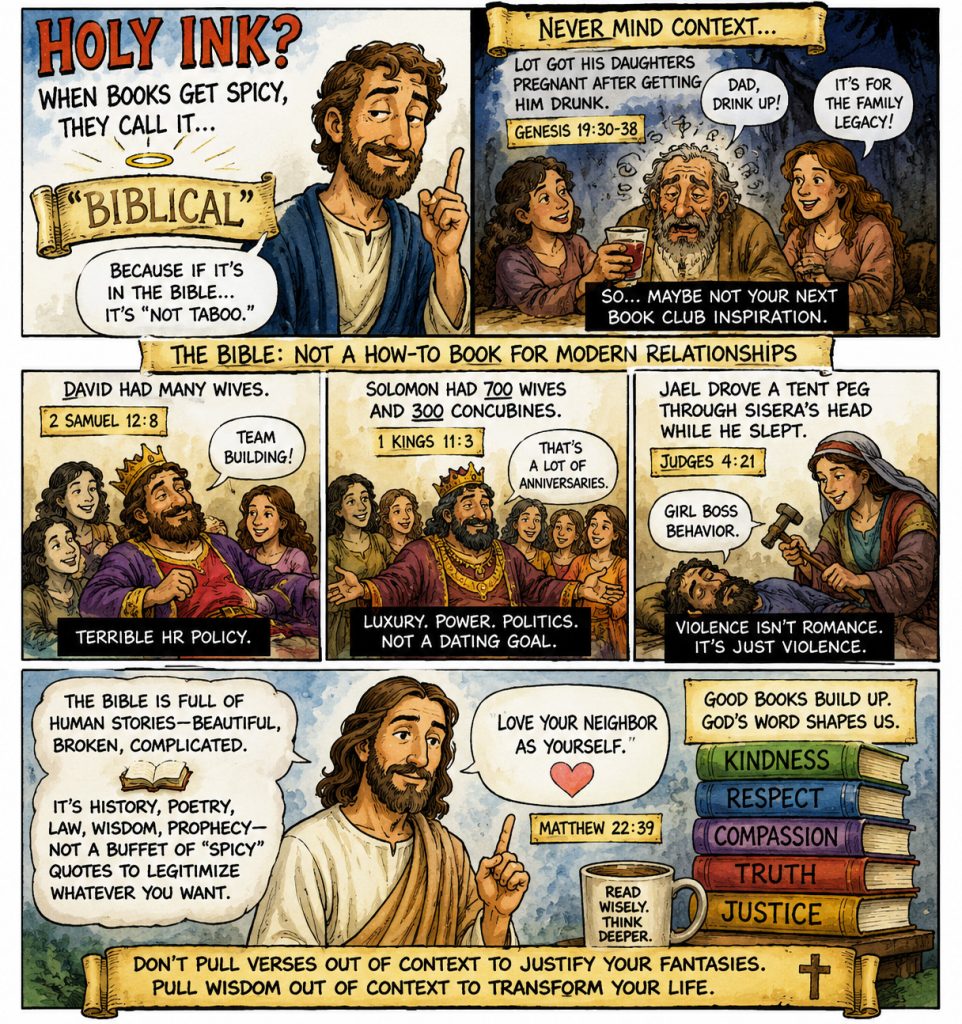
Consider the story of Lot and his daughters in Genesis 19. After escaping the destruction of Sodom, Lot’s daughters intoxicate their father and become pregnant by him. Most parents would not consider that an appropriate bedtime story for elementary school children. Yet it appears in one of the Bible’s earliest books.
King David, one of the Bible’s most celebrated figures, committed adultery with Bathsheba and then arranged for her husband to be killed. Solomon, often praised for his wisdom, reportedly had hundreds of wives and concubines. The Book of Judges contains graphic acts of violence, including the story of Jael driving a tent peg through a sleeping man’s head. Elsewhere, wars, massacres, and executions are described in detail.
If these stories appeared in a contemporary novel without religious packaging, many parents would object to placing that book in a young child’s hands. School boards and libraries routinely evaluate books for age-appropriate content. By the standards often applied to modern literature, large portions of the Bible would receive restrictions or require adult guidance.
Supporters of unrestricted access often respond that context matters. They argue that the Bible does not promote every action it records. That is true. The Bible frequently describes human failures rather than endorsing them. However, that argument actually strengthens the case that the Bible is not a children’s book. Understanding the difference between description and endorsement requires maturity, historical knowledge, and critical-thinking skills that younger children have not yet developed.
A child may see only the action. An adult can examine the lesson, symbolism, historical setting, and moral consequences. The distinction is important. Reading scripture responsibly often requires discussion, explanation, and guidance from parents, clergy, or teachers.
This does not mean the Bible lacks value. On the contrary, millions of people regard it as one of the most important books ever written. It contains profound teachings about justice, mercy, forgiveness, compassion, courage, and faith. But being valuable is not the same thing as being written for children.
Shakespeare is valuable. Homer is valuable. Many great works of literature contain mature themes that require adult interpretation. The Bible belongs in that category. It is a complex collection of books written across centuries, reflecting the full range of human experience—the noble and the horrific, the virtuous and the sinful.
The real question is not whether the Bible is good or bad. The question is whether it should honestly be described as a children’s book. Based on its actual contents, the answer is no. It is a book for mature readers, and when children encounter it, they benefit most when adults provide guidance, context, and thoughtful discussion rather than pretending its difficult passages do not exist.


