
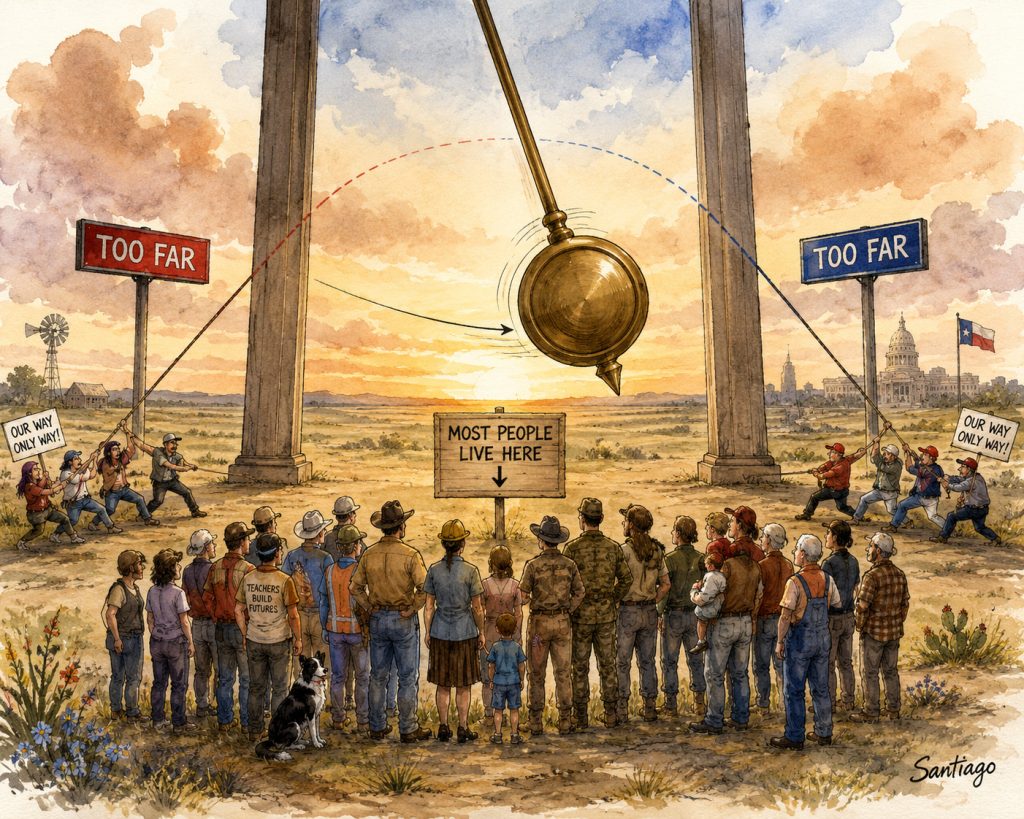
For much of the last two decades, American politics has seemed locked in a contest between competing extremes. The left pushed for more government involvement in social and economic issues. The right pushed for deregulation, lower taxes, local control, and economic development. Each side viewed compromise as weakness and ideological purity as a virtue.
Yet beneath the daily headlines, there are signs that the political pendulum may be starting to swing back toward the middle.
One of the most interesting examples can be found in an unexpected place: rural Texas and the growing debate over data centers.
For years, Texas leaders aggressively recruited businesses with tax incentives, light regulation, and promises of abundant land and energy. The formula worked. Texas became a magnet for investment, attracting everything from manufacturing plants to technology companies. Data centers, which power artificial intelligence, cloud computing, and much of the modern digital economy, are the latest beneficiaries.
But success has created new tensions.
Residents in rural communities are beginning to ask difficult questions. They worry about water consumption, rising electricity costs, battery storage facilities, noise pollution, and the impact massive industrial projects may have on their way of life. Many are not environmental activists or progressive organizers. They are conservative landowners, ranchers, local officials, and Republican voters.
The political significance lies not in the concerns themselves but in the response.
Conservative activists who traditionally opposed government regulation are now calling for stronger oversight. Local communities are demanding zoning authority that many Texas conservatives have historically resisted. Politicians who once celebrated virtually every new development project are now talking about limits, conditions, and safeguards.
Governor Greg Abbott’s recent comments illustrate the shift. Rather than rejecting data centers, he has argued that they should provide their own power, reuse their own water, and avoid shifting infrastructure costs onto ordinary consumers. This is not a rejection of economic development. It is an attempt to balance growth with accountability.
That balancing act is the essence of political moderation.
The same pattern is appearing elsewhere in American politics.
Progressives who once championed unrestricted urban growth increasingly acknowledge concerns about crime, public disorder, and housing affordability. Conservatives who once opposed almost any government intervention increasingly support restrictions when they believe local communities, families, or national interests are threatened.
In both cases, ideological certainty is giving way to practical concerns.
History suggests that this is how political systems often correct themselves. When one set of ideas dominates for too long, the unintended consequences become harder to ignore. Voters begin asking whether the solution has created new problems. They seek balance rather than absolutes.
The debate over data centers is not really about technology. It is about competing values. Economic growth versus quality of life. National competitiveness versus local control. Corporate investment versus community interests.
Those are not questions that fit neatly into traditional left-right categories.
Perhaps that is why the discussion feels different.
The pendulum has not necessarily swung all the way back to the center. The loudest voices in politics still tend to come from the edges. But when conservative activists call for regulation, when pro-business governors demand corporate accountability, and when communities insist that growth must serve local interests rather than the other way around, something important is happening.
Americans may be rediscovering an old lesson: solutions rarely exist at the extremes.
The center is not a place where nobody gets what they want. It is the place where competing interests are forced to coexist.
And after years of political polarization, that may be where the pendulum is beginning to move once again.


