
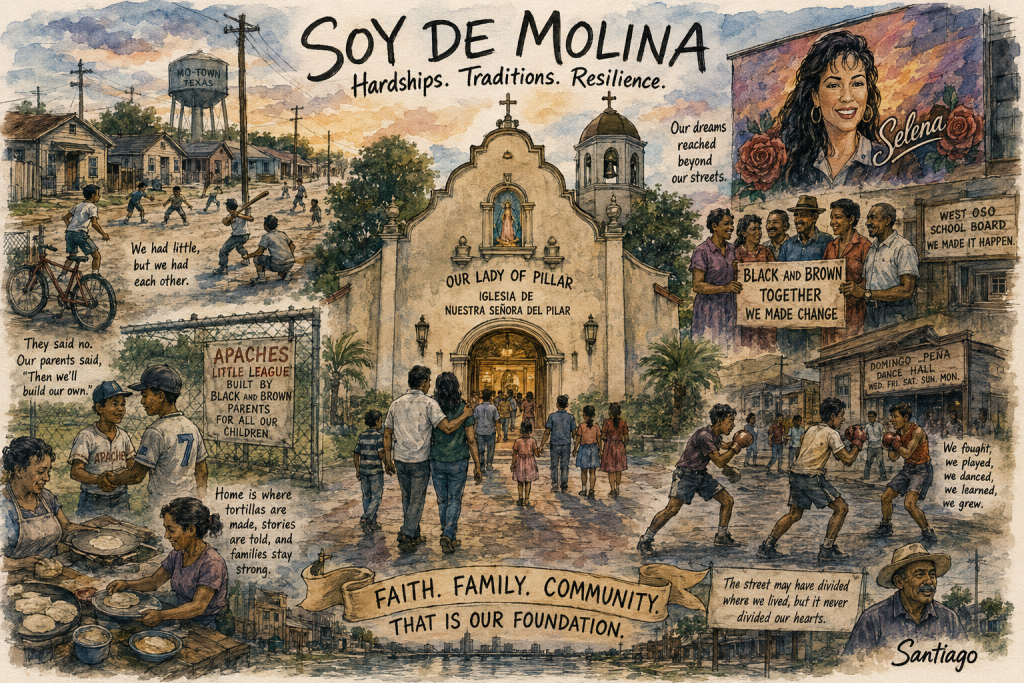
Soy de Molina
Three Witnesses, One Neighborhood
When someone asks where I grew up, I could answer simply:
Corpus Christi, Texas.
That would be true.
I could be more precise and answer:
The West Side.
That, too, would be true.
But neither answer tells the story.
The answer that carries meaning is much shorter.
“Soy de Molina.”
To those who never lived there, Molina is just another neighborhood on a city map. To historians, it has become a case study in segregation, poverty, civil rights, and political change. To those of us who called it home, it was something different altogether.
It was where we learned who we were.
Understanding Molina requires listening to three different witnesses. Each tells the truth, but none tells the whole truth alone.
The first witness is the historian.
A master’s thesis written at the University of North Texas carefully documents the forces that shaped Molina after World War II. It tells of Mexican-American and African-American veterans returning home, searching for affordable places to build lives for their families. It describes unpaved streets, poor drainage, outdoor privies, overcrowded schools, and years of municipal neglect. It explains how discrimination limited opportunity and how Black and Brown residents eventually joined together to demand better schools, paved roads, city services, and political representation.
The thesis is important because it answers the question:
Why did Molina become what it became?
Without understanding those conditions, no honest history of the neighborhood can be written.
The second witness is the documentary.
Unlike the historian, the filmmakers do not begin with statistics or government records. They begin with people.
Neighbors remember delivering newspapers across Villarreal Street and stopping in Hispanic homes to eat warm tortillas. Families recall businesses that became gathering places. Elderly residents remember names, friendships, churches, music, and traditions that no government report could ever preserve.
One of the documentary’s most powerful lessons is that although Villarreal Street often marked where Black and Hispanic families lived, it did not divide their lives. Children crossed it every day. Friends crossed it every day. Families crossed it every day.
The documentary answers a different question:
What did it feel like to live there?
The third witness is memory.
Not memory shaped by decades of research.
Memory shaped by childhood.
I remember a neighborhood where parents refused to let discrimination determine the future of their children. When other Little Leagues excluded them, Black and Mexican-American parents built their own field. They did not wait for permission. They did not ask others to solve the problem. They picked up hammers, shovels, and determination, and created opportunity with their own hands.
I remember my father working with others to improve the community, believing that change came not from speeches alone but from neighbors standing together.
I remember a neighborhood where hardship existed, but hardship never became our identity.
Today, visitors may recognize Molina because of the Selena mural that honors one of Corpus Christi’s most beloved daughters. That mural is more than public art. It reminds us that Molina has always produced people whose influence reached far beyond the neighborhood’s boundaries.
There is a temptation in writing history to simplify.
Some writers reduce neighborhoods like Molina to poverty.
Others reduce them to political movements.
Still others remember only crime or struggle.
Each contains a measure of truth.
None tells the whole story.
Molina was poor.
Molina faced discrimination.
Molina struggled for equal schools, better streets, and political representation.
Those facts deserve to be remembered.
But they are not why those of us who grew up there still say with pride,
“Soy de Molina.”
We remember parents who sacrificed for their children.
Veterans who returned from war and built homes with their own hands.
Teachers who expected more from students than the world expected from them.
Neighbors who watched over one another.
Black and Brown families who discovered they had more in common than those outside the neighborhood ever imagined.
The historian explains how the neighborhood was built.
The documentary preserves the voices before they disappear.
Those of us who lived there carry something neither can fully capture.
We remember the smell of tortillas drifting through an open window.
The laughter between houses.
The baseball games.
The churches.
The friendships.
The feeling that despite having less than many others, we belonged to something larger than ourselves.
History often remembers governments, wars, and famous people.
Communities survive because ordinary people quietly build lives that history rarely notices.
Molina was built by those ordinary people.
If future generations wish to understand the neighborhood, they should read the historian’s research.
They should watch the documentary.
But they should also listen to those who simply say,
“I wasn’t studying Molina. I was growing up there.”
Because history is not only found in archives.
Sometimes it is found in the memories of those who still answer one simple question with uncommon pride:
“Soy de Molina.”


