
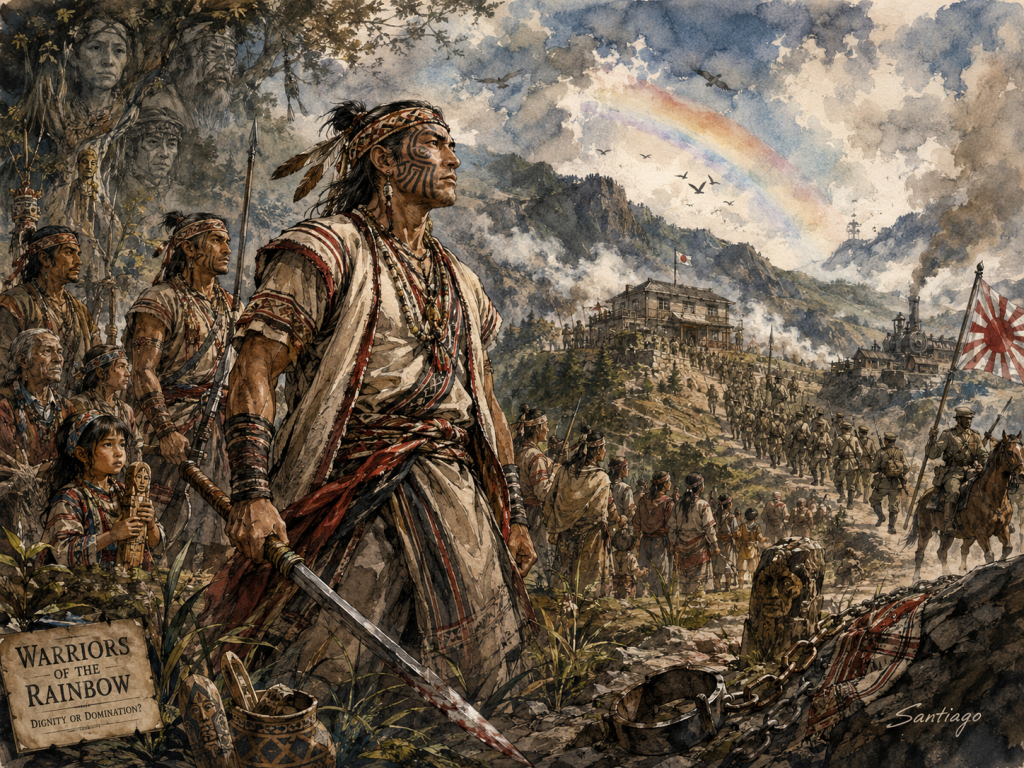
Some movies are entertainment. Some movies are history. And some movies feel like people rising from the grave and saying, “Remember us.”
Warriors of the Rainbow: Seediq Bale is one of those films.
It is based on the real 1930 Wushe Incident in Taiwan, when the Indigenous Seediq people rose against Japanese colonial rule. But the movie is not powerful only because it shows rebellion. It is powerful because it asks a harder question: what does a people do when survival means surrendering the soul?
The Japanese in the film represent more than an occupying army. They represent a system that wants to remake the Seediq into something smaller, obedient, useful, and ashamed of itself. Their customs are restricted. Their weapons are taken. Their labor is controlled. Their dignity is insulted. Their children are pulled toward another way of life. The empire does not only want their land. It wants to decide who they are.
That is where the movie becomes unforgettable.
The Seediq are not shown as innocent victims waiting to be saved. They are warriors, hunters, fathers, sons, women, elders, and children living under the pressure of history. Their world is violent, spiritual, proud, and deeply tied to ancestors. To them, life is not measured only by breathing. A man can still be alive and already conquered. A people can survive and still be erased.
That is the terrible beauty of the film: the Seediq know the odds. They know the Japanese have modern weapons, numbers, organization, and the machinery of empire. They are not fools. They are not dreaming of an easy victory. Their decision is more tragic than that. They choose to fight because the alternative is to live permanently under humiliation.
In that sense, Warriors of the Rainbow is not simply a war movie. It is a movie about dignity. It is about the line a people reaches when they decide that death with honor is better than life under domination.
The battle scenes are brutal, sometimes shocking, and not softened for comfort. But the violence has purpose. It shows what happens when two worlds collide and one of them has decided the other must disappear. The film does not ask the viewer to treat rebellion as clean or simple. It shows the cost. Children suffer. Families are broken. The warriors become both heroic and doomed.
That is why the film stays with you.
Mona Rudao, the Seediq leader at the center of the story, is not presented as a modern political speaker. He is a man of an older world, carrying the weight of his people’s customs, pride, and survival. His leadership is not about speeches. It is about memory, shame, courage, and the knowledge that a generation may have to die so that the next one is not taught to kneel.
For American audiences, the film may feel unfamiliar because it is Taiwanese, Indigenous, subtitled, long, and historically specific. That may be why it has not been promoted or seen as widely as it deserves. But that is also what makes it valuable. It tells a story outside the usual Hollywood map. It reminds us that empire did not only happen in the places Americans already know. It happened in mountains, villages, schools, police stations, and homes where people were told their old ways had no future.
Warriors of the Rainbow is one of the best historical epics I have seen. Not because it is easy to watch, but because it is hard to forget. It is a brutal, beautiful film about an Indigenous people who chose death with dignity rather than life under Japanese domination.
The movie’s deepest message is simple:
The conqueror may take the land.
The conqueror may take the body.
But the conqueror does not get to decide the worth of a people’s soul.


