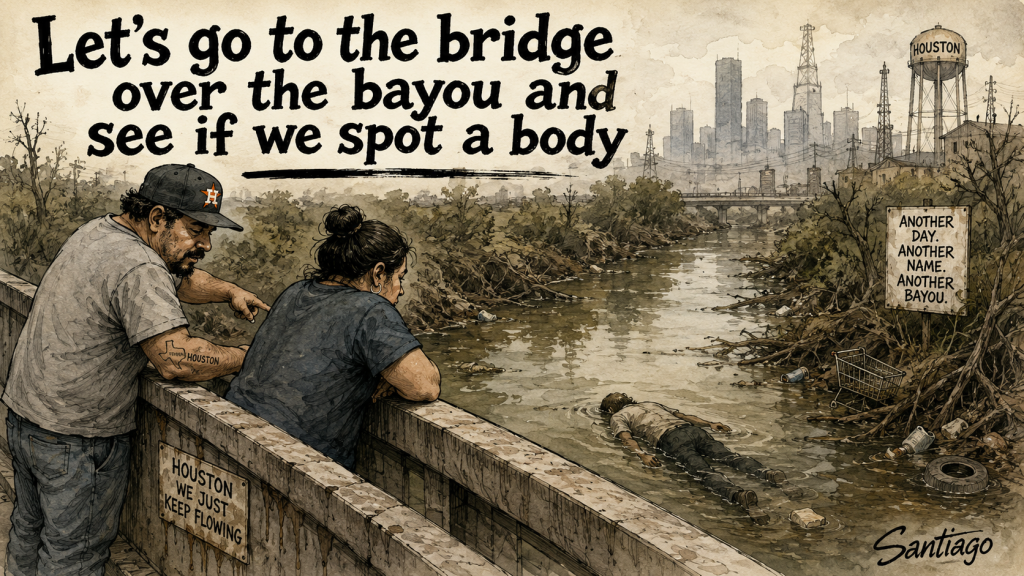
That sounds sick.
It is supposed to.
Finding a body in a Houston bayou has become common enough that the discovery may lead the evening news, remain there for a day, and then disappear beneath the next shooting, fire, political scandal, or Texans injury.
Another body.
Another bayou.
Another investigation pending.
By February 2026, records obtained from the Harris County medical examiner showed that 208 bodies had been recovered from Houston-area bayous since 2017. Eighty-four of those deaths—more than 40 percent—were classified as undetermined. The records also listed 47 accidental drownings, 25 suicides and 18 homicides.
The count did not stop at 208.
A body was recovered along Buffalo Bayou in April. Another was found naked in Greens Bayou in May. On July 13, yet another body was discovered near the junction of Greens and Buffalo bayous in east Houston. At the time of that discovery, authorities had not released the person’s identity or circumstances of death.
Houston officials say there is no serial killer loose in the city.
Mayor John Whitmire and Police Chief Noe Diaz publicly dismissed the idea after five bodies were recovered from Houston waterways within one week in September 2025. Diaz said investigators had found no evidence connecting the deaths.
They may be right.
One person almost certainly did not kill more than 200 people and dump them into Houston’s bayous. The victims vary greatly in age, sex, circumstances and cause of death. Crime experts have said that pattern does not resemble the more narrowly selected victims commonly associated with a single serial killer.
Fine.
But “one killer did not murder all of them” is not the same statement as “there could not be a killer among them.”
That is where the questions begin.
How can officials be so certain when 84 deaths are officially undetermined?
Have investigators compared the 18 known homicides with all 84 undetermined deaths—not simply case by case, but by location, injuries, victim history, time of disappearance, condition of the body and the place where each person was last seen?
How many of the victims entered the water where their bodies were found?
How many were carried there by Houston’s currents?
How many died in the bayou?
How many were already dead when they entered it?
And how many cases were damaged beyond solution because water, heat, time and decomposition destroyed the evidence?
A body found on land may be surrounded by evidence: blood, footprints, shell casings, clothing, tire marks, a weapon or witnesses. A body pulled from moving water may arrive stripped of its surroundings and separated from whatever once explained how that person died. Medical examiners acknowledge that submerged and decomposed bodies may leave too little evidence to distinguish between competing manners of death.
That does not prove murder.
It proves uncertainty.
And uncertainty is exactly where a careful killer would want to work.
But what if most of the bayou deaths are precisely what officials say they are—accidents, suicides, medical emergencies and drownings—and one or two are not?
What if someone killed one person and used the bayou because he knew the water might erase the story?
What if it worked?
What if he tried it again?
That would not produce one obvious pattern connecting 200 victims. It would produce one or two murders concealed among scores of unrelated tragedies.
The perfect hiding place would not be an empty bayou.
It would be a crowded one.
Whitmire has suggested that some victims were homeless people living near the water. That may explain some deaths. But when KPRC asked how many victims were actually homeless, it found that no reliable total was available.
That raises another unpleasant question.
Are we investigating every death with the same determination, or does an unidentified, poor, addicted, mentally ill or homeless victim receive less urgency because officials assume they already understand how that life ended?
Dead people do not become less dead because they lived beneath a bridge.
Their families do not grieve less because their lives were complicated.
And “probably homeless” is not a cause of death.
Houston has approximately 2,500 miles of bayous and waterways. The official count begins in 2017 because that was when the medical examiner began consistently tracking these recoveries in one system. We do not even have an equivalent count for the decades before it.
We also do not have a simple public database where Houstonians can examine every case: the victim’s name, where the body was found, the known cause of death, whether the case remains open and what safety measures have been taken at repeated recovery locations.
The Houston Chronicle found fragmented responsibility, inconsistent safety measures and no single agency clearly in charge of the bayous. Some areas have lighting, patrols, cameras or barricades. Others do not. City officials had announced no comprehensive new prevention plan despite record numbers of deaths in 2024 and 2025.
Maybe there is no serial killer.
I hope there is not.
But Houston officials should stop acting as though asking the question is crazier than finding more than 200 bodies in the water.
The public is not required to choose between believing that one madman killed everyone and believing that city government has fully explained every death. Both positions can be wrong.
There is a large, dark space between them.
Eighty-four people are in that space.
Their deaths remain undetermined.
So let us go stand on the bridge over the bayou and look down.
Perhaps we will see muddy water, floating trash, and the slow current passing beneath us.
Perhaps we will not spot a body.
But in Houston, apparently, give it time.