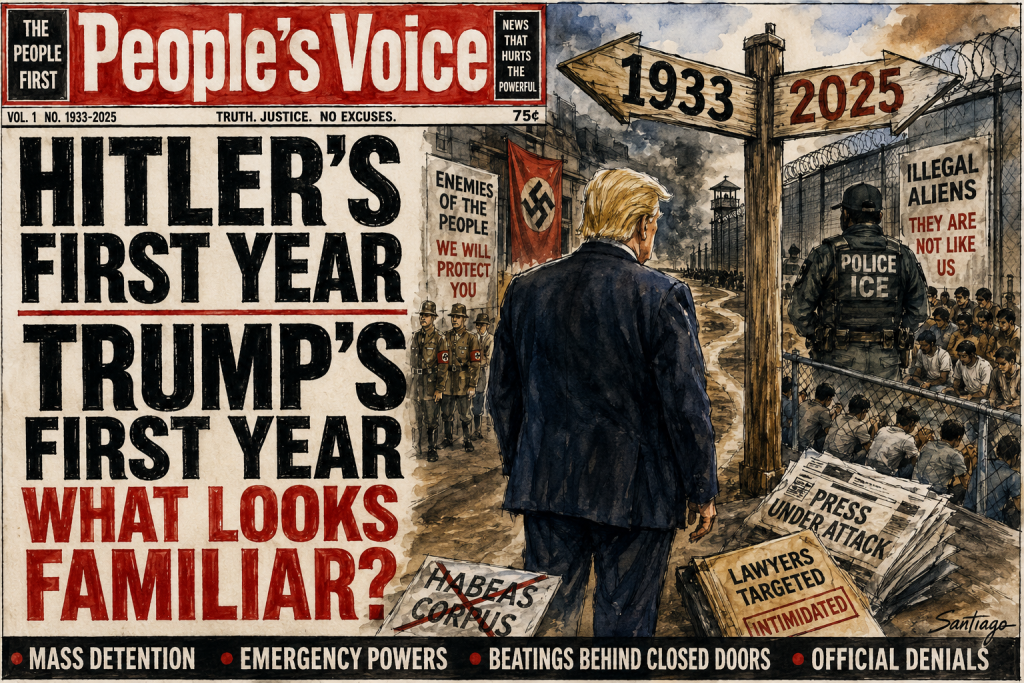
HITLER’S FIRST YEAR. TRUMP’S FIRST YEAR. WHAT LOOKS FAMILIAR?
Mass detention. Emergency powers. Beatings behind closed doors. Attacks on lawyers and the press. Official denials. History does not have to repeat itself exactly to warn us.
There were no gas chambers during Hitler’s first year in power.
That sentence matters because every time someone compares Donald Trump with Adolf Hitler, the defense comes quickly: Trump has not murdered six million Jews. America is not Nazi Germany. ICE detention centers are not Auschwitz.
All true.
But Hitler did not begin with Auschwitz.
He began with words. Enemies. Traitors. Criminals. Foreign threats. People who supposedly did not belong in the nation and could not be trusted within it.
Then came emergency powers.
Then arrests.
Then detention without the ordinary protections of law.
Then camps.
Then beatings behind walls where the public could not see them.
Then official explanations telling Germans that nothing improper was happening—or that whatever was happening was necessary for their protection.
Adolf Hitler became chancellor on January 30, 1933. Less than a month later, the Reichstag burned. Hitler blamed Communists and persuaded President Paul von Hindenburg to sign an emergency decree suspending basic constitutional protections. The government could arrest people without specific charges, suppress newspapers, dissolve political organizations, intercept communications and overrule state and local governments. The emergency never really ended. It became the legal foundation of the Nazi police state.
The first regular concentration camp, Dachau, opened on March 22, 1933.
It was not originally built as a death camp. It was announced as a place for political prisoners—people described by the government as dangerous enemies of Germany. Prisoners were placed outside the ordinary judicial system. They were not necessarily convicted of crimes. The government called it “protective custody.”
Protection for whom?
Certainly not for the prisoner.
During March and April 1933, an estimated 40,000 to 50,000 political opponents were taken into protective custody. Nazi storm troopers and SS guards routinely beat and tortured prisoners. Some were murdered. Police were ordered not to interfere with Nazi violence and, in some cases, to assist it.
The government was building two systems at once.
One was the system people could see: courts, laws, government offices and official announcements.
The other operated underneath it: arbitrary arrests, political violence, intimidation and detention beyond the normal reach of judges.
On March 23, Hitler pushed through the Enabling Act, allowing his government to make laws without parliament, even when those laws violated the German constitution. Communist legislators and some Social Democrats were prevented from voting because they had been arrested or detained. SS men stood inside the building to intimidate the representatives who remained. German judges accepted the result rather than confronting it.
By July, every political party except the Nazi Party had been outlawed.
That was Hitler’s first year.
Not Auschwitz.
The road to Auschwitz.
Donald Trump began his second presidency on January 20, 2025. He did not inherit Germany in 1933. He inherited a constitutional republic with old institutions, independent states, opposition politicians, federal judges, private newspapers and millions of citizens who could still object.
But look at the methods.
Trump did not describe illegal immigration merely as a problem to be controlled. He repeatedly described it as an invasion. Once people become an invading force, they are no longer treated as individual human beings. The farmworker, the asylum seeker, the mother, the violent gang member and the longtime resident begin to blur into one threatening mass.
That change in language has consequences.
A criminal is entitled to an accusation and evidence.
An invader is something to be expelled.
An enemy is something to be defeated.
In March 2025, Trump invoked the Alien Enemies Act of 1798, a wartime law, to remove alleged Venezuelan gang members. People were flown to a prison in El Salvador before many had a meaningful chance to contest the government’s accusation. The Supreme Court ruled that people targeted under the act were entitled to notice and an opportunity to challenge their removal through the courts.
Think about what that means.
The government was not merely arguing over whether someone should be deported. It was claiming the power to identify a person as an enemy, place him on an airplane and deliver him into a foreign prison.
What happens when the government is wrong?
What happens when the man has no lawyer?
What happens when nobody knows where he has been taken?
Trump also attempted to alter birthright citizenship by executive order. Lower courts concluded that the order was likely unlawful. The Supreme Court’s first major ruling in the dispute dealt with the power of judges to issue nationwide injunctions, not with whether Trump’s interpretation of the Fourteenth Amendment was constitutional.
Again, look past the legal language.
A president had asserted the power to decide that some children born on American soil would not be recognized as American citizens, despite the language and long history of the Fourteenth Amendment.
Then came the detention system.
When Trump returned to office, ICE held approximately 40,000 people. By November 2025, the population had climbed to nearly 66,000—an increase of roughly 70 percent. It later reached approximately 70,000 during January 2026. Many detainees were being held while civil immigration cases remained unresolved, not because they had been convicted of crimes.
During Trump’s first year, the government opened Camp East Montana at Fort Bliss in El Paso, designed to become the country’s largest immigration detention center.
Now the stories are coming out.
Human Rights Watch and the American Civil Liberties Union interviewed detainees who reported routine beatings, denial of medicine, chronic hunger, spoiled food, filthy conditions and interference with access to lawyers and family members. Reuters reported that the organizations based their findings on 80 interviews. The Department of Homeland Security called the allegations “categorically false” and said no detainees were being beaten or abused. A federal watchdog had already found failures involving use-of-force reports, medicine and rushed contracting.
The government says it is not happening.
The prisoners say it is.
That sentence could have been written in almost any country where guards discover that the people under their control have become politically disposable.
A man being held down and beaten does not stop to ask whether Trump is exactly like Hitler.
A woman being humiliated by a guard does not calculate whether her detention center meets the historical definition of a Nazi concentration camp.
A sick prisoner denied his medicine does not comfort himself with the knowledge that American elections still exist.
He knows only that government officers control the door, the food, the telephone, the medicine and his body.
And unless the man on the floor is named Meme, millions of Americans may never imagine that the body could be theirs.
That is how cruelty grows.
First, the victims are given a label.
Illegal.
Alien.
Invader.
Gang member.
Enemy.
Once the label becomes stronger than the person, almost anything can be explained away. A beating becomes a “use of force.” Isolation becomes “administrative segregation.” Hunger becomes a “meal-service issue.” A preventable death becomes an “incident under review.”
The language washes the blood from the report.
The Trump administration has also acted against institutions capable of resisting it. Trump issued executive orders targeting prominent law firms because of lawyers they employed, clients they represented or work they had performed. Federal judges blocked several of those orders as unconstitutional. His White House restricted Associated Press access after the news organization continued using “Gulf of Mexico” while also acknowledging Trump’s preferred name, “Gulf of America.”
Lawyers and reporters are inconvenient in every government.
They ask for names.
They demand records.
They enter detention centers.
They challenge accusations.
They find the person hidden beneath the label.
Hitler moved much further and much faster. By the end of 1933, organized political opposition in Germany had been crushed. Independent unions had been destroyed. Other political parties had been outlawed. The press was being brought under government control. Violence was not merely tolerated; it was being incorporated into the state.
Trump has not accomplished that.
But the question is not whether the two governments have reached the same destination.
The question is whether some of the road signs look familiar.
A population described as an invading enemy.
Emergency authority used to bypass ordinary law.
People detained without criminal convictions.
Prisoners placed far from families and lawyers.
Reports of beatings and degrading treatment.
Government denials.
Pressure on attorneys and news organizations.
Citizens persuaded that constitutional protections belong only to the right kind of people.
Now come the differences—the ones Trump’s defenders will rightly raise.
America is not Nazi Germany. Trump has not outlawed the Democratic Party. Opposition candidates still run for office. Newspapers openly attack the president. Federal judges have blocked administration actions. Civil-rights organizations enter detention facilities, interview prisoners and publish reports. Congress still exists. Governors resist Washington. Elections remain competitive.
The Nazis openly intended to destroy democracy and create a racial dictatorship. Their early camps targeted political opponents and became part of a system that eventually imprisoned and murdered Jews, Roma, disabled people, gay men, Soviet prisoners, resistance fighters and millions of others. Nothing now occurring in the United States equals the Holocaust.
Those differences are real. They must never be hidden.
But they do not erase the comparison.
They explain why the warning is being given now.
A fire alarm is not an accusation that the building has already burned down. It is a warning that someone smells smoke.
Hitler’s first year teaches us that democratic collapse does not begin with gas chambers. It begins when a leader identifies an enemy, claims an emergency, weakens legal restraints, creates places where people can be held beyond public view and convinces ordinary citizens that the prisoners deserve whatever happens to them.
Donald Trump is not required to become Adolf Hitler for America to learn something from Adolf Hitler.
The final question is not:
Has America become Nazi Germany?
It is more dangerous than that:
How many of Hitler’s first steps are Americans willing to excuse before they admit they recognize the road?
.