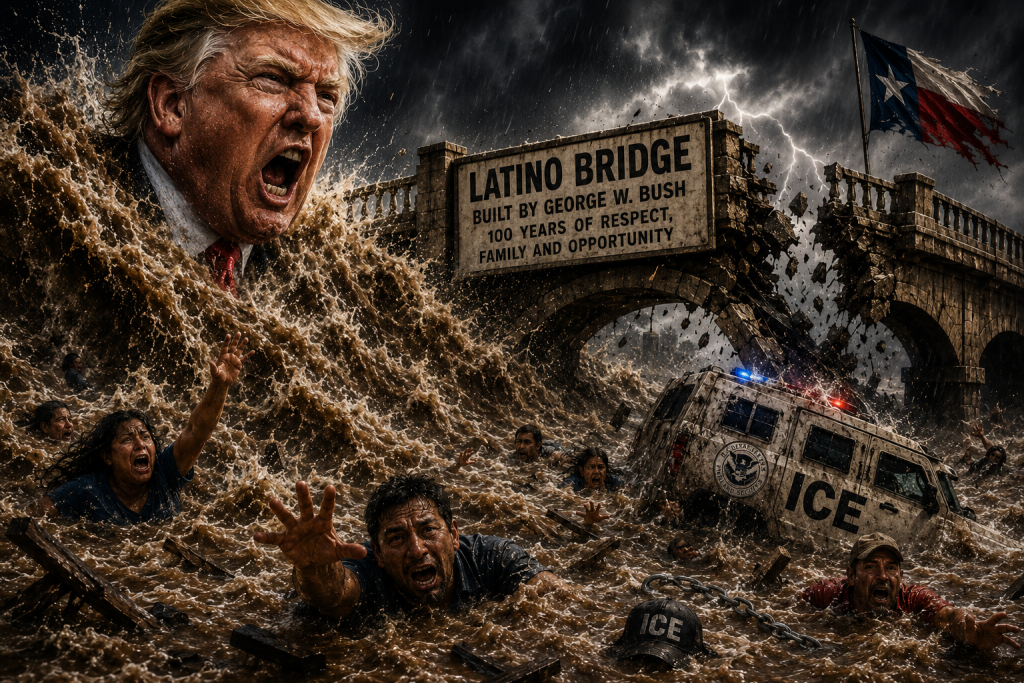
Bush built it. Trump may be destroying it—and Texas Republicans are beginning to panic.
BUSH BUILT THE LATINO BRIDGE. IS TRUMP WASHING IT AWAY?
For years Texas Republicans have acted as though political gravity itself belonged to them. The Democrats could make noise, raise some money, win a county here and there, but when the counting ended Texas would still be Texas: Republican, disciplined, and increasingly comfortable in its own skin.
That confidence is beginning to crack.
Not in one dramatic explosion. Not with a single poll. Not because some Democratic consultant sent out a triumphant memo. The change is smaller than that, and for that reason more interesting. It shows up in behavior. In sudden caution. In men who usually swagger deciding, for once, to watch their step.
Ken Paxton, who would not debate John Cornyn in the Republican primary, now says he will debate James Talarico, a Democrat. Greg Abbott, who almost never puts daylight between himself and Donald Trump on immigration, suddenly called a recent ICE shooting “tragic,” supported a Texas Rangers investigation, and said out loud what should not have to be said in a civilized country: “We don’t want to see people shot. Period.” Republican leaders are calling for unity. Ted Cruz has warned that Talarico has a real chance. Dan Patrick has warned Republicans not to take the race lightly. National Republicans are moving in with money, messaging and concern.
The official story is that this is all routine.
It is not routine.
Politicians do not suddenly become cautious when they feel safe. They do not ask for unity when they believe victory is automatic. They do not soften their tone, hedge their language, or accept risks like debates because they woke up in a generous mood. They do those things when they smell danger.
The dangerous question is simple:
What do Texas Republicans know that they are not telling us?
A large part of the answer may run through Hispanic Texas.
For a long time Republicans understood something that Democrats too often forgot: Texas could not be governed permanently against its Mexican-American population. George W. Bush understood that. He did not approach Latinos as a temporary inconvenience or as an alien mass pressing against the border. He approached them as Texans, neighbors, churchgoers, small-business owners, workers, veterans, parents. He spoke the language of invitation. He campaigned in Hispanic communities. He backed immigration reform. He made many Mexican-American voters feel that they did not have to stop being who they were in order to vote Republican.
Bush did not turn South Texas Republican overnight, but he built a bridge. Donald Trump later crossed that bridge and went farther than many thought possible. In 2024 he reportedly won a majority of the Latino vote in Texas. Counties in South Texas that had been Democratic almost since memory began moved sharply toward the Republican column. Working-class Hispanic voters, angry over inflation, cultural snobbery, the border, and the sense that Democrats took them for granted, gave Republicans something close to a political miracle.
That miracle may now be weakening.
Not because Latino voters have suddenly become liberals. Not because they have fallen in love with the Democratic Party. Not because every Mexican-American family in Texas has turned into a campus seminar on social justice. The possible shift is more practical and more dangerous than that.
People vote with their pocketbooks, their nerves, and their sense of dignity.
Prices are still high. The cost of living still hurts. Working families who thought Republicans would bring economic relief have not exactly been dining on filet mignon since Trump returned. And immigration enforcement, which many Hispanic voters supported in the abstract, looks different when it arrives in the neighborhood in a mask, with weapons, confusion, and stories of people detained, beaten, or shot.
There is a difference between saying, “We need border security,” and seeing a government behave as though every brown face is a suspect.
There is a difference between wanting order and watching a state or federal machine create fear in communities where many citizens and lawful residents now wonder whether legal status will protect them at all.
There is a difference between tough talk and a dead body.
That is where Abbott’s reaction matters. If he believed the politics of the shooting were harmless, he could have hidden behind procedure, let the federal government talk, and moved on. Instead he felt the need to call it tragic, to emphasize that immigration laws can be enforced without killing people, and to place the Texas Rangers into the story. That is not just governance. That is political instinct. Abbott may have felt the ground moving under his feet.
And Paxton’s debate decision matters for the same reason. If he were gliding toward Washington on the strength of Republican unity and Democratic weakness, why bother? Why give Talarico a stage? Why take an unnecessary risk? One answer is vanity. Another is pressure. A third is fear that refusing to debate would look like weakness in a race no longer considered safe.
Put the pieces together and a picture begins to emerge.
Republicans may be looking at Texas Latino voters and seeing not a rebellion, but an erosion.
A man who voted for Trump may stay home.
A woman who still likes Abbott may skip Paxton.
A Catholic family may decide it has had enough of the chaos, the cruelty, or the rising cost of groceries.
A conservative small-business owner in the Valley may not become a Democrat, but may decide Talarico is the safer bet than Paxton.
And in a close election, staying home is a vote. Skipping one race is a vote. Losing enthusiasm is a vote.
That possibility may be what has suddenly put a tremor into Republican voices.
Because the modern Texas Republican coalition depends on more than Anglo conservatives in the suburbs and oil-country loyalists. It depends on enough Latinos believing that the GOP sees them as part of Texas rather than as a problem to be managed. George W. Bush helped build that relationship patiently, politically, almost architecturally, like a bridge built over time, one beam at a time. Trump did not build it, but he inherited it, crossed it, and profited from it.
Now imagine that bridge a hundred years old, still standing because generation after generation kept it standing. Then imagine Trump not as a builder, but as a flood. A raging river. Loud, muddy, destructive, slamming into the old structure with such force that the planks begin to rip loose. That is the picture. Bush built a bridge to Latino Texas. Trump may be the river tearing it down.
If that image feels too dramatic, look again at the behavior of the people who know Texas politics best. They are the ones acting nervous.
This does not mean Texas has turned blue. It does not mean Talarico is about to march into the Senate. It does not mean Hispanic voters are a single bloc moving in one direction like cattle through a gate. Latino voters are divided by class, religion, generation, region and temperament. Many still support Trump. Many still distrust Democrats. One poll is not an election, and one string of nervous Republican reactions is not proof of a coming collapse.
But that is not the claim.
The claim is smaller, sharper, and more plausible:
The voters who helped keep Texas red may no longer be as dependable as Republicans pretend.
And if that is true, everything else begins to make sense. Paxton’s sudden willingness to debate. Abbott’s sudden sensitivity to an ICE shooting. The calls for unity. The warnings from Republican leaders. The unease in a party that is used to certainty.
You can call it speculation. It is speculation. But it is fact-grounded speculation, the kind politics is built on. We know what these men are doing. We know how unusual some of it is. We know what issues are bothering Latino voters. We know that close races make powerful people behave in revealing ways.
So ask the question again:
What do Texas Republicans know that they are not telling us?
Maybe they know the old bridge is no longer as solid as it looks.
.