
Presidents give wars noble names.
Freedom. Security. Peace through strength.
They stand before flags and polished uniforms. They speak of unavoidable choices and terrible responsibilities. They tell us that every missile was necessary, every target carefully chosen, every American life placed in danger only after all other roads had been exhausted.
And when the bodies return home, they tell the mothers:
He died for freedom.
But what if freedom had very little to do with it?
What if America entered this war because the man in the White House cannot bear to be second to Barack Obama?
It sounds too small to explain something so enormous.
That is precisely why it should frighten us.
We expect wars to begin with great motives: invasion, national survival, an enemy marching across the border. We expect rooms filled with maps, intelligence reports and grave men calculating consequences.
But history is full of catastrophes born from smaller things.
Pride.
Jealousy.
Humiliation.
The need of one powerful man to prove that he is greater than another.
Obama began two major new American combat campaigns:
- Libya in 2011
- The war against ISIS in Iraq and Syria in 2014
| War or major combat operation | President who started U.S. involvement | Dates started | American military deaths |
|---|---|---|---|
| Iran War—Operation Epic Fury | Donald Trump | 2026 | 16, as of July 18, 2026 |
| War against ISIS—Operation Inherent Resolve | Barack Obama | 2014 | 123 |
| Afghanistan War | George W. Bush | 2001 | 2,458 |
| Libya air war—Operation Odyssey Dawn | Barack Obama | 2011 | 0 |
| Iraq War | George W. Bush | 2003 | 4,492 |
| Bosnia and Kosovo operations | Bill Clinton | 1995 | 20 |
| Somalia intervention | George H.W. Bush | 1992 | 43 |
| Persian Gulf War | George H.W. Bush | 1990 | 383 |
| Panama—Operation Just Cause | George H.W. Bush | 1989 | 23 |
| Grenada—Operation Urgent Fury | Ronald Reagan | 1983 | 19 |
| Lebanon intervention | Ronald Reagan | 1982–1984 | 265 |
Trump has now begun the war with Iran.
The scoreboard, if a president were childish enough to keep one, would read:
Obama: Two
Trump: One
That is not evidence. It is not a secret memorandum discovered in a White House safe. It is not proof of motive.
It is a question.
But what if the man in the White House needs to outdo Obama?
Trump has measured himself against Obama for years. Crowds, economic numbers, television ratings, military strength, international respect—whatever Obama accomplished, Trump must claim he accomplished more. Whatever Obama built, Trump must replace. Whatever agreement carried Obama’s fingerprints must be destroyed, renamed or remade in Trump’s image.
Obama negotiated an agreement with Iran.
Trump withdrew from it.
Obama was praised for avoiding a war with Iran.
Trump may now believe that destroying Iran will prove he was stronger.
To a normal person, war is death, grief and permanent loss.
To a man who sees the world as a contest, war may become another category in which someone must finish first.
Another victory.
Another surrender.
Another photograph.
Another country forced to speak his name.
Perhaps Trump does not sit alone at night counting wars on his fingers.
Perhaps no one has ever said aloud, “Mr. President, Obama started two.”
But a man does not always require a carefully stated motive. Sometimes comparison enters the mind as naturally as hunger. Another man possesses something, and therefore he must possess more.
Trump does not need a motive.
He needs an impulse, an enemy and someone close enough to whisper that the explosions will look like victory.
The explanation can come afterward.
First comes the missile.
Then comes the speech.
Iran threatened Israel.
Iran endangered American forces.
Iran supported terrorism.
Iran refused an agreement.
Iran might someday build a nuclear weapon.
Some of those claims may contain truth. But truth can be used in the service of vanity just as easily as lies. A real danger can become an excuse for a reckless response. A president can take a genuine problem and turn it into a personal contest.
That is the danger of government by impulse.
The president acts.
His advisers produce the reasoning.
The generals draw the maps.
The lawyers find the authority.
The speechwriters find the words.
By the time the nation hears the explanation, the bomb is already falling.
Then Iran retaliates.
Americans die.
The president cannot withdraw because withdrawal would make him appear weak. He attacks again. Iran answers again. More countries are pulled into the fire. More American bases become targets. More young men and women are placed in danger.
Soon the war no longer needs the original motive.
It has momentum.
One death demands another. One humiliation requires an answer. Every new grave is used to justify the next grave. The government says we cannot stop now because Americans have already sacrificed too much.
That is how a foolish war protects itself.
The dead become the reason for producing more dead.
And when another American is killed, the president will not visit the mother and tell her:
Your son died because I could not tolerate being compared unfavorably with Barack Obama.
He will not say:
Your daughter died because I wanted to appear strong.
He will not say:
Your child was sent into a war whose purpose changed each time the previous explanation failed.
No.
She will receive a folded flag.
A military officer will stand at her door.
The government will praise her child’s courage, sacrifice and devotion.
Then someone will tell her:
He died for freedom.
The soldier may truly have died bravely.
That does not mean the president sent him wisely.
Courage belongs to the soldier. The decision belongs to the president. We dishonor the dead when we confuse the bravery of those who fought with the judgment of the man who sent them.
That is why the question must be asked before more mothers hear the knock at the door.
What if Trump does not merely want to defeat Iran?
What if he needs to defeat Obama?
What if one war is not enough because Obama began two?
What if another country becomes the next enemy—not because America has no other choice, but because the man holding the power needs a larger victory, a grander war and a place in history higher than the president whose shadow he has spent years trying to escape?
Perhaps that sounds unthinkable.
But the unthinkable becomes possible when a nation gives one man the power to turn his resentments into missiles.
The terrible question is no longer whether Donald Trump has a coherent motive.
The terrible question is whether he needs one.
And before this is over, how many American mothers will be told he died for freedom—when the real reason may have been that the president could not bear to come in second?
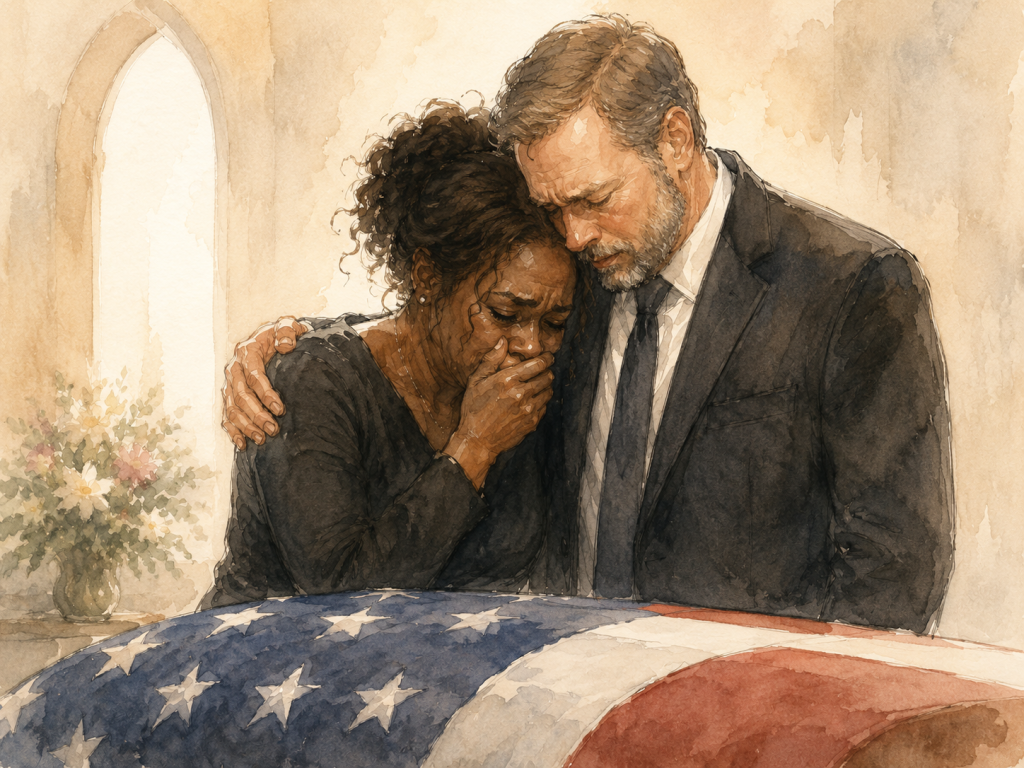
The Loving story taught us that in America, a Black woman and a white man once had to fight the law just to be husband and wife.
Now they stand together over a flag-draped casket, not asking for permission to love, only trying to survive the grief.
The same country that once told them they should not marry may now tell them their child died for freedom.
Love had to fight to live here.
Now it must learn to mourn here too.


